



By most visible measures, America’s food system is working.
Grocery shelves are stocked. Cattle are moving. Pork and poultry are processing. Consumers are still choosing between brands in the meat case.
But systems do not fail only when shelves go bare.
Sometimes they change shape quietly.
And 2026 may be the year that quiet reshaping hardens into structure.
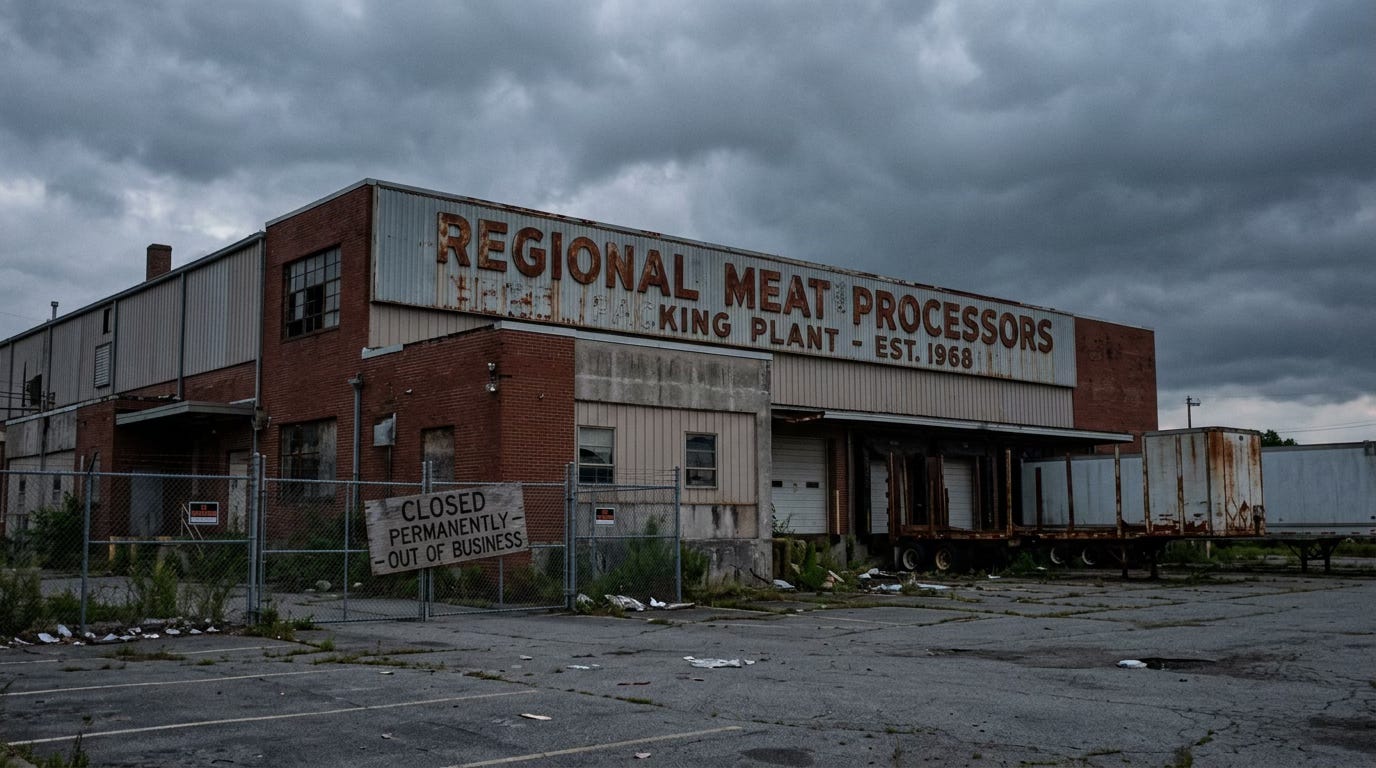
The Layering of 2025
Nothing in 2025 looked like an emergency decree. There were no ration cards, no federal takeover announcements, no public acknowledgment of crisis.
Instead, there was layering.
Inspection economics — the fees, overtime rules, staffing patterns, and scheduling flexibility that determine what it costs to legally operate a kill floor — continued to evolve under federal authority.
For a large, multi-state processor, a shift in inspection availability or overtime structure is a line item.
For a small red-meat plant processing a few hundred head a week, that same shift can mean cutting one slaughter day. One fewer day means fewer local slots. Fewer slots mean independent ranchers haul farther — or wait longer.
At the same time, enforcement posture under longstanding livestock competition laws tightened. The stated goal was producer protection.
In practice, that often meant more frequent audits, stricter interpretation of contract documentation, and increased pressure to formalize business relationships that were once handled informally.
Large firms employ compliance departments.
Small operators hire outside counsel — or assume risk.
Local and regional food support programs saw uneven continuity. Some infrastructure grants continued. Others stalled. Credit markets tightened under inflation pressure. Labor shortages persisted.
None of these developments individually dismantled the system.
Together, they reduced its tolerance for shock.
Wartime Economics Meets Thin Margins
Geopolitical instability does not need to unfold on American soil to reshape domestic food production.
Energy markets are globally connected. If oil shipping routes destabilize or conflict drives volatility, diesel costs move quickly. Fertilizer production, heavily dependent on natural gas, follows energy markets. Refrigerated transportation and processing plant utilities respond in parallel.
Large multinational processors hedge fuel exposure and maintain diversified logistics networks.
Small regional processors pay posted prices.
Farmers already financing last year’s fertilizer bill may face simultaneous feed cost increases and tighter contract spreads when packers defend margins.
Wartime economics does not eliminate food supply.
It redistributes strain.
And strain redistributes leverage.
The Middle Layer Under Pressure
America’s food system operates in three functional layers:
Producers
Processors
Distributors and retailers
The processor layer — regional slaughterhouses, independent packers, small and mid-sized facilities — is the system’s balancing mechanism.
When that layer is healthy:
• Producers have multiple bidding options.
• Haul distances remain manageable.
• Regional price discovery exists.
• Communities retain economic anchors.
When that layer contracts, the system does not collapse.
It concentrates.
A regional plant reducing operations by one day per week may seem minor. But if several plants do the same across a state, producers compete for fewer slaughter slots. Haul distances increase. Transportation costs rise. Leverage shifts.
Consumers rarely see this shift immediately.
But the structure changes beneath them.
Corporate Positioning Signals Direction
While smaller facilities manage survival math, major firms continue investing in scale and automation.
New high-capacity facilities have been announced in the Midwest and Plains states. Shuttered plants have been acquired and repositioned. Automation investments promise higher throughput with fewer labor constraints.
These moves are rational.
Automation reduces injury risk and labor volatility. Larger plants spread compliance costs across greater volume. Vertical integration smooths margins.
But scale advantages compound under volatility.
When energy fluctuates, when compliance tightens, when credit is selective, capital gravitates toward enterprises able to absorb shocks.
Consolidation does not always occur through dramatic acquisition headlines.
Often it unfolds through attrition.
Small operators exit.
Large operators expand into the vacuum.
No emergency order is required.
Structural pressure performs the sorting.
Crisis Language and Structural Outcomes
Periods of international instability compress decision timelines.
Projects framed as “resilience” or “security” often receive accelerated attention. Automation investments become politically safe. High-throughput facilities are described as stabilizing infrastructure.
Meanwhile, independent facilities seeking financing for modernization may face higher borrowing costs and stricter underwriting.
The public conversation centers on food availability.
Less attention is paid to ownership diversity, regional redundancy, and market plurality.
Yet those characteristics determine adaptability when the next disruption arrives.
The 2026 Question
The core question in 2026 is not whether Americans will have food.
It is whether the independent middle layer will retain meaningful presence.
And if that presence erodes this year, who will hold negotiating power over livestock prices, processing access, and contract terms when the next shock hits?
If energy volatility persists, regulatory layering continues, credit remains tight, and automation capital accelerates primarily within large enterprises, the structural balance may shift decisively.
Such a shift would not appear dramatic.
Regional slaughter capacity per capita might decline modestly. Average livestock haul distances might increase gradually. Market share among the largest processors could edge upward incrementally.
Each data point would look manageable.
Collectively, they would redefine leverage.
Once regional processing infrastructure disappears, rebuilding it requires capital, skilled labor, regulatory navigation, and community investment.
In a consolidated landscape, those barriers are higher.
What to Watch in 2026
Structural shifts rarely announce themselves.
But there are indicators:
• Small and regional plants reducing operating days or announcing closures
• Increased average haul distances for livestock
• Additional automation and expansion projects by major packers
• Policy initiatives framed as “resilience” that centralize rather than diversify
• Measurable increases in market share concentration among the largest processors
If those indicators move in the same direction, the middle layer is thinning.
Beyond Calories
Food security is often defined as stable access to calories.
But resilience also depends on distributed processing capacity, competitive livestock markets, and geographic diversity in infrastructure ownership.
If 2026 becomes the year volatility locks in further concentration, reversal will not be simple.
The system will still function.
It will simply function with fewer independent nodes.
The quiet reshaping of America’s food chain is not a story about empty shelves.
It is a story about structure.
And structure, once hardened under crisis, rarely unwinds without deliberate intervention.