



And suddenly, this isn’t just a ranch fight anymore.
For more than three years, Washington State agencies have insisted that what happened to King Ranch was routine environmental enforcement. A pond became a wetland. Maintenance became destruction. A cattle operation became an environmental violator—at least on paper.
That narrative recently hit a wall.
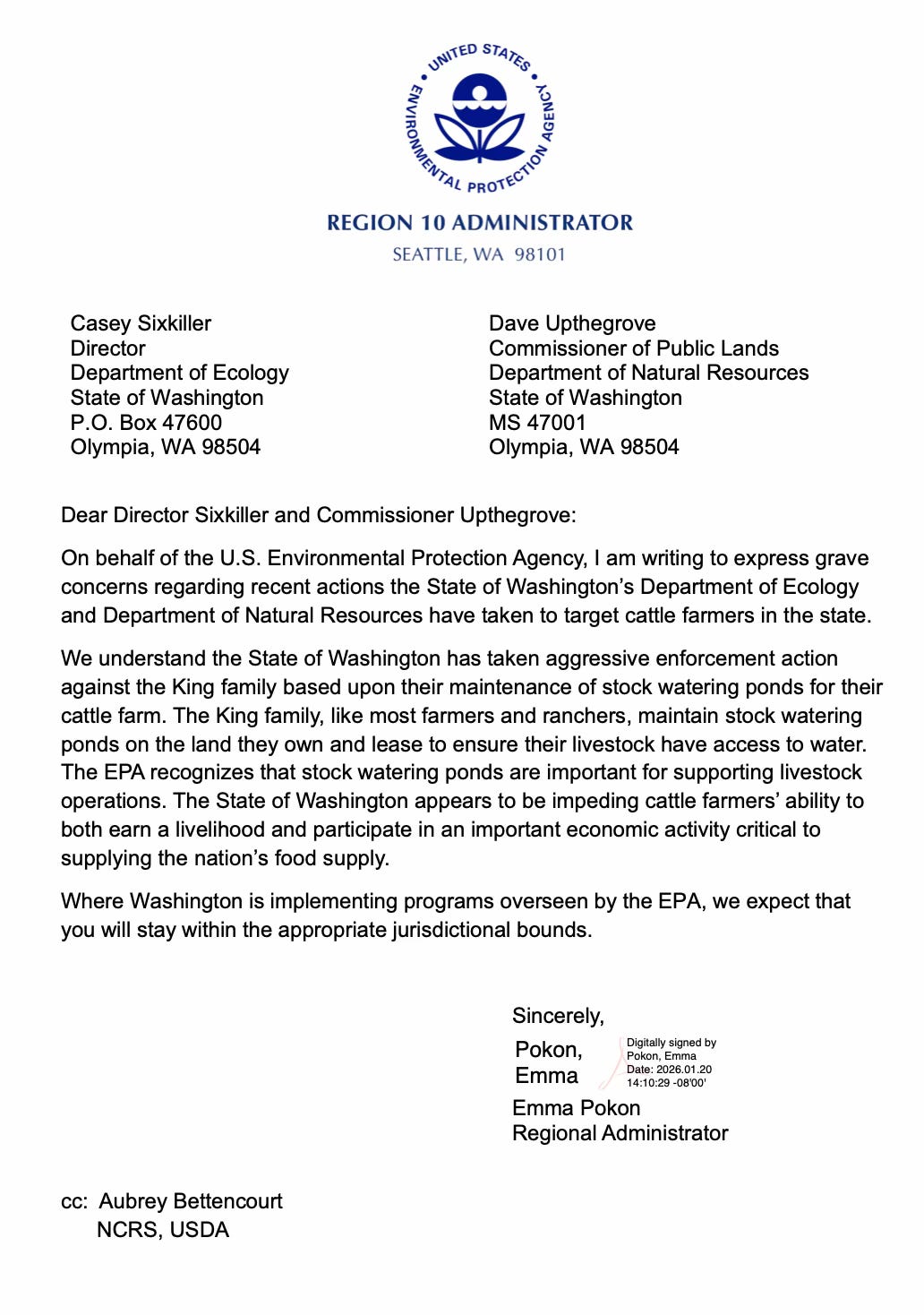
Late last month, the U.S. Environmental Protection Agency did something it almost never does quietly: it sent a formal letter to Washington’s top environmental officials expressing “grave concerns” about how the state is targeting cattle farmers—specifically in the King Ranch case.
And that letter didn’t stay buried in a filing cabinet.
Help Support the King Ranch fight
The Letter That Changes the Case
The EPA letter, dated January 20, 2026, was sent by EPA Region 10 Administrator Emma Pokon to:
Casey Sixkiller, Director of the Washington Department of Ecology
Dave Upthegrove, Commissioner of the Washington Department of Natural Resources
In unusually direct language, EPA states it has “grave concerns” about recent actions taken by Washington agencies and acknowledges that the state has taken “aggressive enforcement action” against the King family based on the maintenance of stock watering ponds.
EPA goes on to recognize what ranchers already know: stock watering ponds are common, legitimate agricultural infrastructure necessary to sustain livestock operations and food production.
Then comes the sentence that changes the entire frame of the case:
“Where Washington is implementing programs overseen by the EPA, we expect that you will stay within the appropriate jurisdictional bounds.”
That is not commentary.
That is a warning.
Why USDA’s Involvement Matters
Two days later, that EPA letter was forwarded by a senior advisor in USDA’s Office of the Secretary directly to counsel for the Kings.
USDA does not typically insert itself into state enforcement disputes unless there is concern that agricultural producers are being swept up in enforcement mechanisms that have drifted beyond their intended scope.
This move signals that the King Ranch case is no longer being viewed solely as a local regulatory matter. It is now on the radar of federal agencies responsible for both environmental oversight and agricultural policy.
It is also worth noting that many in the agricultural community have expressed appreciation for the posture coming out of Brooke Rollins’s office—particularly when it comes to ensuring that farmers and ranchers are not subjected to punitive enforcement without clear statutory footing. That appreciation does not require coordination to be visible; it shows up in moments like this.
More Than One Federal Lane Is Now Involved
Zoom out for a moment, because this matters.
This case is no longer confined to a single state agency—or even a single federal office.
EPA has weighed in directly, in writing.
USDA leadership is engaged at the Secretary’s office level.
NRCS, which establishes national conservation and agricultural practice standards, is copied on the correspondence.
When multiple federal authorities begin intersecting around a single enforcement action, it is usually a sign that the issue has moved out of routine compliance and into federal oversight territory.
That does not happen by accident.
New Reporting Makes the Timing Impossible to Ignore
The timing of the EPA letter becomes even more significant in light of recent reporting.
According to a January 24 investigation by UNWON, the Washington Department of Ecology requested access to the King Ranch ponds on January 5, 2026—years after issuing a $267,540 civil penalty, terminating grazing leases, and opening a criminal investigation tied to the same sites.
In other words, after enforcement actions had already reshaped the Kings’ operation, the state was still seeking to physically inspect the very areas it claims were damaged and legally protected wetlands.
Washington officials say the January request was routine legal discovery related to the Kings’ appeal and point to prior site visits on leased lands that could be accessed without crossing private property. The Kings dispute that framing, arguing the state is attempting to force access across private land in order to retroactively justify enforcement decisions already taken.
Whether these sites are wetlands at all has always been the central issue in the case. That dispute has never been resolved on the ground—only on paper.
The “Targeting” Question Is No Longer Abstract
EPA did not casually reference “targeting cattle farmers.” Federal agencies do not use that language lightly.
We are currently reviewing a set of documents that raise broader questions about how enforcement targets are identified in agricultural cases across Washington State. Those materials are now being examined as part of the evidentiary record surrounding this case.
Because that review is ongoing—and because the documents speak to selection mechanisms and enforcement patterns, not a single action—we are not publishing them yet. When that analysis is complete and appropriate to release, we will publish both the documents and the methodology used to evaluate them.
For now, it is enough to say this: the EPA letter did not introduce the idea of targeting. It responded to conditions that already existed.
This Case Is No Longer About a Pond
The King Ranch case stopped being about a pond a long time ago.
It is about:
how environmental definitions are created and applied after the fact
whether administrative agencies can impose massive penalties without judicial safeguards
and what happens when enforcement authority stretches far enough that federal agencies feel compelled to intervene
EPA did not resolve the case.
It did not rule on the science.
It did not declare a winner.
What it did do was remind Washington that its authority has limits—and that agriculture, livelihoods, and food production are not abstractions to be managed solely through enforcement theory.
What Comes Next
Washington can recalibrate.
It can seek resolution.
Or it can double down and test how serious federal oversight really is.
What it can no longer do is pretend this is a quiet, isolated enforcement action.
It isn’t.
We will continue reviewing documents.
We will continue tracking agency behavior.
And when additional material is ready to be released, we will publish it.
The EPA letter did not arrive in a vacuum.
It arrived in the middle of a case where even the basic facts are still being contested—years after the punishment was imposed.
That is why this story is no longer just about King Ranch.
It is about how power is exercised—and who steps in when it goes too far.