

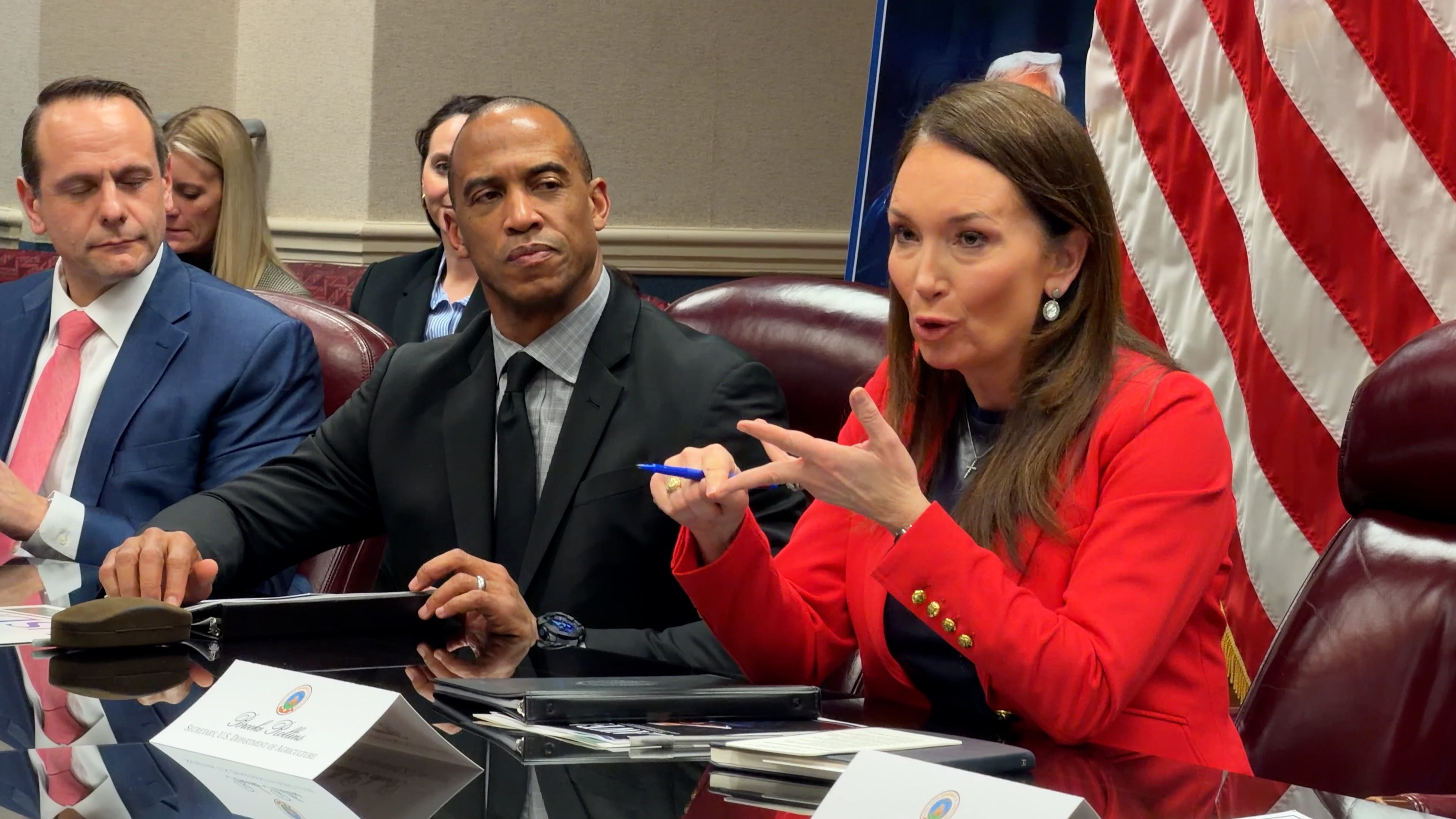
From inside the USDA Whitten Building, the tone of the Lawfare Roundtable was unmistakable: this was not simply an enforcement update, but a broader reframing of agricultural power and property rights.
Secretary Brooke Rollins did more than promise regulatory reform; she questioned consolidation, invoked Kelo v. City of New London, and signaled what could become a constitutional fight over the future of American farmland.
Another notable aspect of the roundtable was who was in the room. In addition to cabinet officials and agency representatives, the audience included independent media voices and individuals directly involved in the disputes being described.
The composition appeared deliberate. This was not a closed-door agency briefing, nor a purely technical policy seminar. It was structured around visible constituents, people who have made their conflicts public and who have come to symbolize broader frustration in rural communities.
That choice suggests the administration is not only recalibrating enforcement posture, but aligning itself with identifiable individuals and narratives that define the “lawfare” thesis.
The Line That Changed the Room
The most surprising moment of the USDA Lawfare Roundtable did not come from the prepared remarks. It came during the press conference.
Secretary of Agriculture Brooke Rollins, responding to a question about consolidation and the future of American agriculture, said:
“Frankly, to deconstruct the larger industry so that we can really begin to rebuild.”
She followed that with a vision of:
“More locally processed, locally raised, smaller farm operations.”
That language is unusual for a sitting Secretary of Agriculture.
Not “support.”
Not “balance.”
Not “reform.”
“Deconstruct.”
For decades, federal agricultural policy; regardless of party, has largely operated within a framework that accepts scale, consolidation, and export competitiveness as structural realities. Administrations have differed on regulation, subsidies, climate policy, and enforcement posture. But none in recent memory have openly framed the larger agricultural industry itself as something that may need to be dismantled and rebuilt.
Rollins’ language suggests something more foundational.
Whether it becomes structural policy remains to be seen. But rhetorically, it marks a shift.
It also aligns with the broader “Make America Healthy Again” (MAHA) narrative that emphasizes food transparency, regional processing, local supply chains, and resilience. In that framing, smaller-scale production is not just economic preference; it is presented as a public health and national security imperative.
That connection matters. The roundtable was not billed as an antitrust summit. It was billed as an effort to address “agricultural lawfare” a term the administration uses to describe regulatory overreach and enforcement practices that allegedly target farmers and ranchers.
Yet during the Q&A, the discussion moved beyond enforcement posture and into structural industry reform.
That raises two separate but related questions:
Is the administration positioning itself against consolidation?
If so, what mechanisms would make that more than rhetoric?
Before answering those questions, it’s important to understand what the Lawfare Framework actually is, and what it is not.
What the Lawfare Framework Actually Is
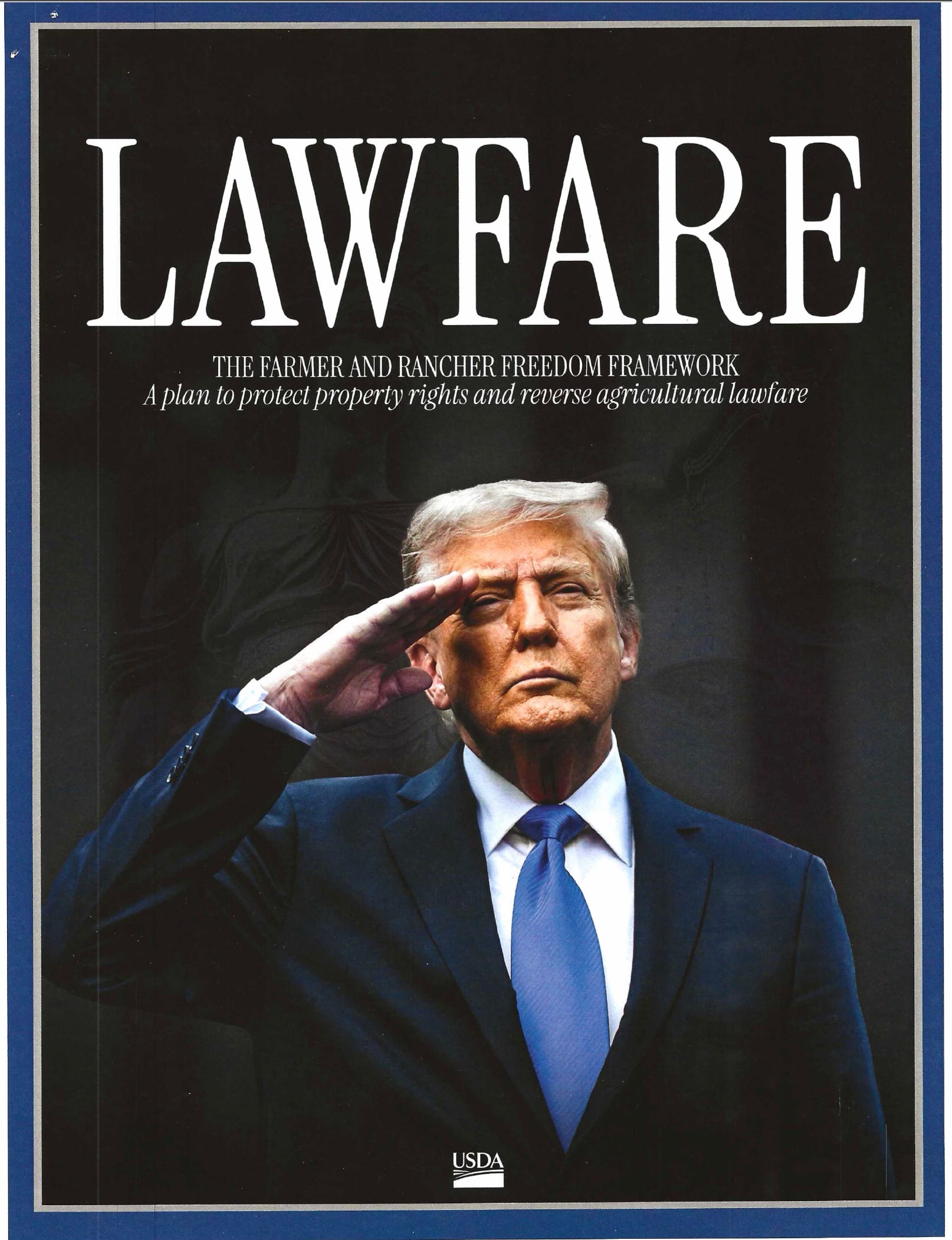
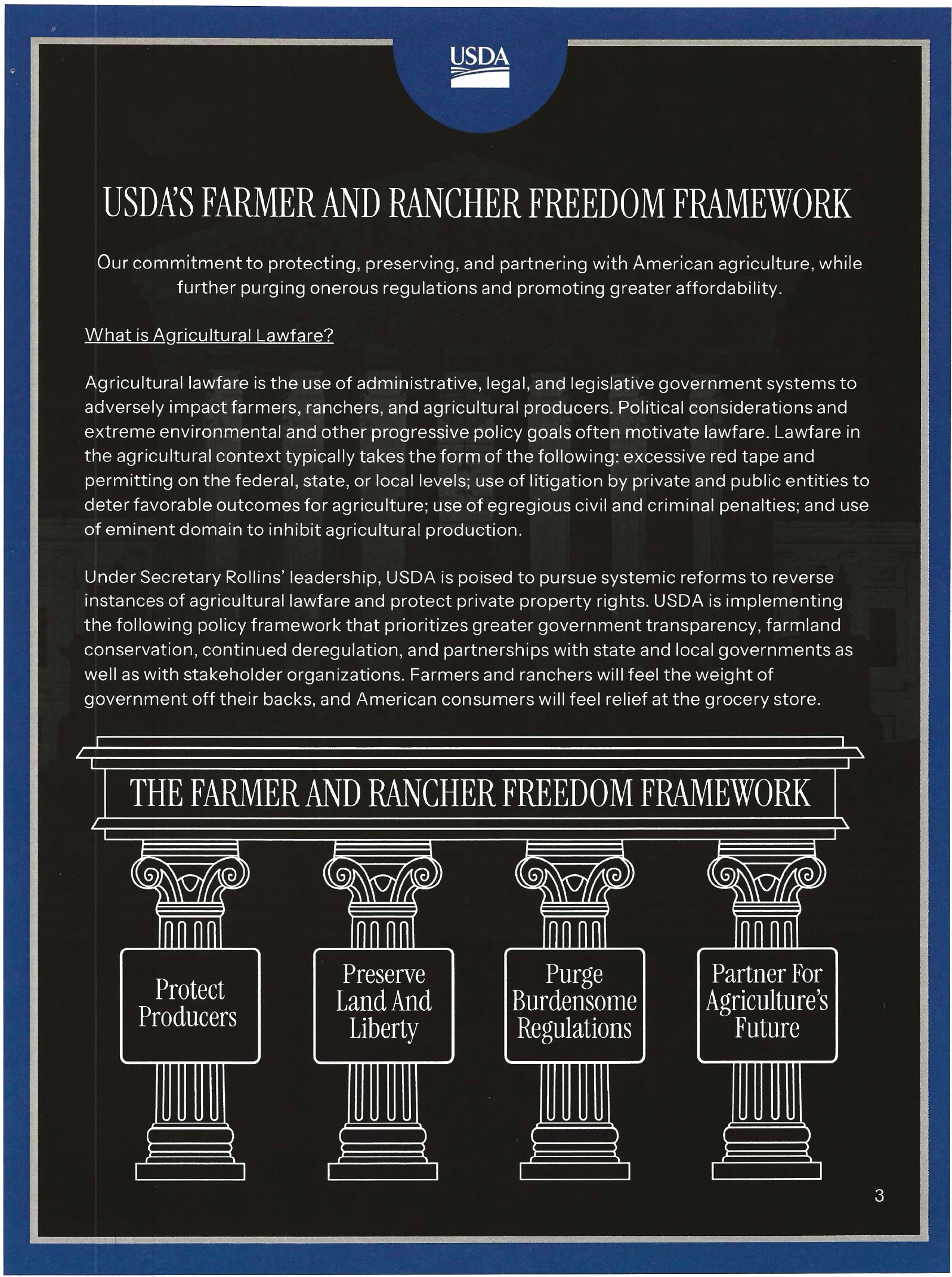
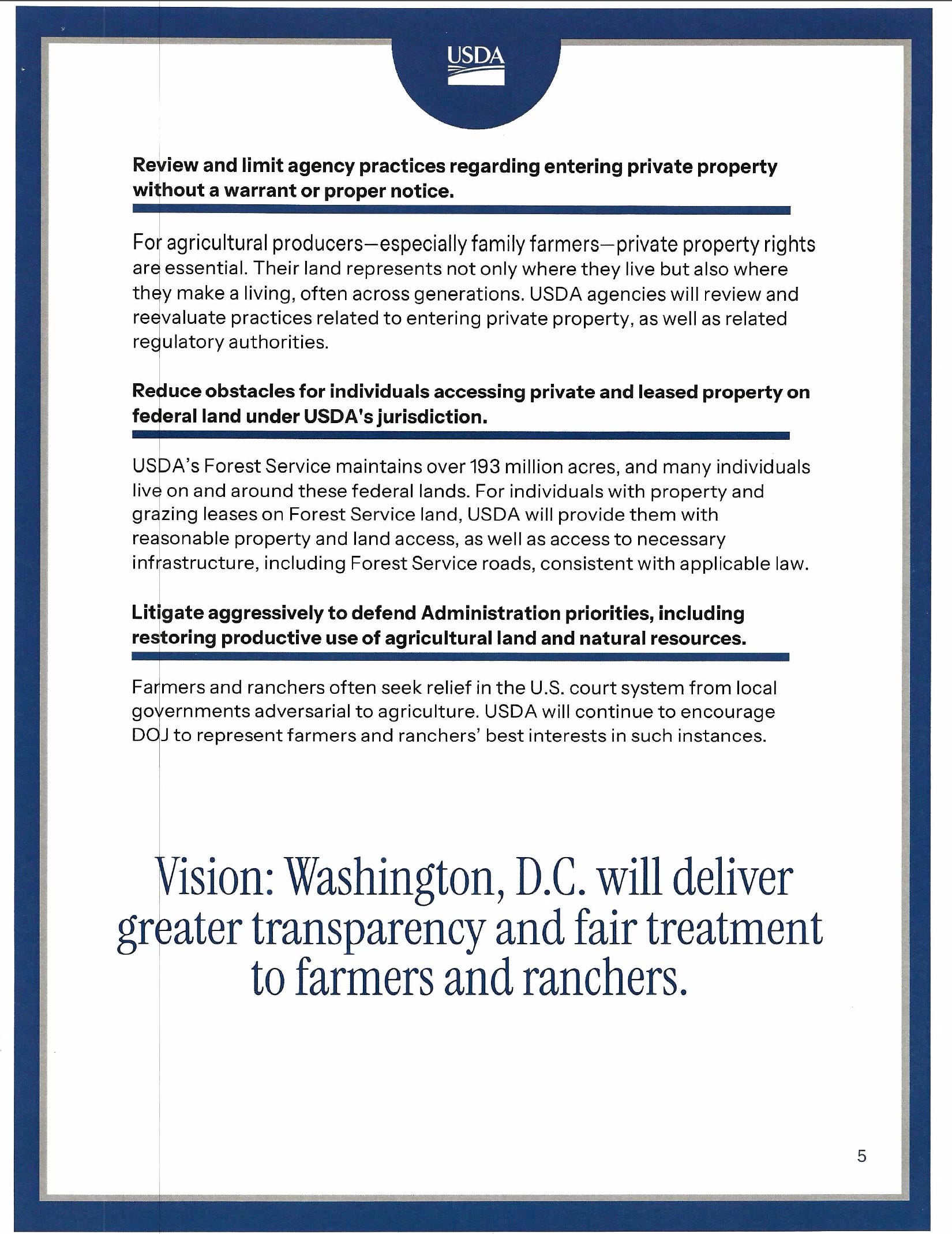
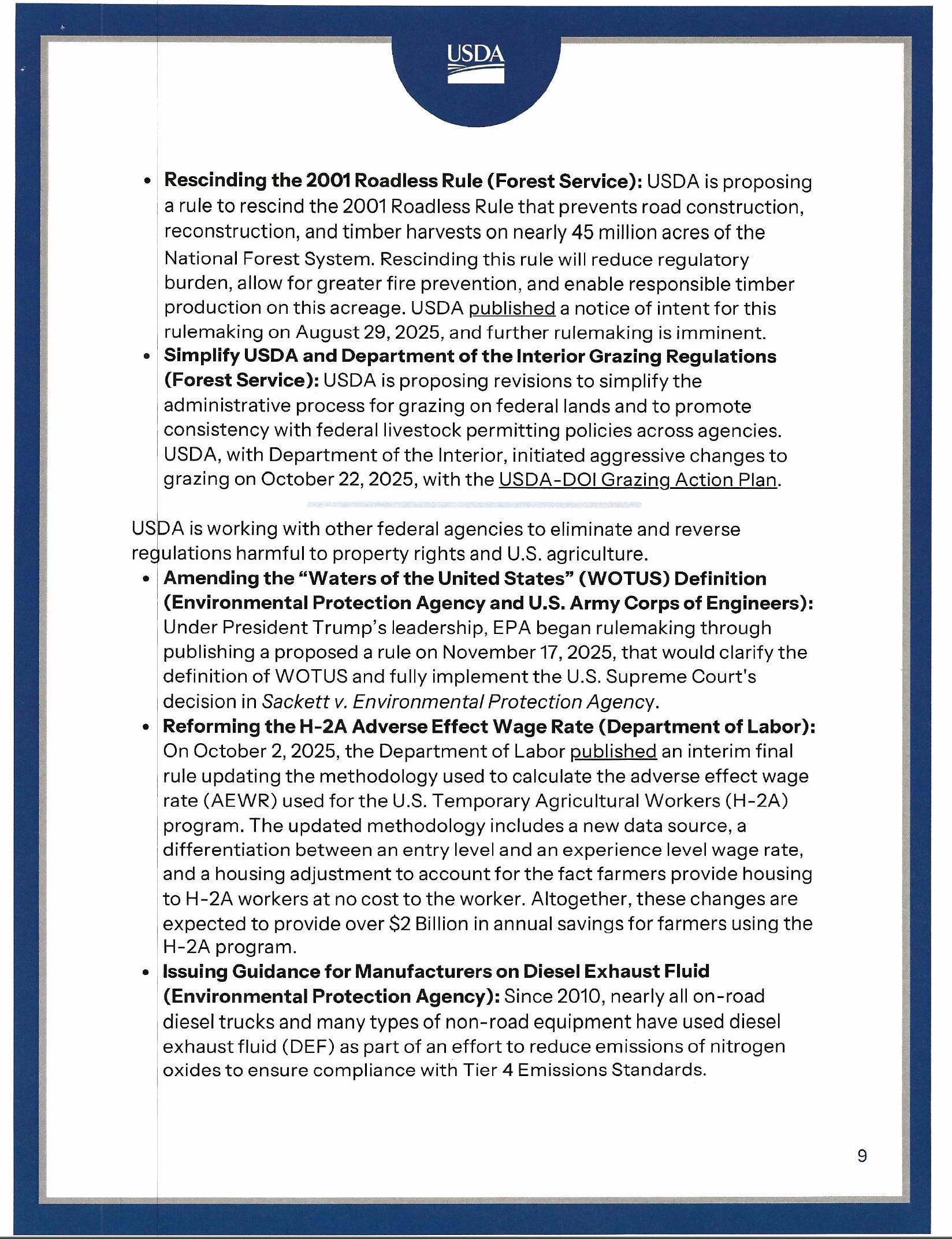
The Farmer and Rancher Freedom Framework, unveiled during the roundtable, rests on four broad pillars. While the language surrounding it was emotionally charged at times, the document itself outlines a set of administrative priorities rather than statutory reforms.
At its core, the framework proposes:
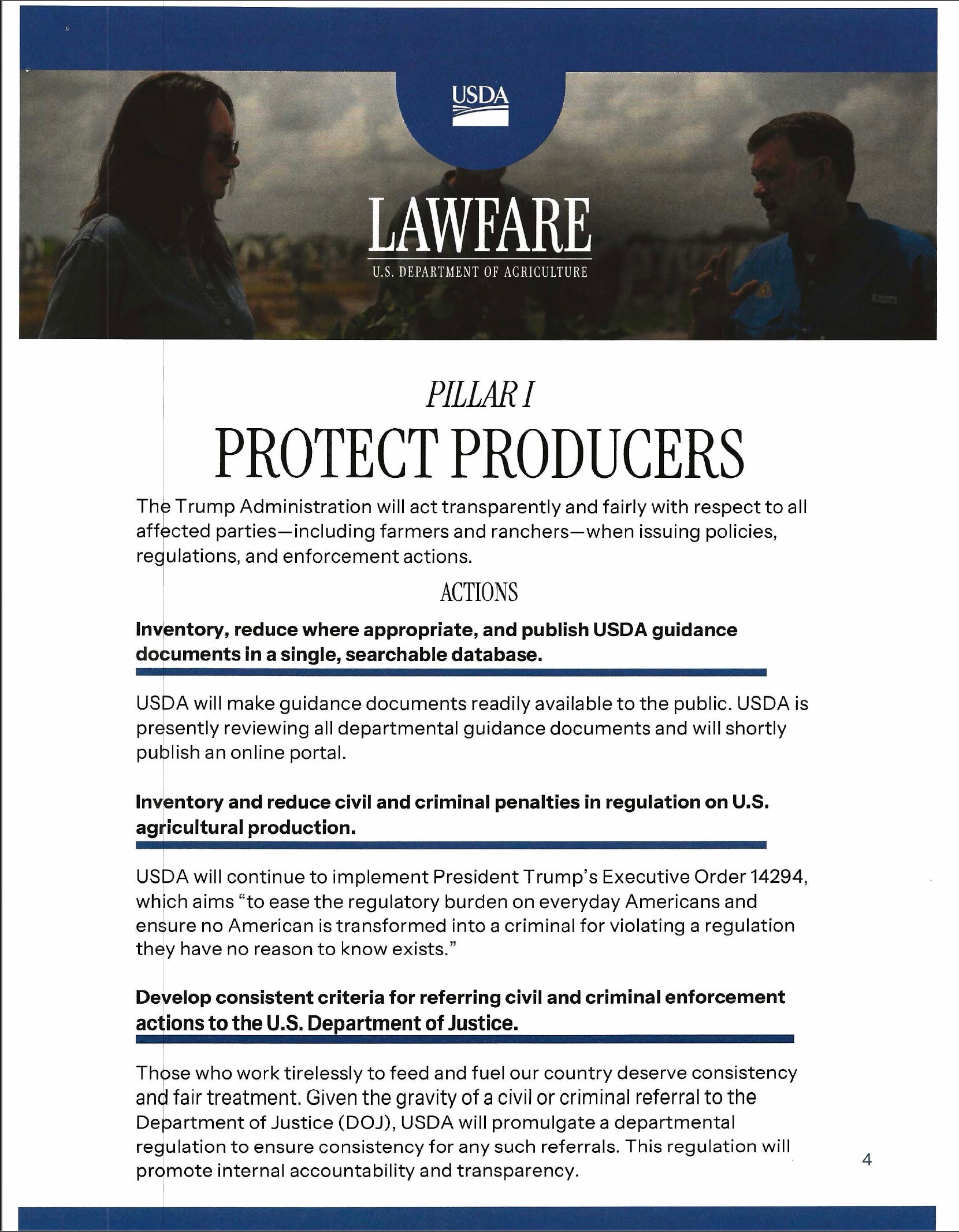
Greater consistency in USDA civil and criminal referrals to the Department of Justice
Increased transparency in enforcement guidance
A review and potential reduction of civil and criminal penalties
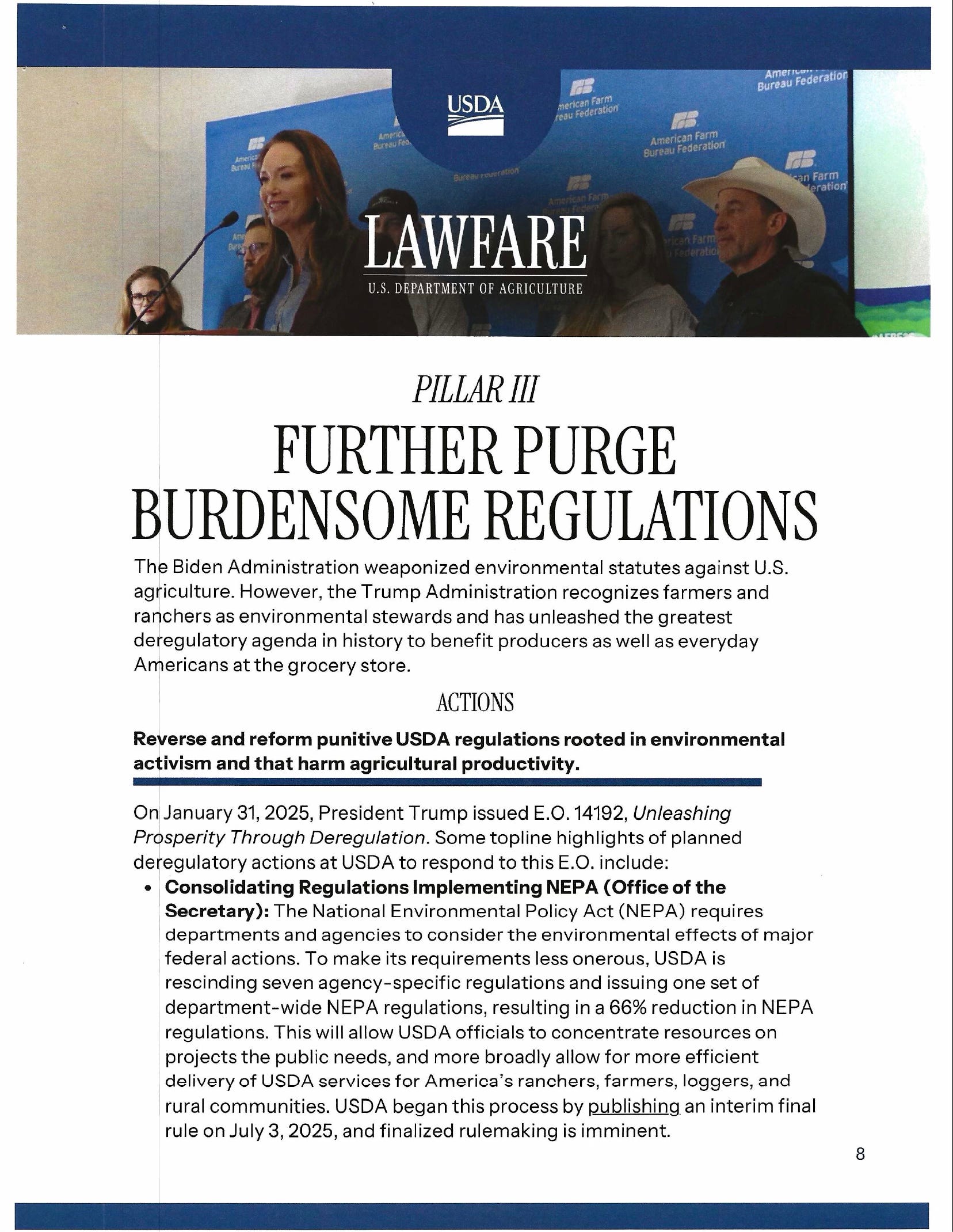
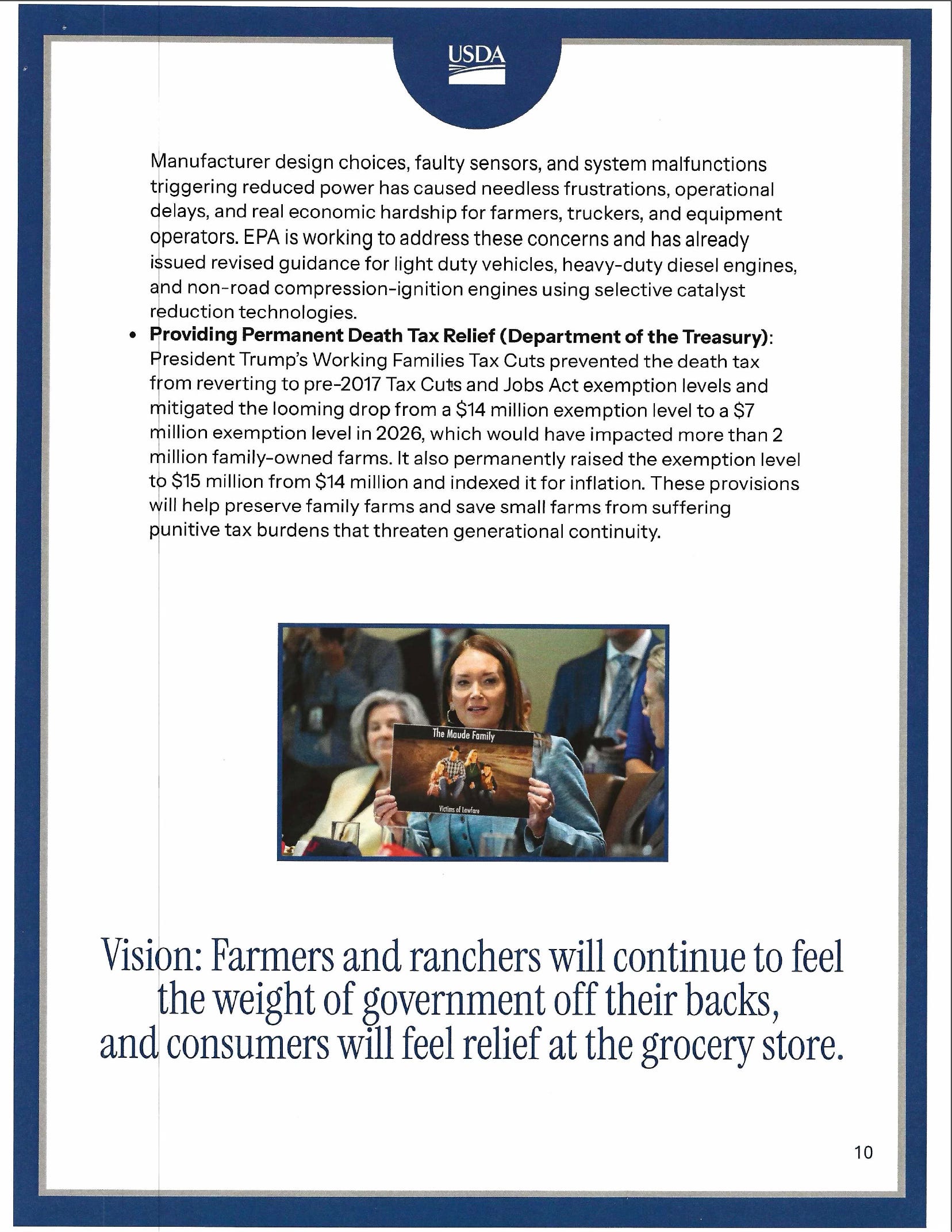
Regulatory reform in areas such as NEPA (National Environmental Policy Act) and ESA (Endangered Species Act) interpretation
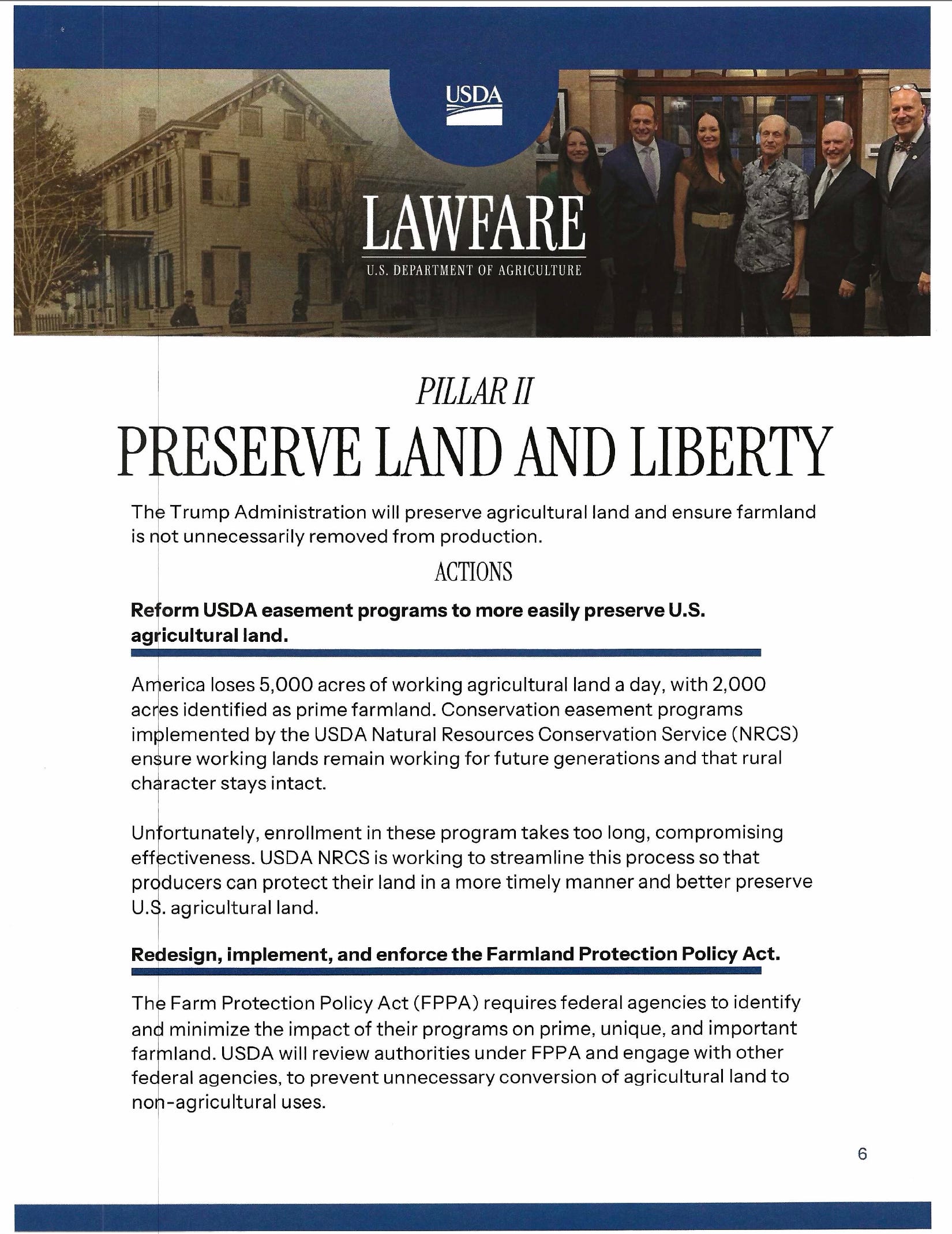
Reform of certain conservation easement processes
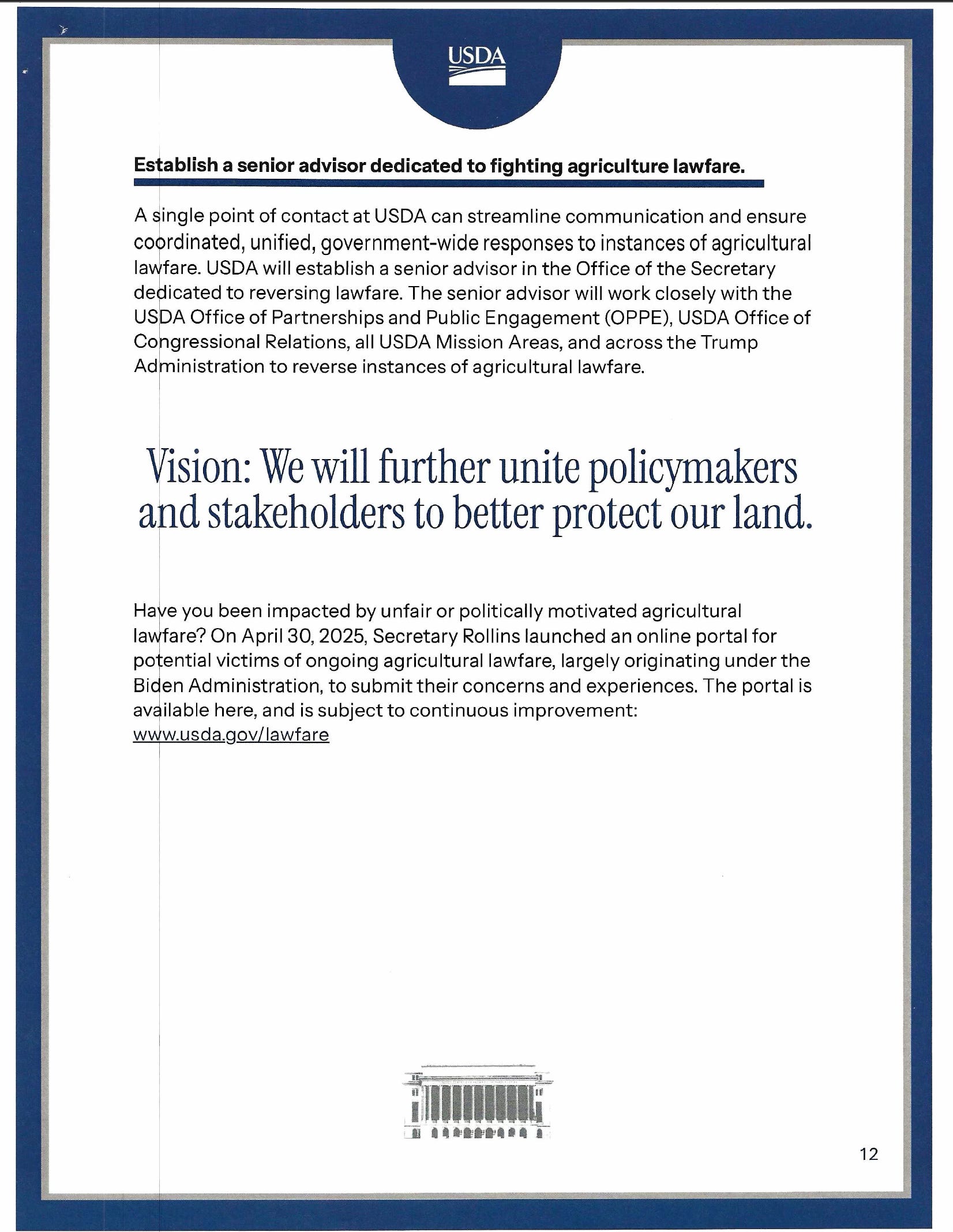
Creation of a senior advisor focused specifically on “agricultural lawfare”
Launch of a portal for producers to report cases of alleged regulatory overreach
Engagement with governors and state officials to align enforcement priorities
This is primarily an executive-branch posture reset.
It does not, on its own:
Rewrite federal statutes
Eliminate delegated state authority
Override independent state agencies
Announce antitrust enforcement changes
Propose new legislation
Instead, it signals a change in how USDA—and potentially DOJ—may handle enforcement referrals, interagency coordination, and regulatory interpretation.
The emphasis on DOJ referral consistency is particularly notable. That suggests an attempt to standardize when and how enforcement matters escalate into civil or criminal litigation. For producers who have long argued that agency discretion can lead to uneven outcomes, that shift could be meaningful—if implemented formally.
Likewise, references to forthcoming NEPA rewrites and reinterpretation of ESA “harm” language signal potential regulatory rollback in land-use and environmental review processes. Those changes, if published in rulemaking form, could materially alter the compliance landscape for agricultural operators.
But at this stage, much of the framework remains directional.
There are announcements. There are commitments. There are signals.
There are not yet published rule texts, enforcement memos, or statutory amendments.
That distinction is critical.
Because the strength of this initiative will ultimately be measured not by its language, but by the tools it deploys.
Implementation Timeline: What Happens When?
While the rhetoric was immediate, the written framework outlines phased execution.
First 30–60 Days: Internal Review Phase
Agency-wide review of enforcement practices
Inventory of guidance documents used in compliance actions
Begin creation of a publicly accessible guidance database
Review of inspection and private property entry protocols
Initial coordination discussions with DOJ on referral consistency
Meaning:
This phase changes posture, not law. It affects internal operations before formal regulatory reform begins.
Within 90 Days: Regulatory Target Identification
Identification of specific regulations for revision or repeal
Review of NEPA implementation burdens
Examination of ESA “harm” interpretations
Coordination discussions regarding Waters of the United States definitions
Review of conservation easement priorities
Engagement with Department of Labor on H-2A wage calculations
Meaning:
This stage defines the targets. It does not yet finalize rule changes but signals which areas will move toward reform.
6–12 Months: Structural Implementation
Publication of proposed rule changes where required
Updated enforcement guidance issued
Senior Lawfare Advisor fully operational reviewing selected cases
Formalized DOJ coordination on strategic litigation
Federal-state engagement where delegated programs are implicated
Meaning:
This is where intent either becomes durable policy—or stalls under administrative or judicial pressure.
Policy credibility will now hinge on whether these milestones are met.
Press conferences announce intention.
Federal Register notices implement change.
Rhetoric vs. Mechanism
The roundtable featured a mixture of technical discussion and charged rhetoric.
Terms such as “war on ranchers,” “weaponization,” and “communistic practices” were invoked by some speakers. The framing was urgent. Existential. At times, combative.
That rhetoric resonates with many producers who feel besieged by complex regulatory regimes, water disputes, zoning conflicts, and environmental enforcement actions. The emotional tone reflects real frustration in rural communities.
But serious analysis requires separating language from mechanism.
Rhetoric describes the problem.
Mechanism determines whether anything changes.
Here are the mechanisms actually discussed:
Formalizing DOJ referral criteria to reduce discretionary escalation
Reviewing civil and criminal penalty structures
Increasing transparency around USDA guidance
Promising NEPA rule revisions
Signaling ESA “harm” reinterpretation
Reviewing conservation easement practices
Coordinating with governors on enforcement posture
Establishing a senior advisor dedicated to reviewing alleged lawfare cases
Those are administrative levers.
They do not automatically override state agencies.
They do not automatically stop an ongoing wetlands enforcement action.
They do not automatically halt eminent domain proceedings.
They do not automatically restructure consolidated protein markets.
They are potential posture shifts within the executive branch.
If one focuses only on the rhetoric, the event appears revolutionary.
If one focuses only on the administrative details, it appears incremental.
The truth likely sits somewhere between those poles.
The framework clearly aims to reshape how federal agencies interact with agricultural producers. It may reduce enforcement escalation in certain contexts. It may streamline environmental review. It may embolden DOJ to defend deregulatory positions more aggressively.
But it does not, at least yet, constitute a wholesale restructuring of the agricultural economy.
Which brings us back to the line that changed the room.
When the Secretary speaks of “deconstructing the larger industry,” that implies something beyond enforcement posture. It gestures toward consolidation, market power, and the structure of food production itself.
If that language is to become structural policy, it would require tools such as:
Antitrust enforcement
Procurement reform
Grant scoring changes favoring smaller processors
Packers and Stockyards enforcement shifts
Market access reforms for independent producers
Some of those tools sit at USDA. Some sit at DOJ. Some require congressional action.
Until those tools are clearly deployed, the rhetoric shapes the narrative, but does not yet transform the system.
That tension between language and mechanism, defines the Lawfare Roundtable.
And it sets the stage for the deeper constitutional fault line that surfaced later in the event: a possible challenge to the Supreme Court’s 2005 decision in Kelo v. City of New London.
Where States Fit Into All This
For all the energy surrounding the Lawfare Roundtable, one structural reality remains unchanged:
USDA cannot order a state agency to stop enforcing its own laws.
That distinction is especially relevant for producers currently in disputes with state departments of ecology, environmental quality, zoning boards, or water resource authorities.
The Clean Water Act, for example, is often administered through delegated state programs. Once delegated, those states exercise significant enforcement authority. USDA does not supervise day-to-day enforcement in those jurisdictions.
So what are the real levers available to a federal administration that wants to recalibrate the landscape?
There are several, but none are simple.
First, federal oversight of delegated programs. Agencies such as EPA retain authority to review whether a state is administering a delegated program in compliance with federal standards. That authority is rarely used aggressively, but it exists.
Second, DOJ litigation posture. If a case involving federal law reaches litigation, the Department of Justice can shape how the federal government intervenes, defends, or interprets statutory provisions. That can indirectly influence outcomes, especially in cases involving federal permits or overlapping jurisdiction.
Third, funding leverage. Federal agencies distribute significant funding to states through grants and cooperative agreements. While funding cannot be arbitrarily withheld, priorities and conditions can influence alignment.
Fourth, congressional oversight. Hearings, investigations, and statutory clarifications can alter the broader enforcement environment.
And finally, Supreme Court litigation. A constitutional ruling can constrain not just federal agencies, but state governments as well.
Without one of those federal hooks, however, state authority remains intact.
If a rancher in Washington State is facing a wetlands enforcement action brought solely under state law, USDA does not have unilateral authority to stop that proceeding.
This is why the invocation of a Supreme Court precedent during the roundtable was so significant.
It suggests that the administration may be thinking beyond agency memos and toward constitutional doctrine.
The “Senior Advisor”
Perhaps the most operationally significant element of the Lawfare Framework is the appointment of a senior advisor dedicated specifically to reviewing alleged cases of agricultural “lawfare.”
According an official close to the matter, thousands of submissions have been received, with only about a hundred made it under review. That detail matters.
This is not a blanket intervention program; it is a legal triage model.
Cases will likely be evaluated for federal nexus, statutory overlap, constitutional implications, and factual clarity before any action is taken.
If the administration intends to reshape enforcement posture, or potentially invite judicial reconsideration of precedent, it must do so through carefully selected legal vehicles. A poorly positioned case could undermine broader reform efforts.
In that sense, the senior advisor role functions as the pressure point between rhetoric and litigation: filtering complaints, identifying strategic cases, and determining which disputes could meaningfully advance the administration’s legal objectives.
Kelo: The Constitutional Fault Line Beneath the Fight
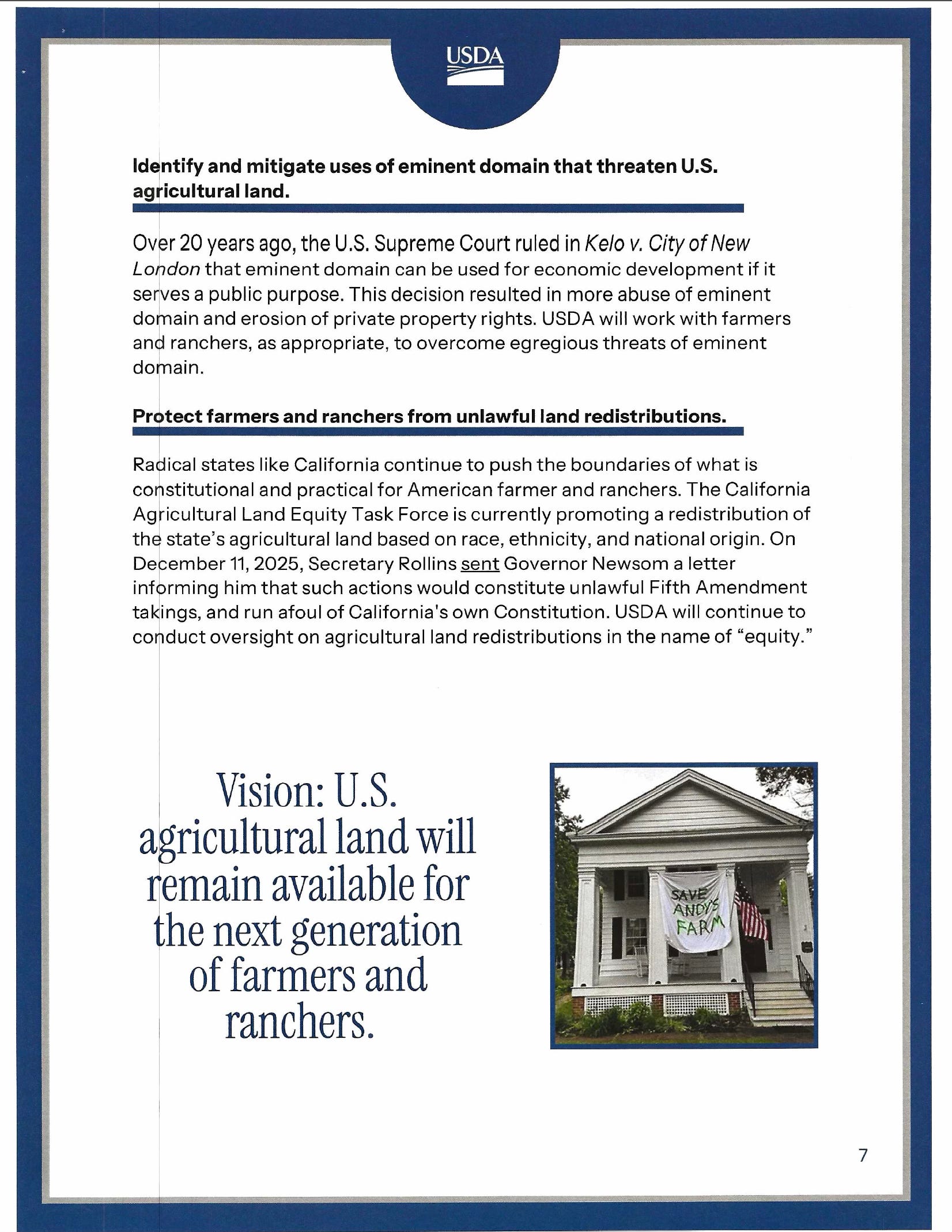
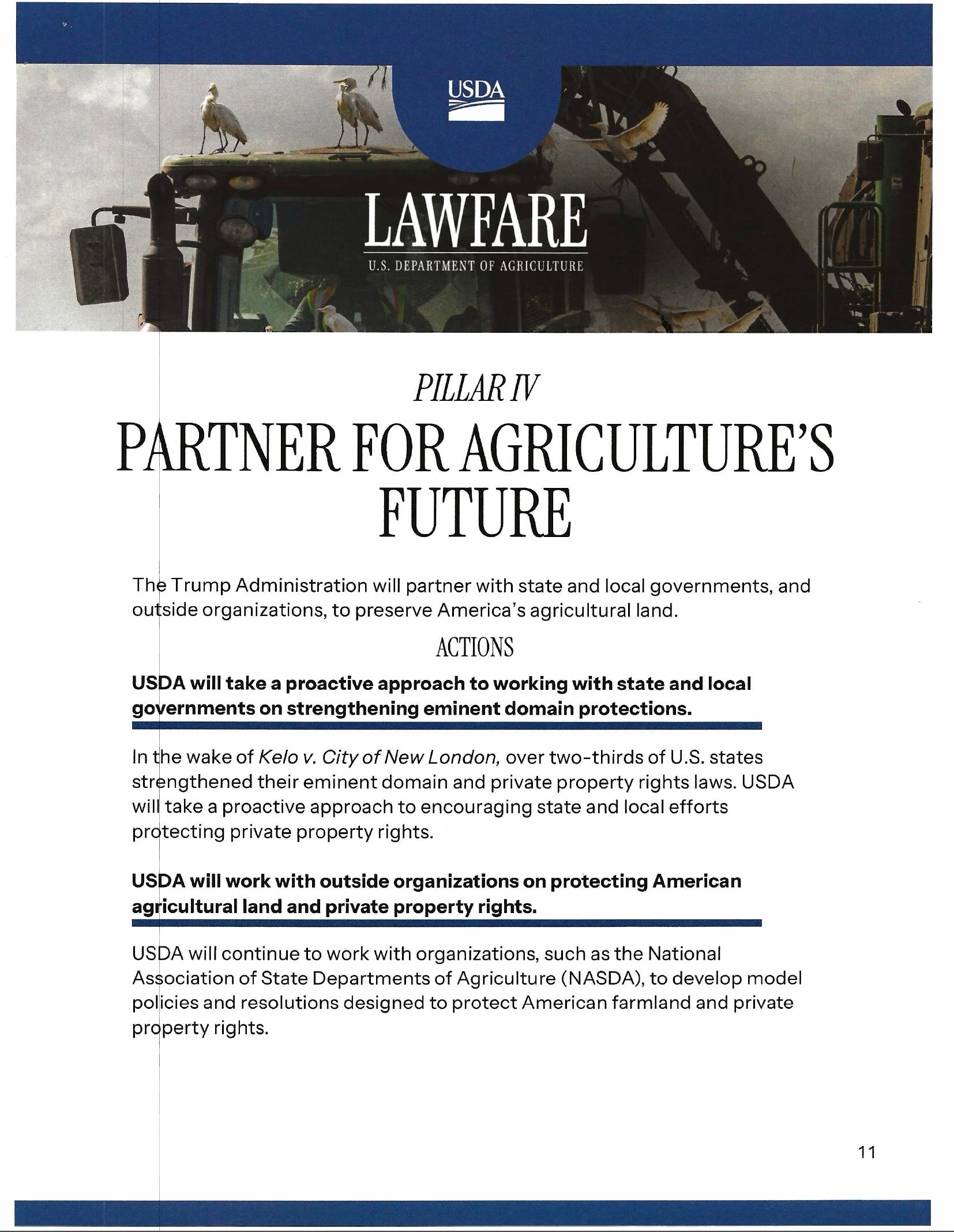
In the middle of a discussion largely framed around enforcement posture and regulatory reform, Secretary Rollins referenced the possibility of revisiting Kelo v. City of New London.
For those unfamiliar with the case, Kelo is a 2005 decision of the United States Supreme Court that expanded the interpretation of “public use” under the Fifth Amendment’s Takings Clause.
The Fifth Amendment states that private property shall not “be taken for public use, without just compensation.”
Historically, “public use” was understood to mean roads, schools, military bases, and other clear public infrastructure projects.
In Kelo, the Court held that economic development could also qualify as a public use; even if the property taken was transferred to another private party, so long as the taking served a broader public purpose, such as increasing tax revenue or creating jobs.
The ruling triggered nationwide backlash.
More than forty states enacted reforms tightening eminent domain standards. Public opposition was bipartisan and intense. Yet at the federal constitutional level, Kelo remains binding precedent.
Why does this matter for agriculture?
Because many modern land conflicts—transmission corridors, pipeline routing, urban expansion, redevelopment zones, industrial siting, rest on the doctrine that economic development qualifies as public use.
If that interpretation were narrowed or overturned, the legal landscape for infrastructure projects could shift significantly.
Transmission lines justified as economic development.
Industrial facilities framed as public benefit.
Redevelopment efforts targeting peri-urban farmland.
All of these rely, at least in part, on the broader reading of public use endorsed in Kelo.
By invoking the case during a discussion about agricultural lawfare, the administration signaled that it views eminent domain doctrine as part of the broader property-rights battlefield.
That is a constitutional move, not a regulatory one.
Could Kelo Actually Be Revisited?
Invoking Kelo rhetorically is one thing. Reversing it is another.
For the Supreme Court to revisit Kelo, several steps must occur:
A live case must present a viable constitutional challenge.
That case must work its way through lower courts.
The losing party must petition the Supreme Court for certiorari.
At least four justices must vote to hear the case.
A majority, five justices, must vote to narrow or overturn precedent.
There is no shortcut.
The Court does not issue advisory opinions. It requires a case vehicle.
The current Court has, in recent years, demonstrated increased sensitivity to property-rights claims. Decisions such as Cedar Point Nursery v. Hassid and Sackett v. EPA reflect a willingness to scrutinize regulatory reach and clarify constitutional limits.
Whether that trajectory extends to revisiting Kelo is uncertain.
Overturning or narrowing a 5–4 precedent that has stood for two decades would be a significant doctrinal move. It would not eliminate eminent domain. It would not end public infrastructure projects. But it could restrict the use of eminent domain for purely economic development transfers.
That would have generational implications.
It would affect not only federal agencies, but state and local governments nationwide.
It would reshape how courts evaluate whether a taking truly serves public use.
But at present, there is no announced test case. No cert petition has been filed. No litigation strategy has been formally unveiled.
The invocation of Kelo signals possibility.
It does not yet constitute a constitutional campaign.
Which brings the analysis back to the core question facing producers:
Is the Lawfare Framework an enforcement posture reset?
A litigation strategy?
Or the opening chapter of a broader constitutional effort?
The answer will depend on what happens next.
The Morning MOU: National Security Framing; Narrative or Leverage?
Earlier that same day, before the Lawfare Roundtable began, USDA announced a Memorandum of Understanding linking agriculture more explicitly to national security priorities.
That move matters symbolically.
Agriculture has long been described as critical infrastructure. But formally tying it to national security elevates the conversation beyond farm policy and into strategic doctrine. Food production becomes not merely economic output, but resilience. Supply chains become defense assets. Land use becomes strategic geography.
The question is whether that framing creates new leverage, or simply reinforces narrative alignment.
On its face, the MOU does not alter statutory authority. It does not expand USDA’s enforcement powers. It does not override state jurisdiction. It does not amend eminent domain law.
However, national security framing can have indirect consequences.
It can justify prioritization in interagency coordination.
It can influence federal funding streams.
It can affect how infrastructure projects are evaluated.
It can shape DOJ’s posture when defending federal regulatory reforms.
It can alter procurement strategies tied to food security.
In other words, it can create political gravity.
But gravity is not authority.
If the Lawfare Framework is to meaningfully affect state-level conflicts, it will not be because agriculture was labeled strategic. It will be because concrete federal tools are deployed.
At this stage, the MOU appears more aligned with strategic positioning than immediate enforcement leverage.
It reinforces the narrative. It does not yet rewrite the rules.
What Changes Tomorrow Morning?
This is the question that determines whether the roundtable was rhetorical or operational.
For producers currently in regulatory disputes, the relevant inquiry is simple:
What is different now?
Are there new enforcement memos?
Has USDA issued revised civil or criminal referral criteria?
Has DOJ published updated guidance?
Has a NEPA rewrite been formally proposed?
Has the ESA “harm” reinterpretation entered rulemaking?
Has a senior lawfare advisor been appointed and given review authority?
Is there a documented mechanism for reviewing delegated state programs?
If the answer to those questions is yes, the framework begins to take shape.
If the answer is no, then the initiative remains a directional signal rather than an operational shift.
Policy credibility is built through documentation.
Press conferences announce intention.
Federal Register notices implement change.
Until rule text is published, enforcement guidance is revised, or litigation posture is formally documented, the practical environment facing producers remains largely the same.
That does not mean nothing will change. It means the change must be measured in memos and filings; not applause lines.
The Fork in the Road
The Lawfare initiative now sits at a structural crossroads.
It can become one of three things.
First, an executive enforcement posture reset.
In this scenario, USDA standardizes referrals, reduces discretionary escalation, streamlines regulatory review, and coordinates more aggressively with DOJ to defend deregulatory interpretations. The impact would be meaningful but largely administrative.
Second, a litigation strategy against regulatory expansion.
Here, the administration would use DOJ to challenge federal overreach, reinterpret statutory provisions, and potentially support producers in high-profile cases. The impact would be more visible and more confrontational.
Third, a long-term constitutional campaign.
This would involve identifying test cases, supporting cert petitions, and inviting the Supreme Court to revisit doctrines such as Kelo. That path would be generational. It would move beyond agency posture and into constitutional realignment.
Each path carries different implications.
An enforcement reset affects process.
A litigation strategy affects outcomes.
A constitutional campaign affects doctrine.
Which path the administration chooses will determine whether the roundtable is remembered as symbolic or transformative.
The Agricultural Reality Check
For producers in active disputes, the analysis must remain grounded.
If a rancher in Washington State is facing a wetlands enforcement action brought solely under state law, the Lawfare Framework does not automatically halt that case.
If a landowner is confronting eminent domain proceedings for a transmission corridor justified as economic development, Kelo remains binding precedent today.
If a farmer is navigating ESA habitat designation, no reinterpretation has yet been formally adopted.
If a producer is entangled in zoning conflicts, local ordinances still govern.
The framework may change posture.
It may influence future litigation.
It may reshape regulatory interpretation.
But it does not, at present, override the structural authority of states.
That reality does not diminish the importance of what was discussed. It clarifies it.
Policy shifts are often incremental before they are visible.
The question is whether this moment marks the beginning of incremental change or simply a recalibration of tone.
What to Watch in the Next 90 Days
The difference between rhetoric and reform will become visible quickly.
Watch for:
Publication of a formal NEPA rewrite proposal.
Release of a proposed ESA “harm” reinterpretation rule.
Documented DOJ guidance altering civil or criminal referral standards.
Appointment and defined authority of the senior lawfare advisor.
Establishment of a transparent case review mechanism.
Any cert petition or litigation strategy explicitly inviting reconsideration of Kelo.
Congressional hearings or draft legislation tied to property-rights reform.
Those markers will determine whether the Lawfare initiative evolves into durable policy.
Absent those developments, the roundtable will remain a significant rhetorical moment; but not yet a structural shift.
The most consequential statement of the day may not have been about enforcement at all. It may have been the willingness to question consolidation and to publicly invoke a Supreme Court precedent that reshaped American property rights.
Whether that invocation becomes doctrine is now a matter of action, not language.
And that is what serious observers should be watching.
In Washington, it is easy to mistake language for leverage. The Lawfare Roundtable offered both charged rhetoric and tangible administrative signals. But the true measure of this initiative will not be found in press conferences. It will be found in rule text, enforcement memos, litigation strategy, and if the constitutional path is pursued a live case that asks the Supreme Court to reconsider the meaning of “public use.” Secretary Rollins’ willingness to speak openly about deconstructing consolidation and revisiting foundational property-rights doctrine marks a notable shift in tone. Whether that tone hardens into structural reform now depends on what follows. For producers navigating real conflicts on real land, the next ninety days will reveal whether this moment was a recalibration—or the beginning of something far more consequential.