



This investigation examines the Washington State Department of Ecology’s “Straight-to-Implementation” (STI) model as applied in the Spring Flat Creek watershed. It analyzes how accelerated enforcement sequencing intersects with nondiscretionary federal Clean Water Act planning obligations, federally conditioned §319 funding, and state discharge authority under RCW 90.48.
This overlap raises a narrower institutional question:
When federal law, federal funding, and state enforcement authority converge before a completed TMDL allocation, are planning, reporting, and sequencing fully aligned?
That question is not theoretical. It is administrative—and it is reviewable.
Inside Washington’s Straight-to-Implementation Model Amid Active Federal Scrutiny
In Whitman County, Washington, Spring Flat Creek — a small intermittent tributary in the Palouse — has become the proving ground for a regulatory model that blends:
Federal Clean Water Act authority
Federally conditioned §319 grant funding
State enforcement power under RCW 90.48
Numeric riparian buffer implementation
Pre-TMDL watershed intervention
On paper, Washington’s “Straight-to-Implementation” (STI) program is designed to move faster than the traditional Total Maximum Daily Load (TMDL) process.
In practice, internal planning documents, enforcement letters, buffer maps, and federal funding records reveal a structure that now intersects with active federal scrutiny of Washington’s agricultural enforcement posture.
This is no longer a watershed-specific issue.
It is a question of how a statewide implementation model operates within federally overseen programs.
The Legal Baseline: TMDL Required — Even If Implementation Begins Early
Spring Flat Creek is listed as a Category 5 impaired water under the Clean Water Act.
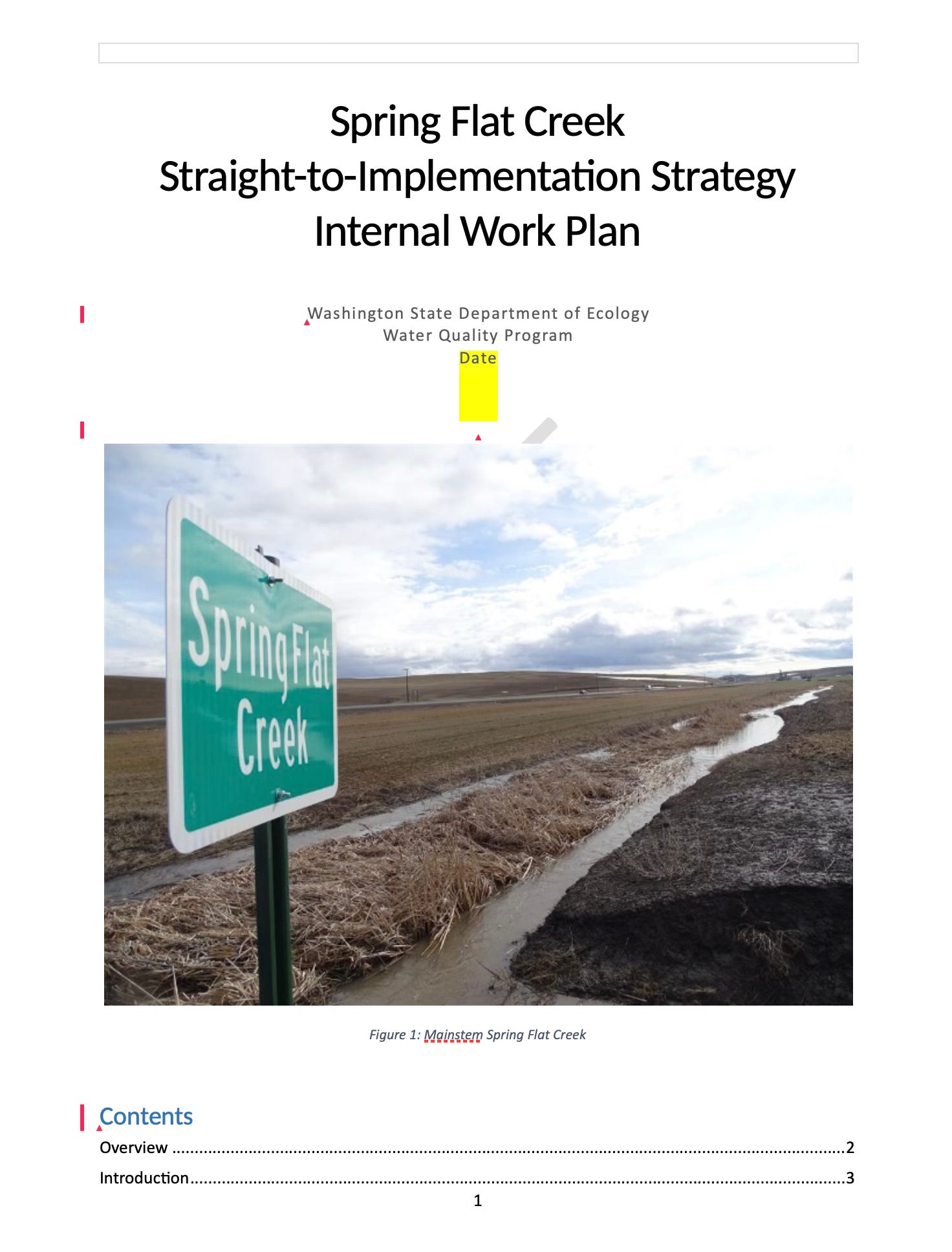
Washington’s own STI planning document states plainly:
“Total Maximum Daily Loads (TMDLs) are required for all waterbodies that do not meet water quality standards.”
The document continues:
“Developing TMDLs can be long, labor-intensive efforts… The purpose of a straight-to-implementation (STI) effort is to get to cleaner water faster.”
And critically:
“While the STI is being implemented, the requirement to develop a TMDL remains.”
This language establishes the sequencing tension.
Under §303(d) of the Clean Water Act, TMDL development for impaired waters is a nondiscretionary planning obligation. EPA encourages early corrective action; implementation does not have to wait for modeling to conclude.
But implementation sequencing does not eliminate the requirement to develop, prioritize, and publish allocation modeling within a TMDL framework.
What the STI document does not specify for Spring Flat Creek:
A defined TMDL completion timeline
A watershed-specific prioritization schedule
A measurable trigger for transition from STI to finalized allocation modeling
Early action is permissible.
Indefinite sequencing without transparent scheduling invites institutional review.
The Enforcement Architecture: State Authority and Visual Screening
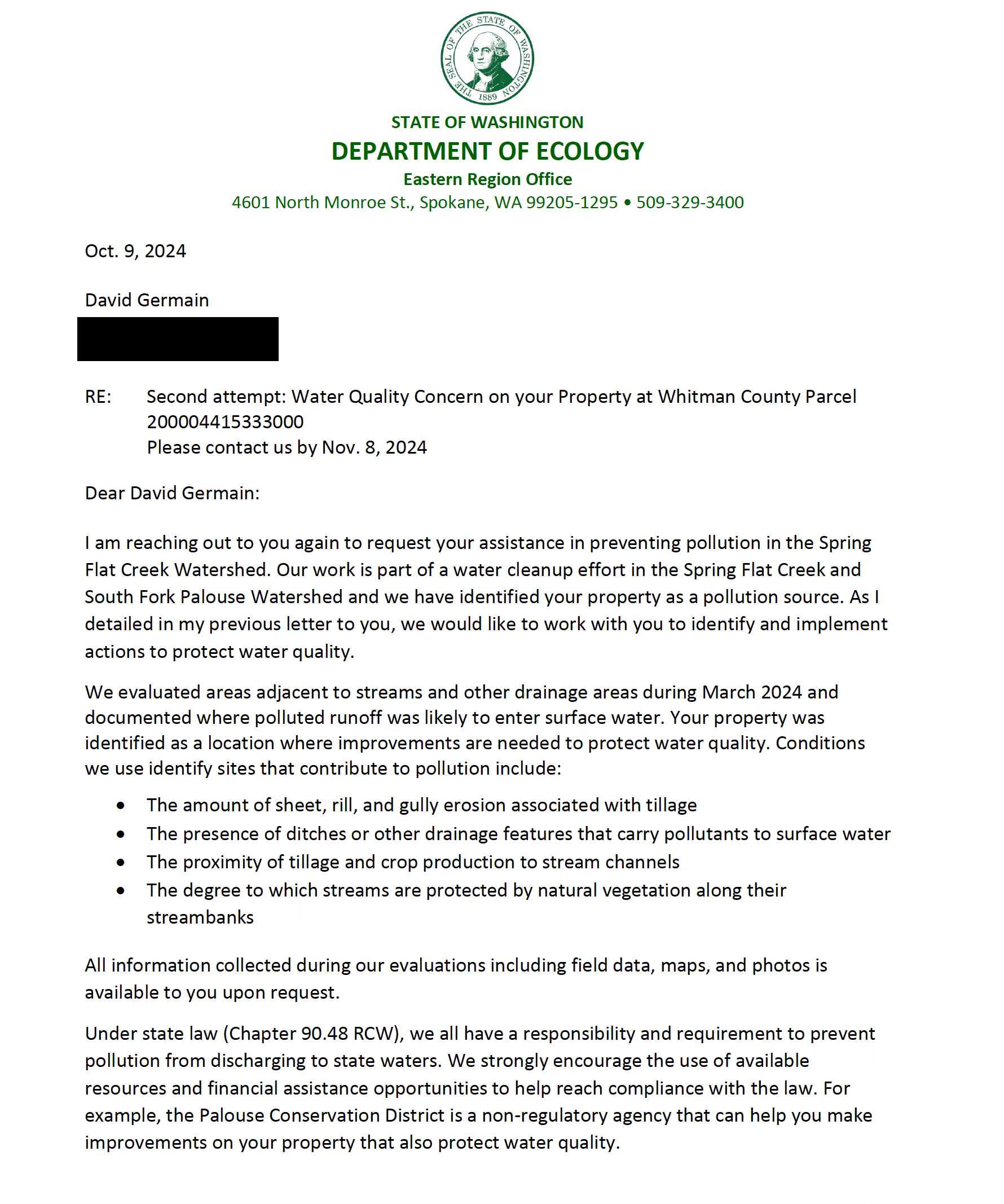
In 2024, multiple Spring Flat landowners received nearly identical enforcement letters.
The letters state:
“We identified your property as a pollution source.”
The basis for identification is described as:
“documented where polluted runoff was likely to enter surface water.”
Follow-Up Letter (Yenna):
“We identified your property as a pollution source.”
The identification is described as:
“documented where polluted runoff was likely to enter surface water.”
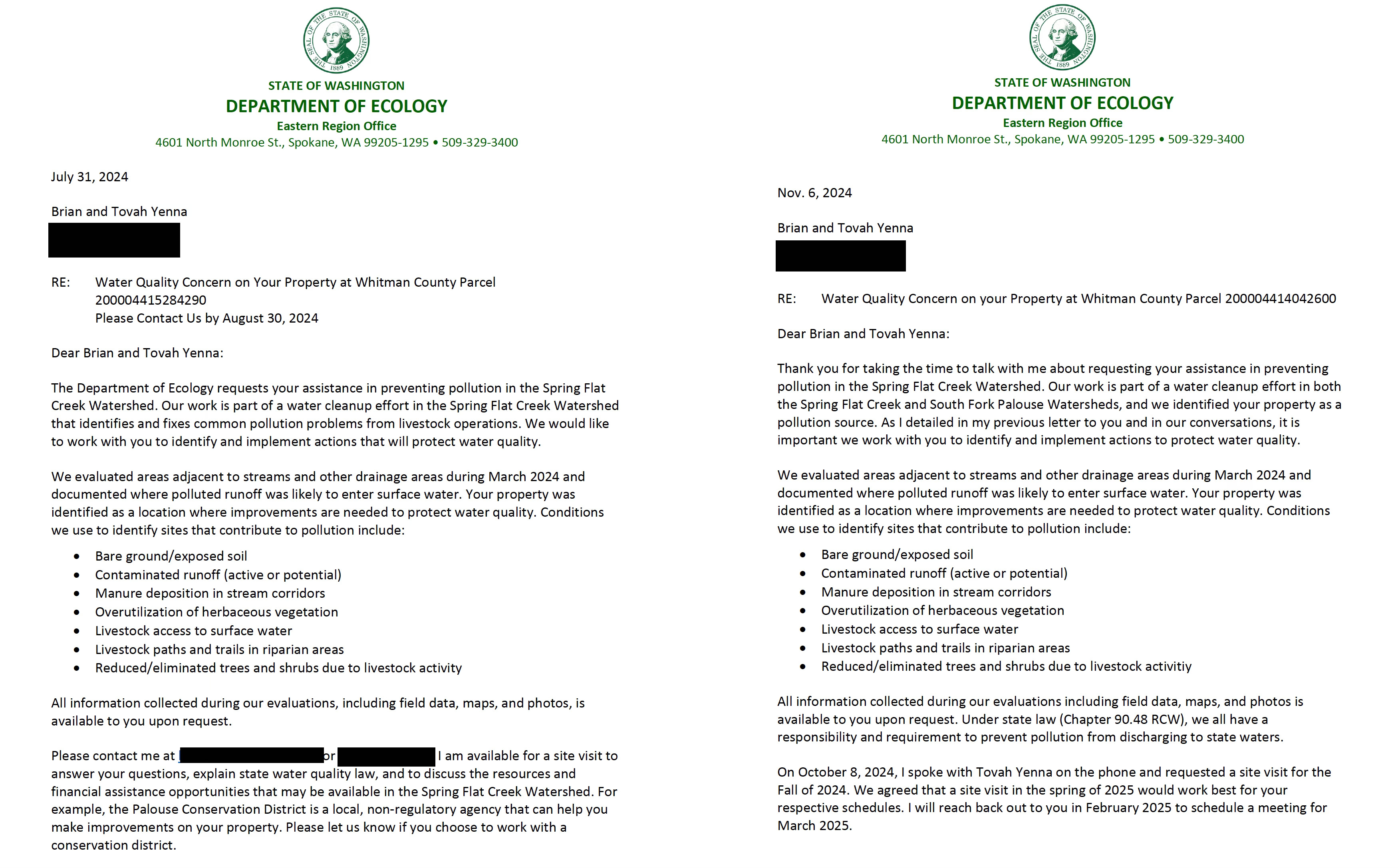
Cited conditions include:
Sheet and rill erosion
Tillage proximity to streams
Bare ground/exposed soil
Livestock access
Reduced riparian vegetation
Notably absent from the letters:
Numeric sediment sampling
Temperature exceedance data
Dissolved oxygen readings
Modeled pollutant load comparisons
TMDL allocation exceedance references
Under RCW 90.48, Washington may act where there is substantial potential for discharge. That authority is independent of federal TMDL timing. The state does not need to wait for numeric allocation modeling to require corrective measures.
That distinction matters.
Visual indicators may satisfy state-law enforcement thresholds.
However, when corrective measures implemented through such determinations intersect with federally conditioned §319 funding and annual load-reduction reporting to EPA, the evidentiary bridge becomes relevant to federal transparency.
During the March 11, 2026 Washington Cattlemen’s Association town hall, nonpoint program supervisor Ben Rau confirmed that field staff continue to rely on precisely these visual indicators:
“The primary thing when we’re doing those watershed evaluations and what we’re looking for to identify sources of pollution are those site conditions… the Livestock and Water Quality Focus Sheet and then the Landowner Site Assessment Tool. And those are the same things that then we also use, our field staff use to identify sources.”
The compliance question is not whether Washington can act.
The question is how site-level visual determinations translate into quantifiable load-reduction figures reported to federal authorities.
Numeric Buffer Implementation: Acreage Conversion and Authority
A site visit follow-up letter to one landowner included mapped riparian buffers:
60-foot buffer along Spring Flat Creek
30-foot buffer along a tributary
Approximately 12 acres of productive land converted
The STI document clarifies:
“35-foot buffers were used… merely for simplicity… 35-foot buffers are not the recommended buffer widths.”
EPA permits modeled load reductions for nonpoint source pollution. Nationwide, agricultural runoff is typically addressed through proxy modeling rather than parcel-by-parcel laboratory measurement.
The issue here is not the use of modeling.
It is the interaction between:
Numeric buffer assumptions
Enforcement escalation referencing potential administrative orders
Acreage conversion tied to corrective expectations
Federal reporting of modeled load reductions
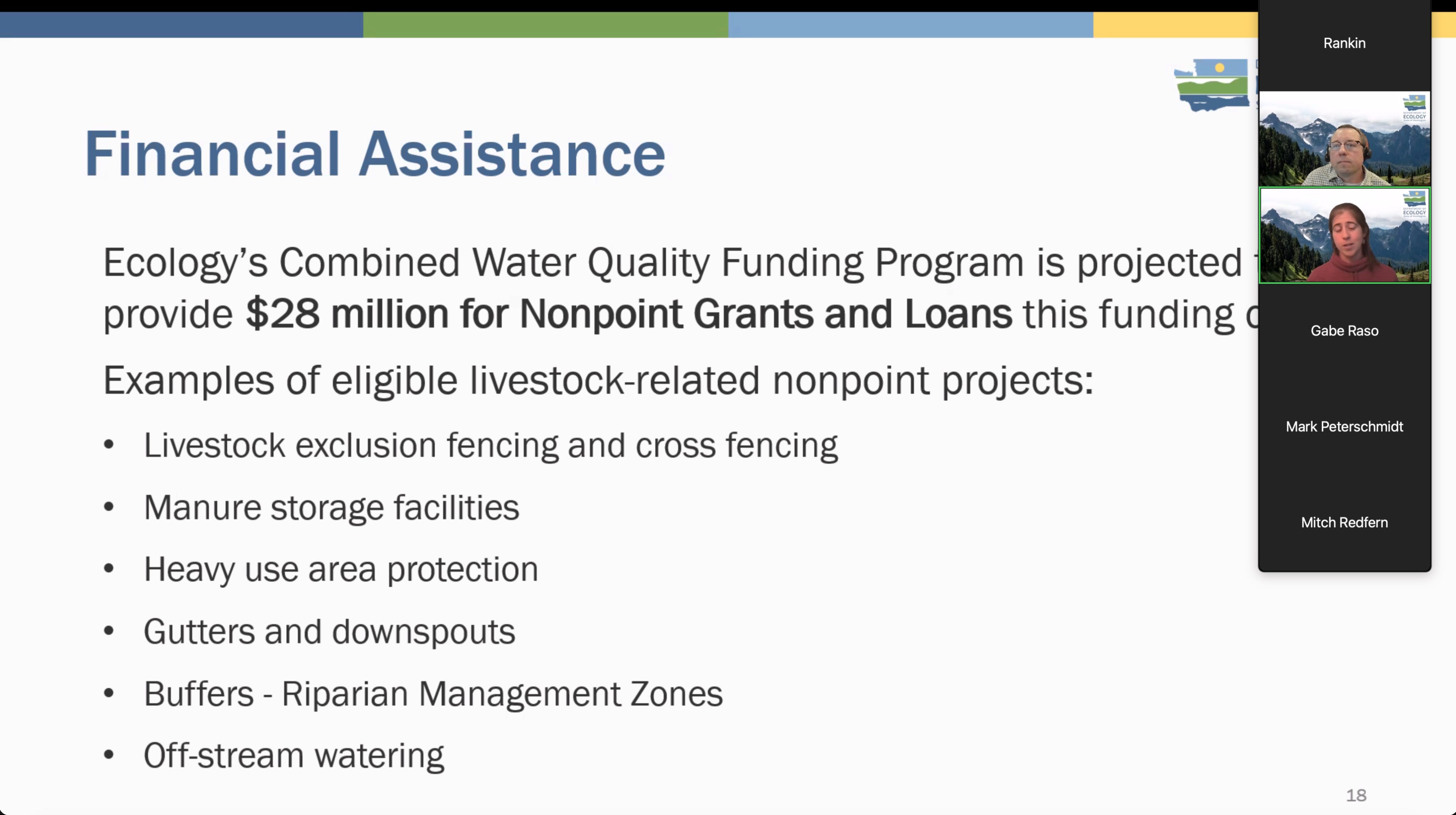
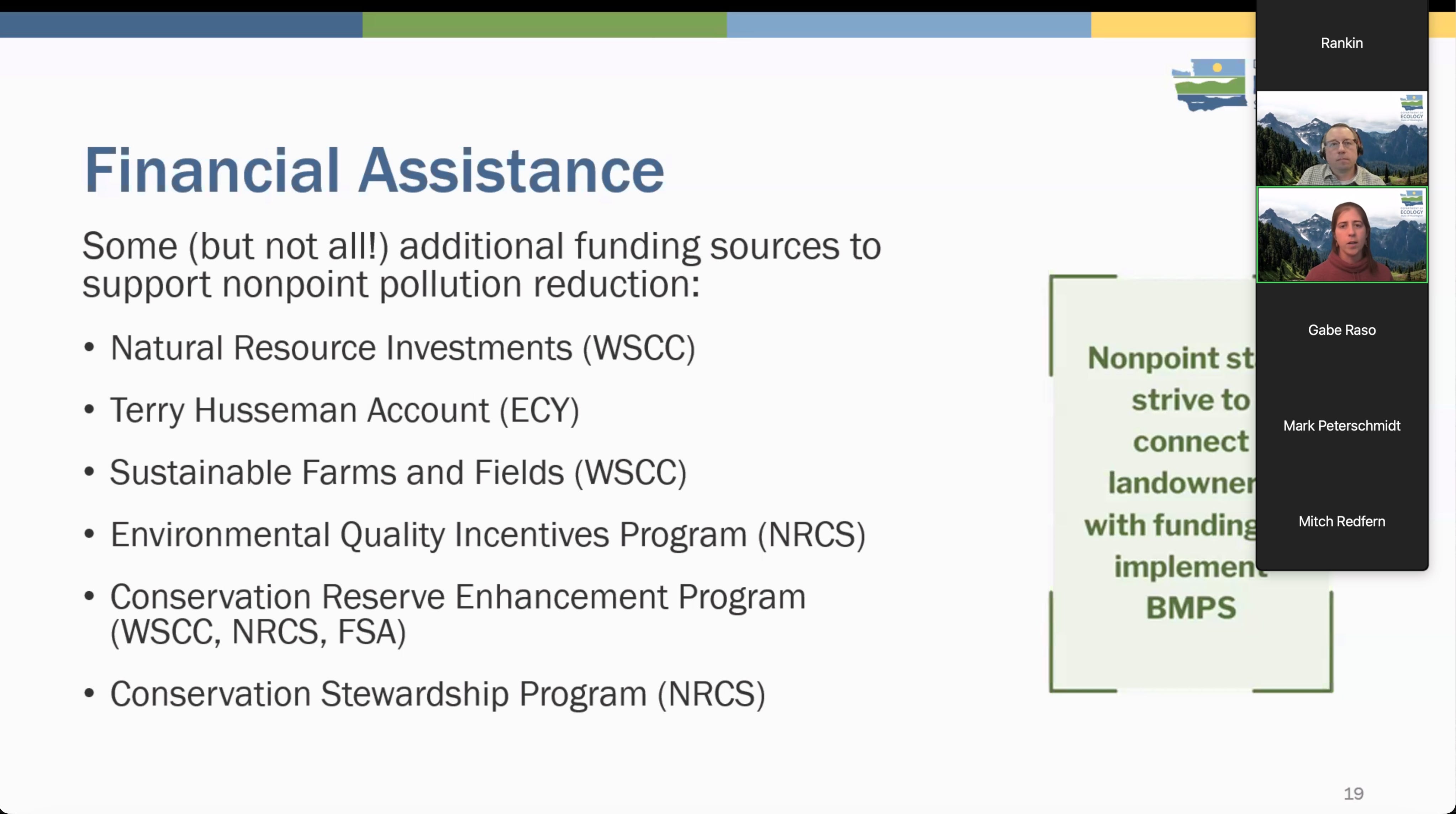
Ecology’s March 2026 presentation slides explicitly list “Buffers – Riparian Management Zones” as an eligible project under the agency’s Combined Water Quality Funding Program, projected to provide $28 million for nonpoint grants and loans. The slides also highlight additional funding sources (WSCC, NRCS, FSA, etc.) that staff “strive to connect landowners with” for BMP implementation.
The new Voluntary Clean Water Guidance for Agriculture—final chapters submitted to EPA and in the final publication stage as of the March 11 town hall—plays a central role in these recommendations. Statewide nonpoint policy lead Hannah Coe and Ben Rao explained its function and its tie to funding:
“The role of the voluntary clean water guidance is to provide site-specific BMP recommendations that provide certainty to agriculture producers that if you implement those BMP recommendations that they support clean water and achieve compliance with state water quality laws… When an operator implements those suites of BMPs consistent with the guidance recommendations, we’ll presume that water quality is being adequately protected… We’ll use it to update our funding guidelines and align our funding program with the recommendations found in the guidance.”
If numeric buffer widths function as de facto compliance thresholds connected to enforcement authority — yet derive from internal guidance rather than formally promulgated rule — clarification of authority becomes appropriate.
This is an administrative question, not a political one.
Federal §319 Funding and the “Methodological Bridge”
Grant documentation from the Palouse Conservation District confirms that federal §319 funds are integrated into watershed implementation efforts, with annual sediment and nutrient load reductions reported to EPA.
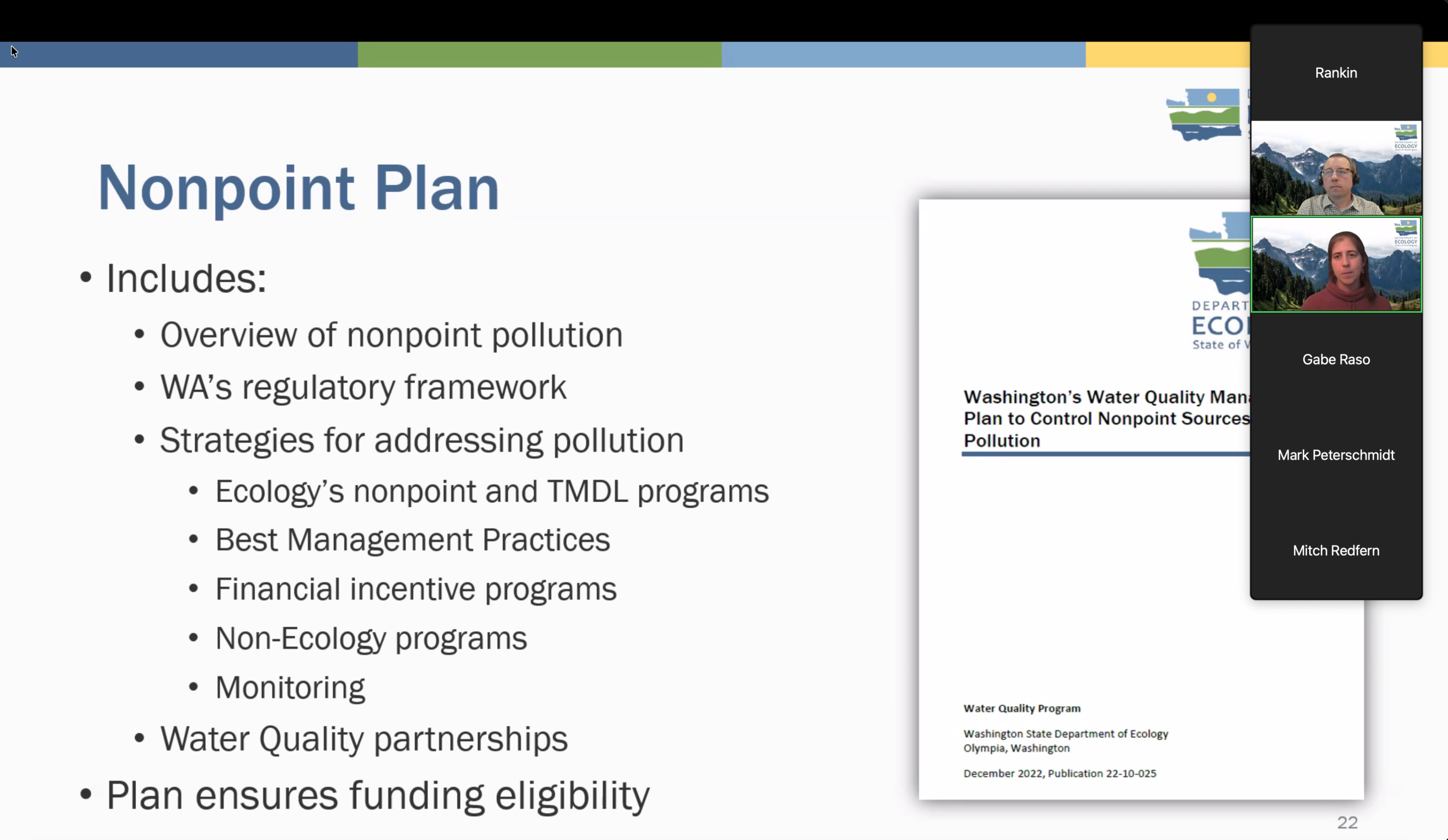
Ecology’s own March 2026 slides state that the updated Nonpoint Plan “ensures funding eligibility” and is required by EPA to maintain access to federal grant and loan dollars. The slides further show how nonpoint staff actively connect landowners to these funds — including for the very riparian buffers being implemented through the STI model and enforcement pipeline.
EPA allows modeled reductions in nonpoint source programs. The oversight question is therefore not whether modeling is permitted.
It is whether modeling assumptions and reported reductions are:
Traceable to documented site-specific conditions
Consistent with Clean Water Act planning sequencing
Transparent in methodology and allocation basis
If enforcement letters rely on visual indicators of potential runoff, but federal reports rely on generalized buffer models to quantify reductions, documentation alignment becomes central.
This creates a “methodological bridge” between site-level conditions and federally reported outcomes.
The Federal Reporting Mechanism: How Load Reductions Are Generated
Grant documentation from the Palouse Conservation District provides a detailed view into how water quality improvements are quantified and reported within Washington’s nonpoint source framework.
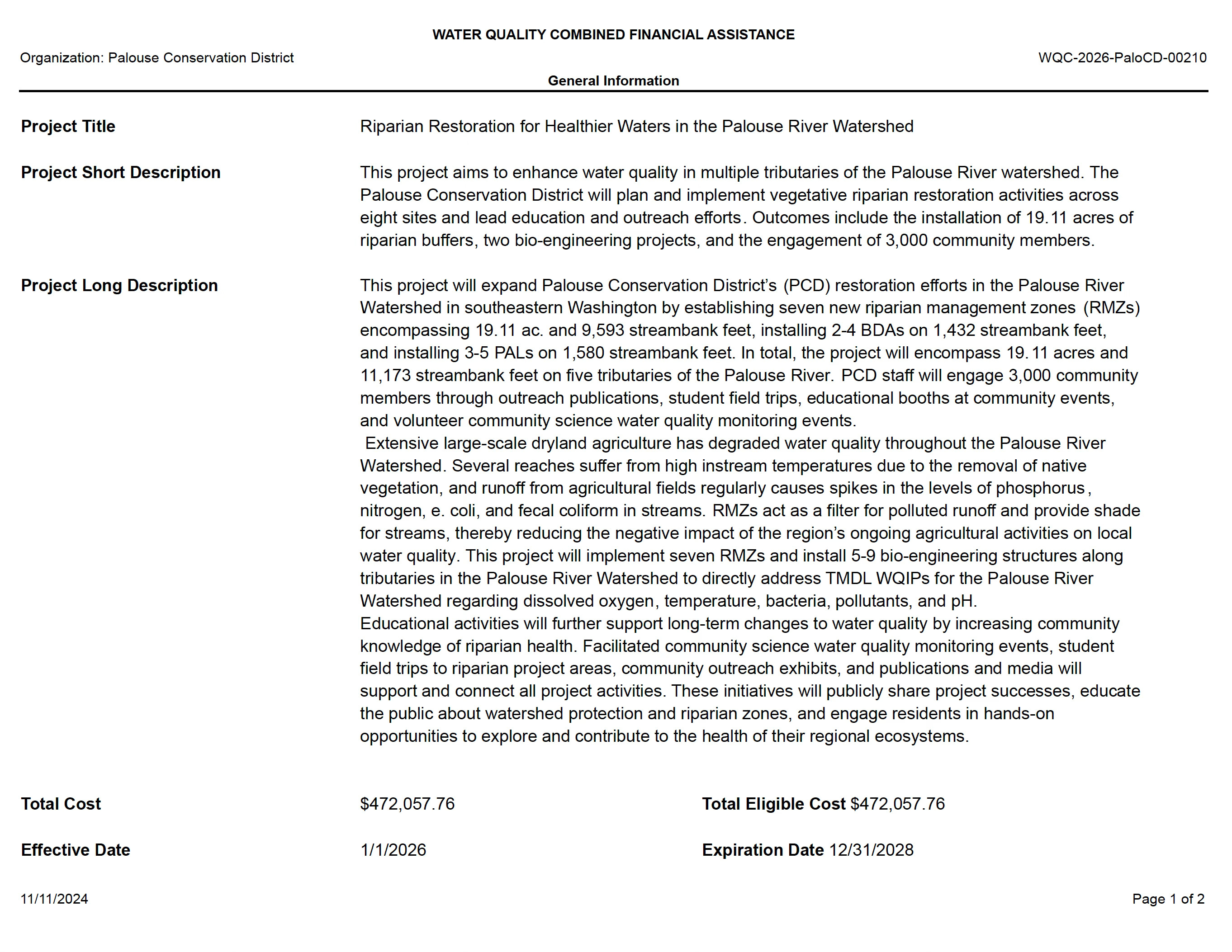
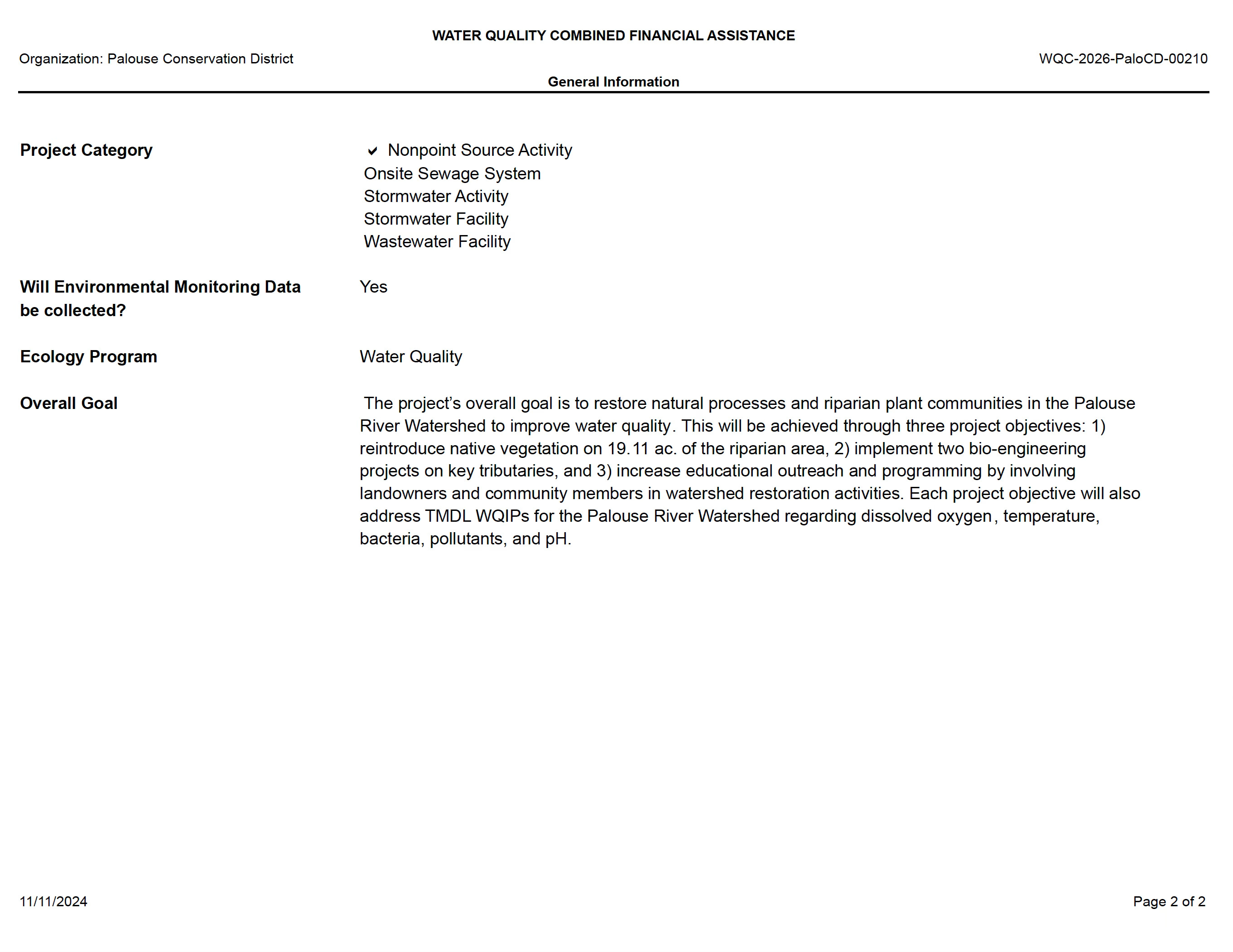
The project proposes the installation of 19.11 acres of riparian buffers and related restoration practices across multiple tributaries in the Palouse River watershed.
These activities are explicitly tied to Clean Water Act implementation and are designed to:
Address TMDL Water Quality Improvement Plans (WQIPs)
Improve temperature, dissolved oxygen, bacteria, nutrients, and pH
Contribute to watershed-scale pollutant reduction goals
Rather than relying on parcel-level pollutant measurement, the program uses standardized conservation practices—such as riparian buffers and vegetation systems—implemented across multiple sites using established design criteria.
These practices are then translated into quantifiable pollutant reductions through accepted modeling frameworks.
In other words:
Installed practices become federally reported outcomes.
This distinction is critical.
Federal programs permit modeled reductions. Direct measurement is not always required.
However, when modeled reductions are:
Derived from standardized practices
Applied across multiple sites
Reported annually as federal outcomes
Implemented within a system that also includes enforcement escalation
the relationship between field conditions, implementation decisions, and reported outcomes becomes central to program transparency.
The question is whether that relationship remains consistently documented, traceable, and aligned with Clean Water Act planning requirements.
It identifies a critical point of alignment:
whether federally reported water quality improvements—generated through modeled assumptions tied to best management practice installation—are consistently supported by documented site conditions and integrated within a clearly defined Clean Water Act planning framework.
As implementation expands across multiple watersheds, that alignment is not merely technical.
It is foundational to how federal environmental outcomes are measured, reported, and understood.
Federal Scrutiny Is Already Active
This investigation unfolds amid documented federal concern regarding Washington’s agricultural enforcement posture.
EPA Region 10’s Regional Administrator wrote:
“Where Washington is implementing programs overseen by the EPA, we expect that you will stay within the appropriate jurisdictional bounds.”
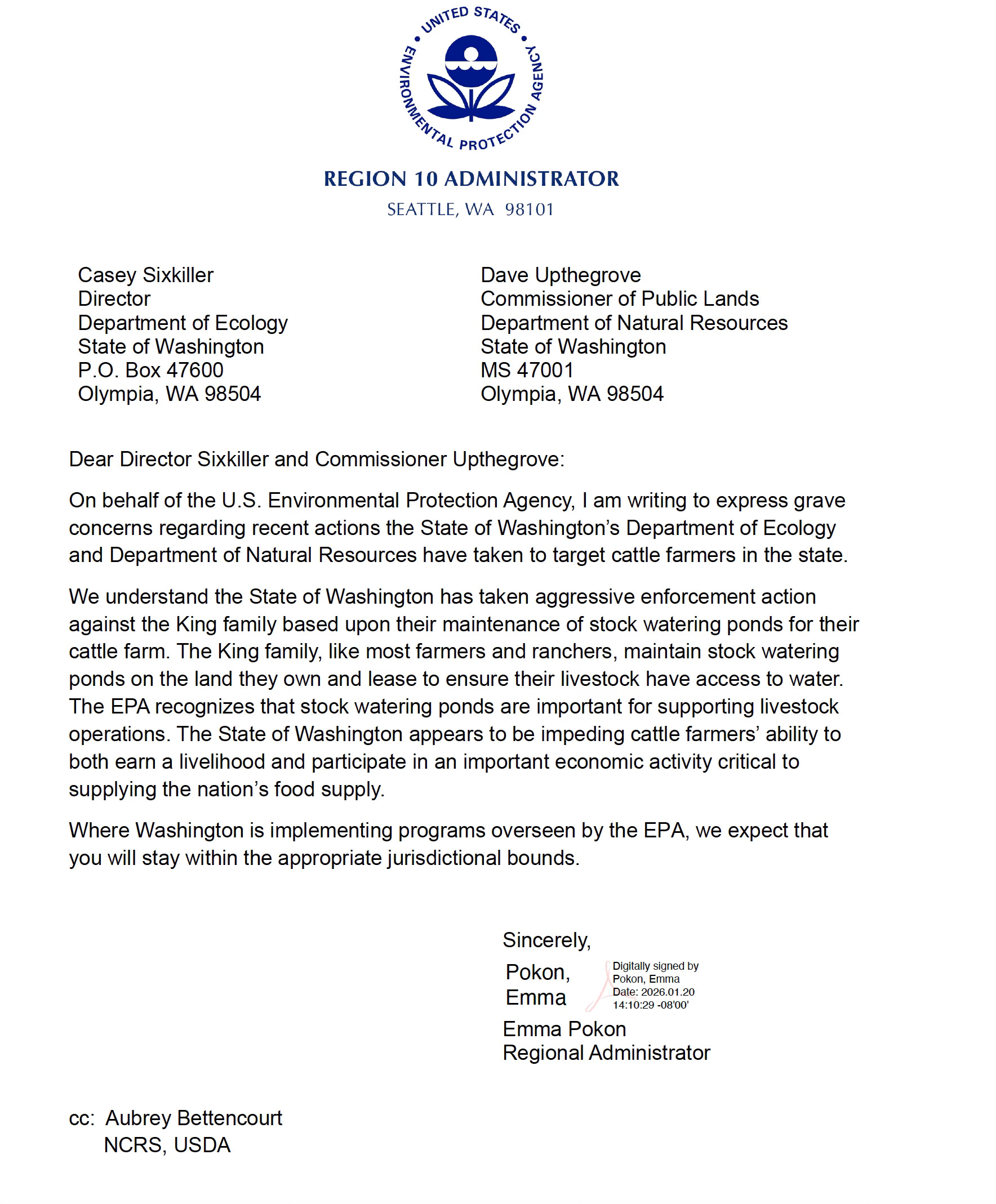
This statement does not allege violation.
It confirms that federal agencies are actively evaluating how state-level enforcement operates within federally overseen program boundaries.
Separately, the U.S. Secretary of Agriculture stated:
“USDA is reviewing funding it provides to the state of Washington and any institutions within it that may be weaponized against farmers and ranchers…”
USDA Letter to Washington State…
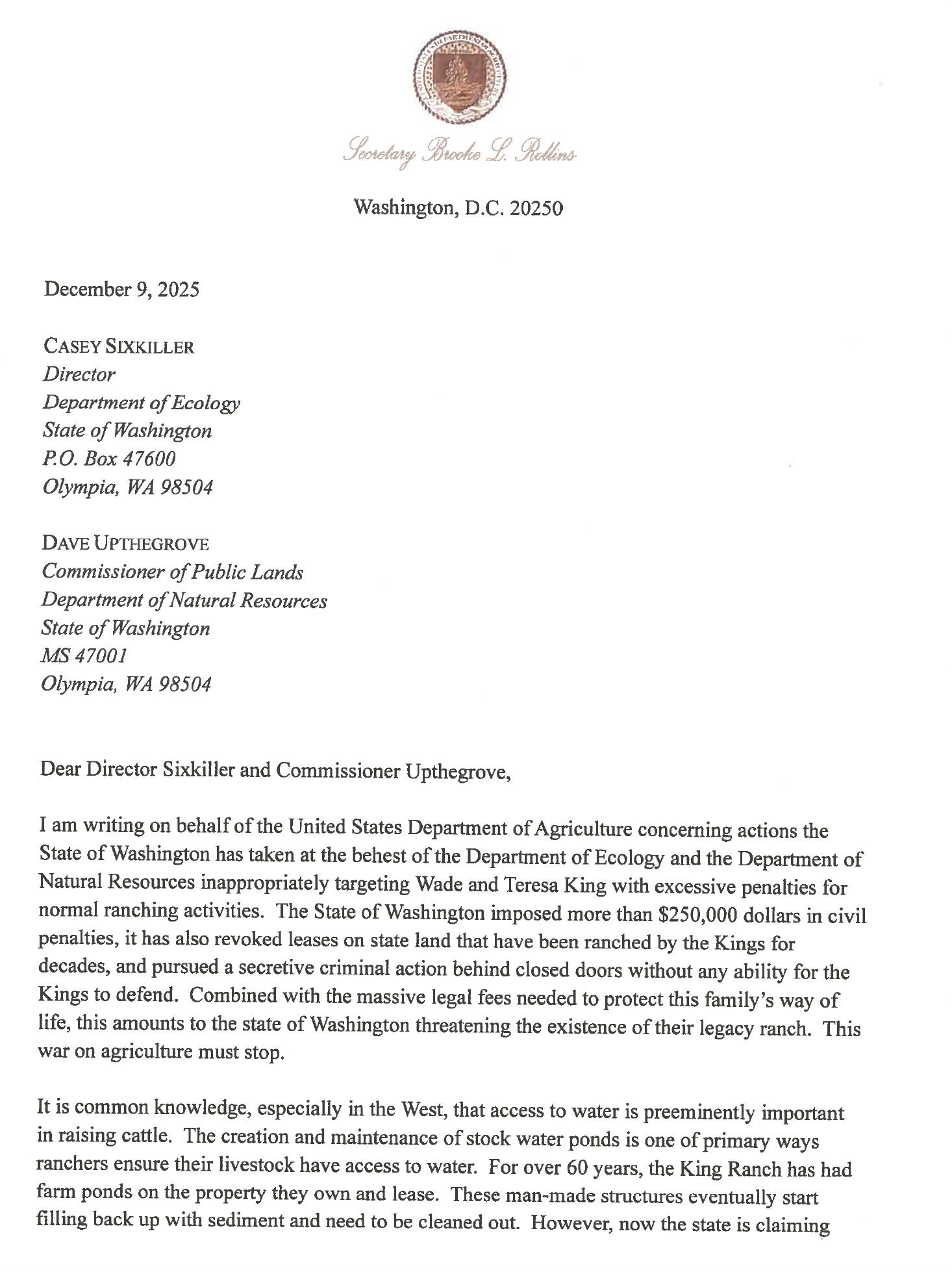
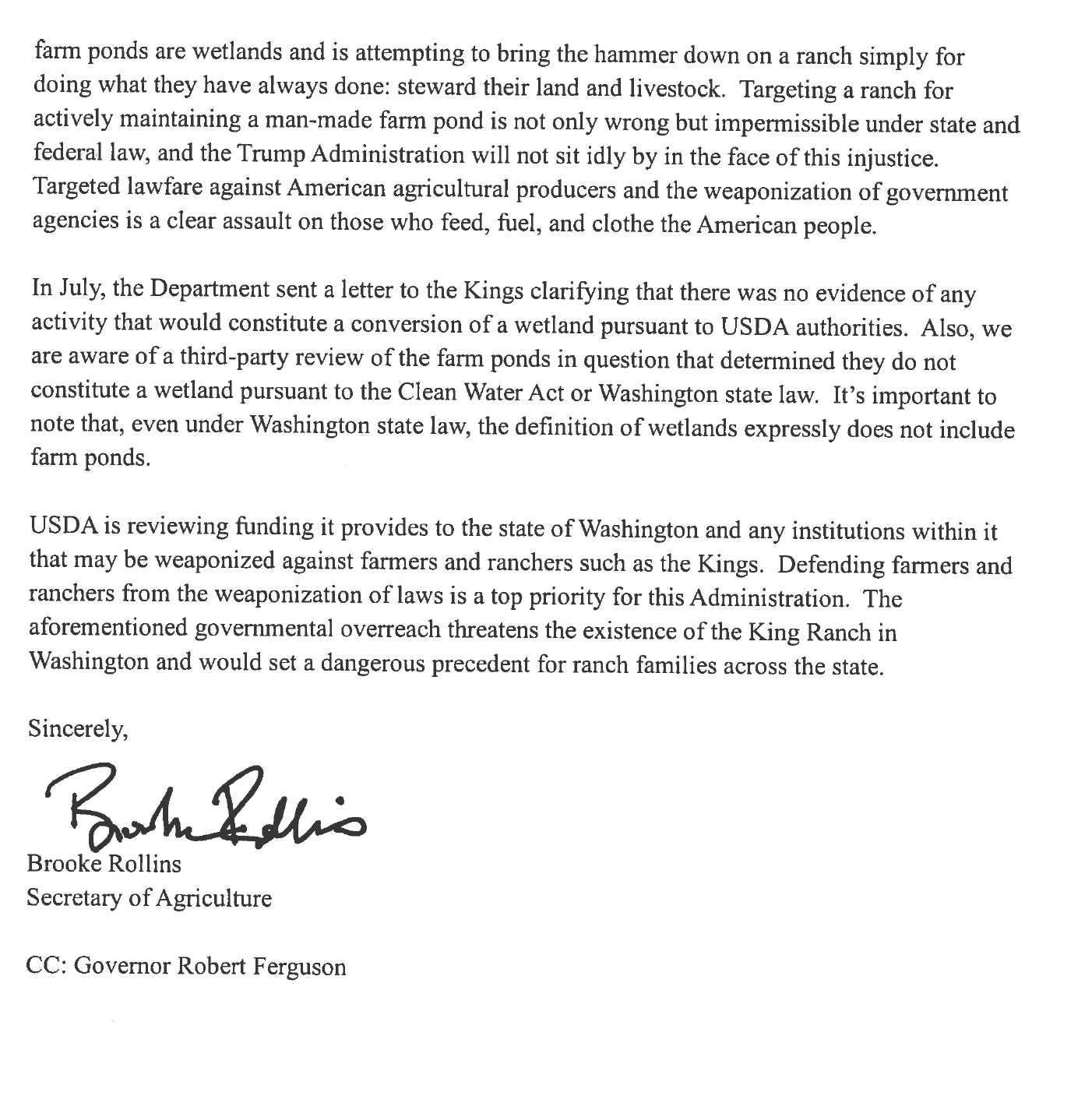
These letters concern other enforcement contexts.
But they establish a broader institutional environment:
Federal agencies are actively reviewing how Washington exercises authority within federally overseen agricultural programs.
Spring Flat Creek’s STI model integrates:
EPA-delegated Clean Water Act authority
Federally conditioned §319 funding
State enforcement under RCW 90.48
Implementation sequencing prior to completed TMDL allocation
Within that environment, alignment clarification is not speculative.
It is institutional.
From One Watershed to a Statewide Implementation Model
On March 11, 2026, the Washington Cattlemen’s Association hosted a virtual town hall with officials from the Washington State Department of Ecology to discuss updates to the state’s Nonpoint Pollution Plan.
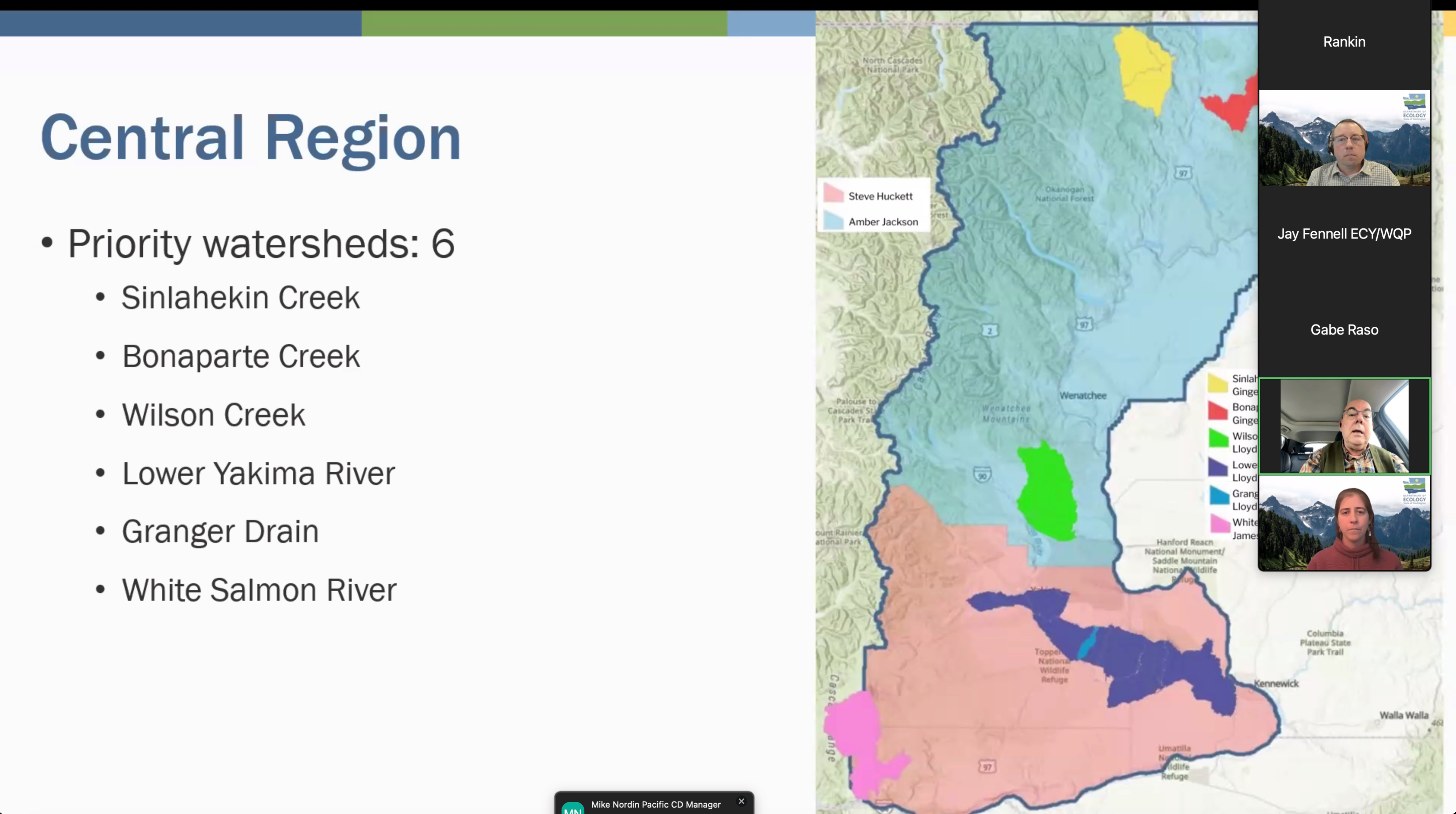
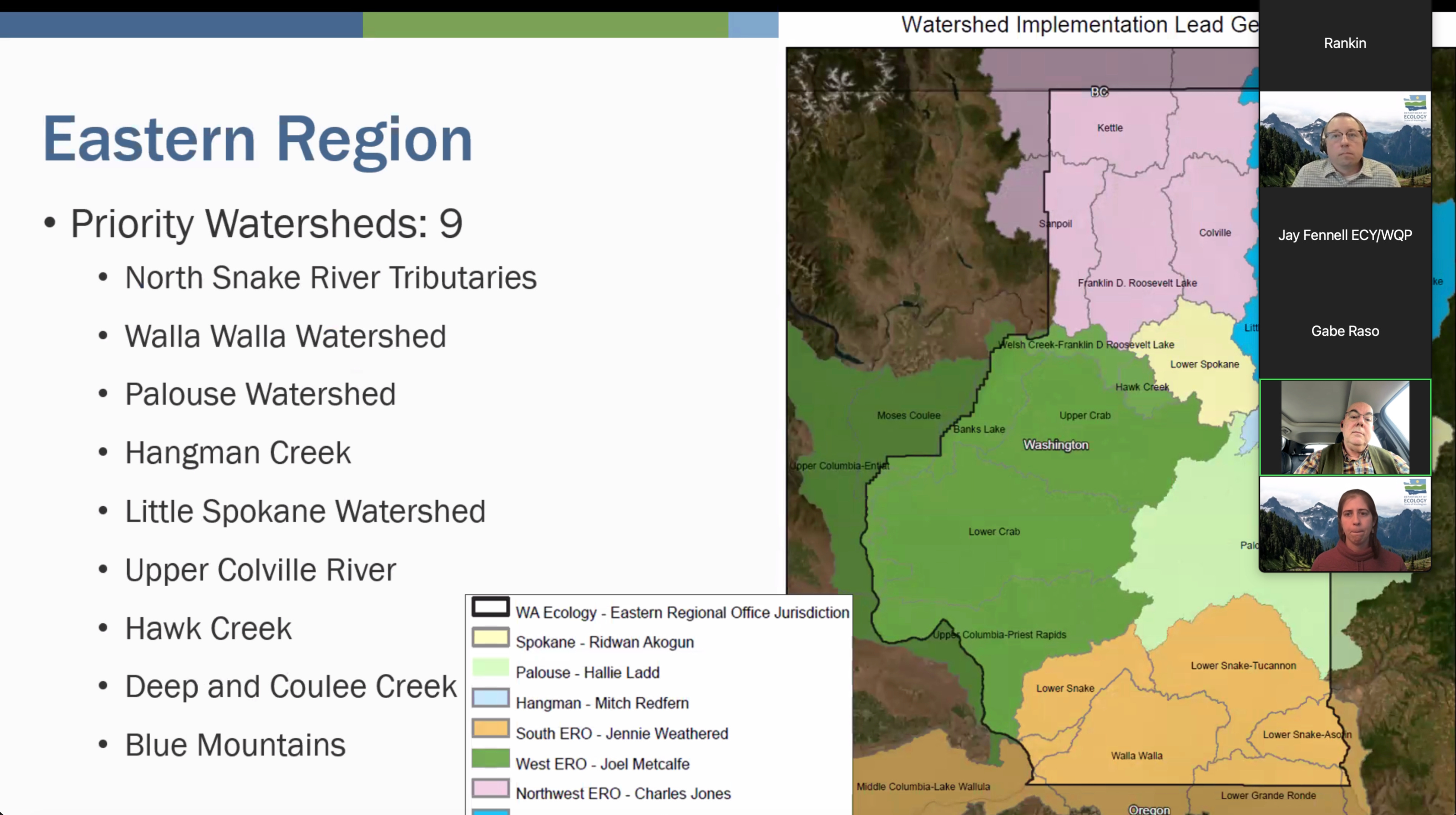
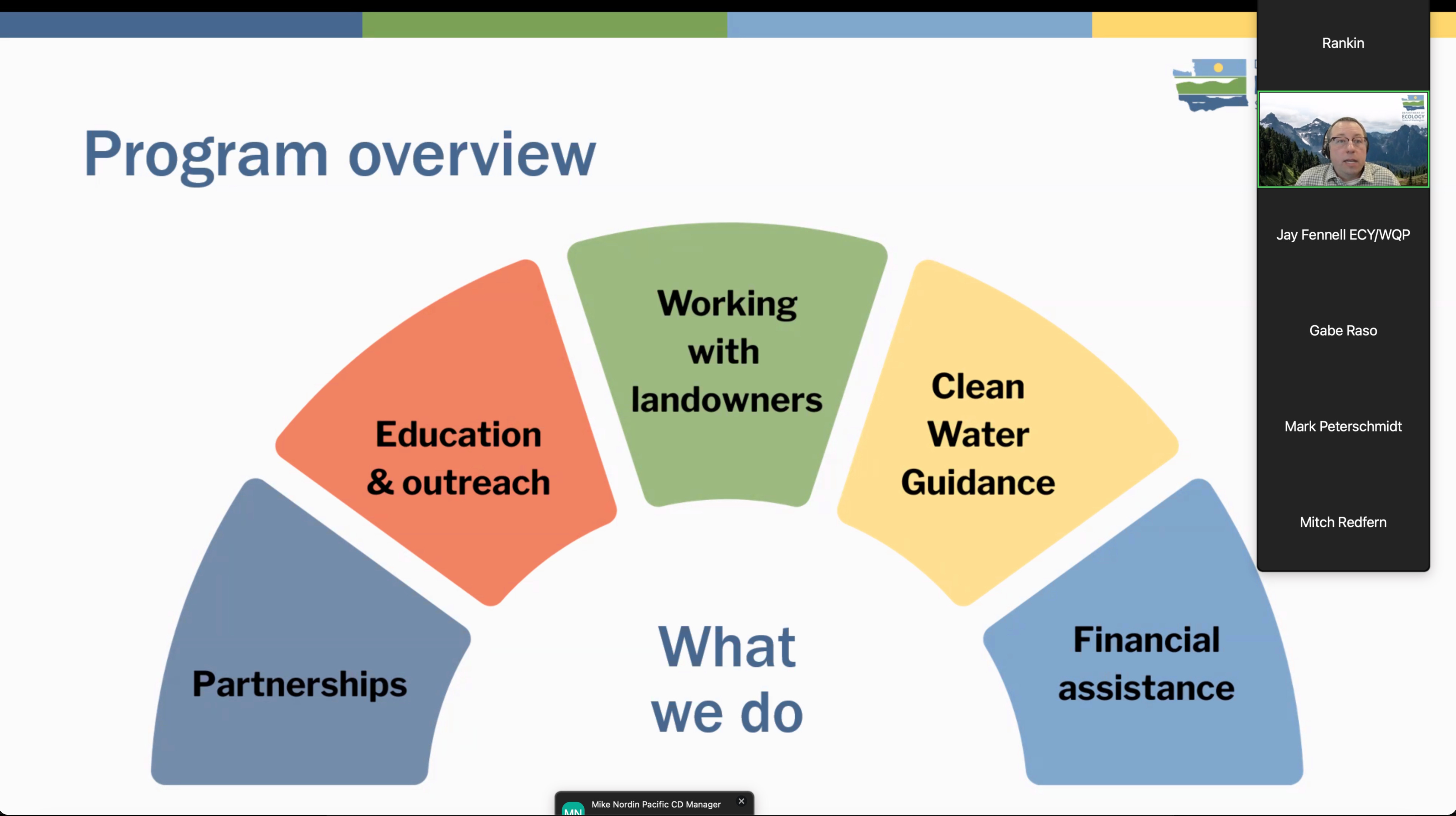
During that meeting, Ecology described a program structure that extends beyond any single watershed—one that mirrors the structure documented in Spring Flat Creek.
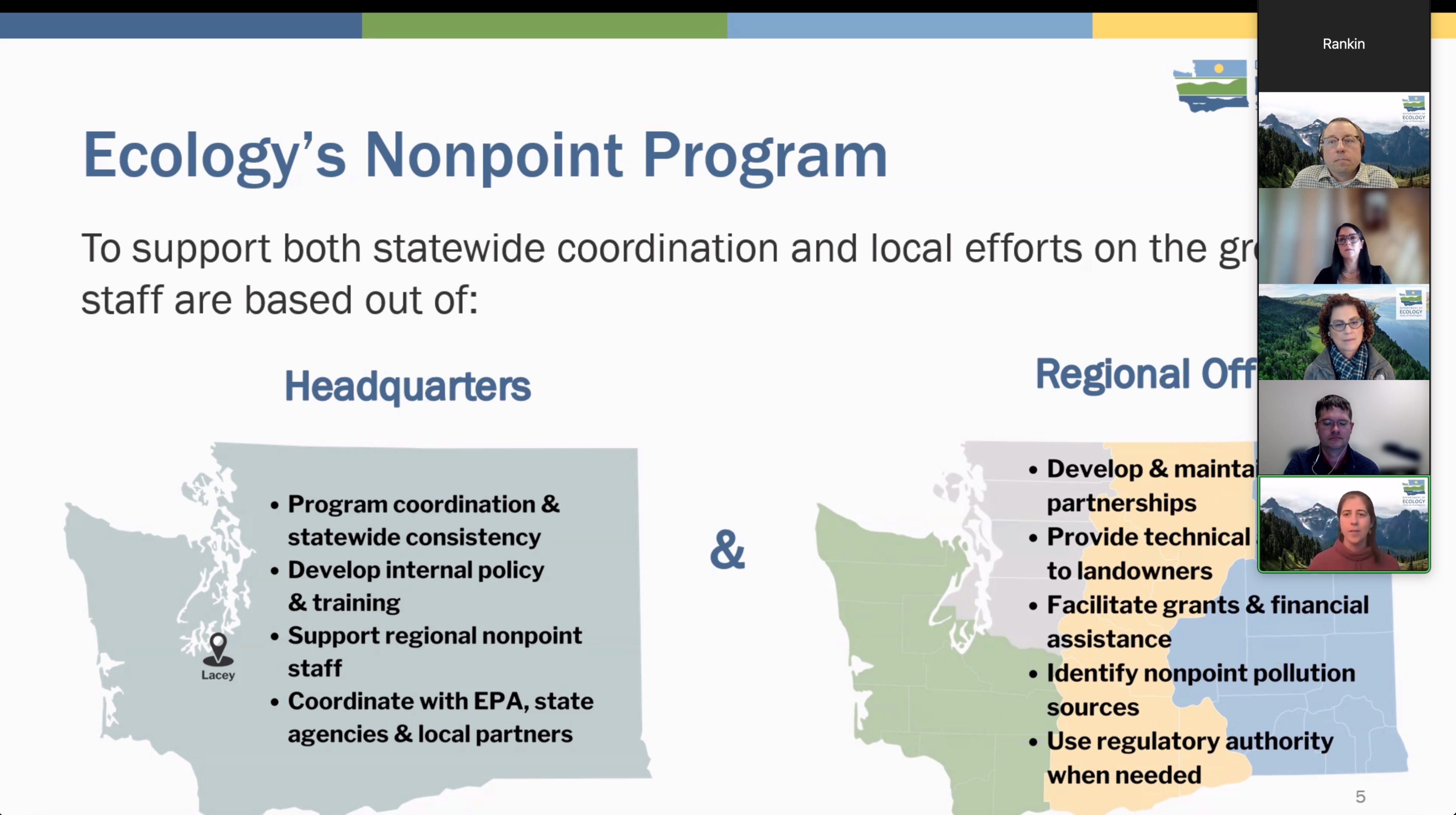
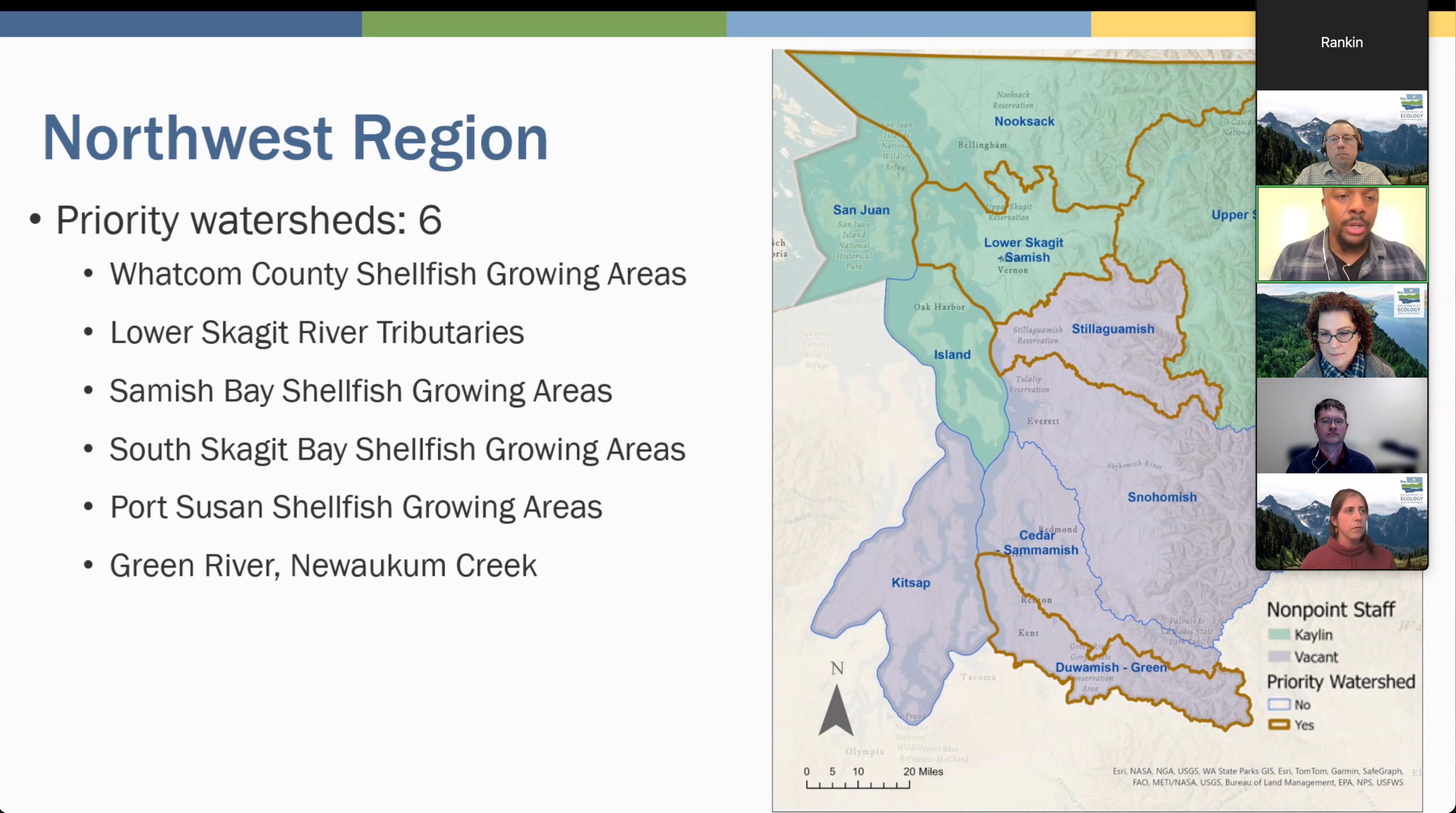
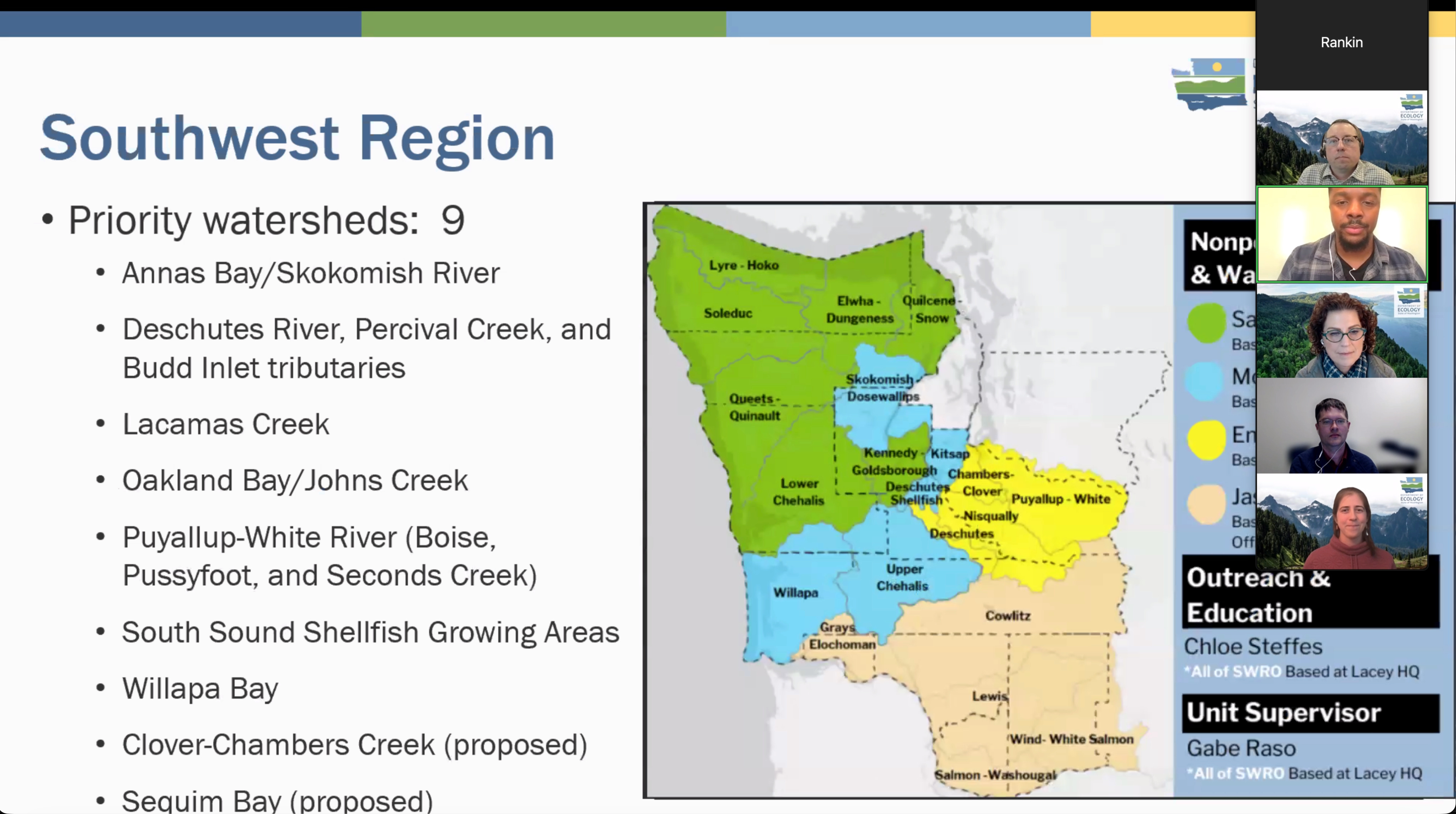
Agency representatives outlined a consistent operational approach:
Identification of “priority watersheds”
Field-based watershed evaluations
Site-level identification of conditions linked to potential pollution
Delivery of technical and financial assistance
Escalation to enforcement where voluntary measures are not adopted
This description closely mirrors the structure documented in Spring Flat Creek.
In both contexts, properties are identified through watershed surveys, evaluated using similar visual criteria, and engaged through a sequence of outreach and escalation that can ultimately reference state enforcement authority under RCW 90.48.
What emerges is not a localized enforcement anomaly.
It is a repeatable implementation framework.
Spring Flat Creek is not unique in its structure.
It provides a clear, documentable example of a broader implementation model.
The consistency between field-level documentation and agency descriptions suggests that this structure is not incidental.
It is programmatic.
The Voluntary Framework and the Enforcement Backstop
Throughout the meeting, Ecology repeatedly emphasized that its approach is “voluntary first,” with enforcement described as a last resort.
However, agency officials also confirmed the existence of a clear escalation pathway. Nonpoint program supervisor Ben Rao described the sequence this way:
“We do have a gradual escalation process. So if the problem isn’t being addressed, we’ll give multiple times trying to talk with you on that education outreach technical assistance route. And then at a certain point, we escalate to a warning letter and then it would go to an order.”
Eastern Region watershed unit supervisor Mitch Redfern provided concrete numbers from the Hangman watershed (a priority watershed using the same framework):
“We’ve prioritized 108 sites now that we’ve been actively working with individually on plans and out of those 108 sites, we’ve issued regulatory enforcement actions on five.”
When asked directly about the risk of another “King Ranch situation” for landowners who decline the voluntary route, Mitch added:
“We really try really hard to find an agreement on a plan… I hate getting to that point because it really bogs us down. I’d much rather meet on a site and come up with a plan that works for everybody and we can get funded.”
Technical assistance, cost-share funding, and cooperative engagement were presented as the primary tools of the program.
However, the agency also confirmed the existence of an escalation pathway:
Initial outreach
Follow-up technical assistance
Warning letters
Potential administrative orders or penalties under state law
This structure is consistent with the enforcement pipeline observed in Spring Flat Creek.
The distinction between voluntary participation and compelled compliance is not binary.
It is sequential.
Participation may begin as voluntary.
It may become mandatory if concerns remain unresolved.
That sequencing is central to understanding how implementation occurs on the ground—and how federally supported voluntary programs interact with state enforcement authority under RCW 90.48.
Watershed Identification and Property Selection
A recurring element in both the Spring Flat documentation and the March 11 meeting is the concept of properties being “identified” during watershed evaluations.
Ecology confirmed that field teams conduct watershed-level surveys to identify locations where conditions are likely to contribute to water quality impairment.
Those properties are then prioritized for outreach.
What remains less defined is the methodology behind that identification process:
Whether a standardized scoring system is used
How properties are ranked or prioritized
What data is recorded at the time of identification
How those determinations are documented and communicated
In Spring Flat Creek, letters reference underlying field data, maps, and photographs that are available upon request but not routinely provided.
The same identification language appears to be used across watersheds.
Landowners at the town hall raised this exact concern. Scott Nielsen stated:
“I think those letters, regulatory letters was the first outreach that most of the people were aware of. I don’t think you guys are doing… outreach by ecology to the ag groups locally at all.”
Mitch Redfern acknowledged the gap:
“It would have been nice if we would have done more outreach ahead of us doing some implementation work out there or mailing letters to folks… that feedback was well received… we should be doing more engagement.”
As the program expands statewide, the transparency and consistency of that identification process become increasingly relevant to both producers and oversight agencies.
The Structural Convergence
The following convergence is documented:
Spring Flat Creek is Category 5 impaired.
TMDLs are required under federal law.
STI implementation proceeds before TMDL completion.
Enforcement letters rely on visual indicators under state authority.
Numeric buffer widths are operationalized parcel-by-parcel.
§319 funding requires annual modeled load-reduction reporting.
Federal agencies have raised jurisdictional and funding oversight concerns in related contexts.
Each component independently may be defensible.
Taken together, these elements describe a system in which federal funding, federal planning requirements, and state enforcement authority operate simultaneously—rather than sequentially—within the same watershed framework.
The intersection of all components is what warrants transparency review. As Hannah Coe, statewide nonpoint policy lead, explained during the town hall, the Nonpoint Plan update itself exists to maintain federal funding eligibility:
“The Nonpoint Plan… is required by EPA to describe how we meet Clean Water Act requirements and ensures our eligibility for that grant loan funding… Updating this plan allows us to stay eligible to receive the funding that ultimately we are then able to provide to partners and to landowners…”
Oversight in such circumstances is not adversarial.
It is procedural confirmation of alignment.
Yanasa TV has receipts for all Structural Convergence issued mentioned above.
Why This Matters Beyond One Watershed
Spring Flat Creek is small.
The regulatory architecture is not.
If accelerated implementation models that integrate enforcement escalation and federally reported load reductions become normalized without transparent allocation scheduling and modeling publication, the implications extend beyond Whitman County.
This is not about resisting water quality improvement.
It is about ensuring that improvement and statutory compliance advance together—particularly when Ecology’s own staff have confirmed the reliance on visual screening, the existence of an enforcement backstop, and the direct linkage between the Voluntary Clean Water Guidance and both compliance presumptions and funding decisions..
Conclusion
Washington’s Straight-to-Implementation model may accelerate environmental progress.
State enforcement authority under RCW 90.48 is real.
EPA permits modeled reductions for nonpoint source pollution.
Early action on impaired waters is encouraged.
None of these principles are in dispute.
The question is narrower:
When federally conditioned funding, nondiscretionary TMDL planning obligations, and enforcement mechanisms converge prior to completed allocation modeling, are documentation, sequencing, and reporting fully aligned?
The question is not whether these tools are permissible. The question is whether they are operating in coordinated alignment.
Congressional oversight, EPA review, or Inspector General examination would not presume violation.
They would confirm whether federal planning duties, funding conditions, modeling assumptions, and enforcement sequencing operate in coordinated compliance.
Water quality improvement and federal alignment are not competing goals.
When federal law and federal funds intersect with state authority, transparency is foundational governance.
This investigation continues. The documentation trail is expanding.
Documentation Reviewed
This analysis is based on review of:
Spring Flat Creek STI Final Draft
Enforcement letters (Germain, Yenna, McKean)
Site visit buffer mapping correspondence
Palouse Conservation District §319 grant materials
EPA Region 10 correspondence
USDA correspondence regarding federal funding review
Attendance Western Cattleman’s Association Town Hall Meeting with DOE
All cited materials are retained as part of the investigative record.