



Stokes County Hits Reset on Massive Data Center — Rural North Carolina Draws a Line
In the rolling hills and quiet hollows along the Dan River in northern North Carolina, something rare just happened.
Hundreds of locals packed county meetings. Signs lined the back roads. Petitions carried thousands of names from families who’ve worked this land for generations. And for once, the machine paused.
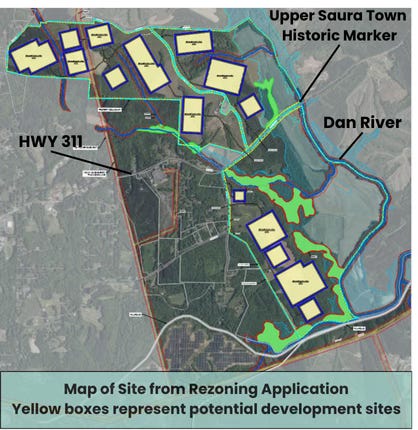
On January 12, 2026, the Stokes County Board of Commissioners voted 3-2 — against their own planning board’s recommendation — to rezone roughly 1,845 acres of rural-agricultural land near Walnut Cove for heavy manufacturing. The project, known as Project Delta, would have cleared the way for a massive hyperscale data center complex to support AI, cloud computing, and the endless hunger of the digital world.
Then residents fought back with a lawsuit. This week, the county admitted the public notice for that January hearing didn’t meet state law requirements. Commissioners voted to void the rezoning and related text amendment, sending the land back to its original zoning and forcing the entire process to start over.
On paper, it’s a procedural correction.
In the hearts of the people who call this place home, it feels like a line drawn in the red clay:
This is our land. Not just cheap ground for whoever writes the biggest check.
The Proposal That Felt Like an Invasion
The plan was straightforward for the developers: rezone nearly 1,845 acres off US 311 near the Dan River, much of it currently residential-agricultural. The vision included warehouse-scale buildings filled with servers running 24/7, heavy power demands, and industrial infrastructure on land that has long grown crops, supported families, and held deep cultural roots.
To some county leaders chasing new revenue streams, it looked like economic development in a rural area that needs it.
To the families who still farm here, hunt these woods, sit on porches listening to whippoorwills at dusk, and trace their history back generations, it felt like the slow erasure of everything that makes Stokes County worth staying in.
Supporters argue the project could bring significant tax revenue and infrastructure investment to the county. But residents weren’t convinced the trade-offs were worth it.
What People Were Really Fighting For
Opposition didn’t come from one complaint — it grew from everything at stake:
Farmland and generational legacy — Once rezoned for heavy industry, productive soil rarely returns to farming. This isn’t blank slate land. It sits near historic Hairston family sites and areas tied to the Saura people. Descendants and local historians worried sacred ground and buried history could be lost forever under concrete.
The quiet life slipping away — Constant noise from cooling systems, increased truck traffic on back roads, bright lights at all hours, and the visual wall of industrial buildings where open fields and tree lines used to stretch. The slow erosion of the peace that defines rural living.
Pressure on resources — These facilities demand enormous electricity and significant water use for cooling, depending on the design. In farm country already balancing crops, livestock, and existing infrastructure, people asked a simple question: When resources get tight, whose needs come first?
Hundreds showed up to speak. Thousands signed petitions. Grandparents, farmers, veterans, Hairston descendants, and everyday working people — not radicals, just folks who wanted their voices heard before the bulldozers rolled.
They forced the conversation to matter.
What the Reset Actually Means
The county didn’t kill Project Delta. The developer (through Engineered Land Solutions) can still revise and resubmit.
But they bought something precious in these fights: time.
Time for real public input. Time for deeper questions about long-term impacts. Time for the community to organize instead of being rushed through a narrow 3-2 vote.
In rural land-use battles, time can be the difference between a decision that can’t be undone and one that actually reflects what the people who live here want.
This Isn’t Just Stokes County
Across rural America, the same pressure is building. Cheap land, smaller populations, and big promises from data centers, energy projects, and logistics hubs. The AI boom isn’t slowing — it’s accelerating, and more counties will face similar proposals in the years ahead.
The deeper question keeps surfacing:
What is this land actually for?
Is it for growing food, raising families, preserving a way of life already growing rare — or is it just the next available plot for whatever the global economy demands next?
For now, the fields along the Dan River in Stokes County are still fields. The river still flows. The nights are still quiet enough to hear the whippoorwills.
But everyone knows the pressure isn’t gone.
And for once, the people who actually live on the land forced the conversation to slow down — before a decision was made that can’t be undone.