



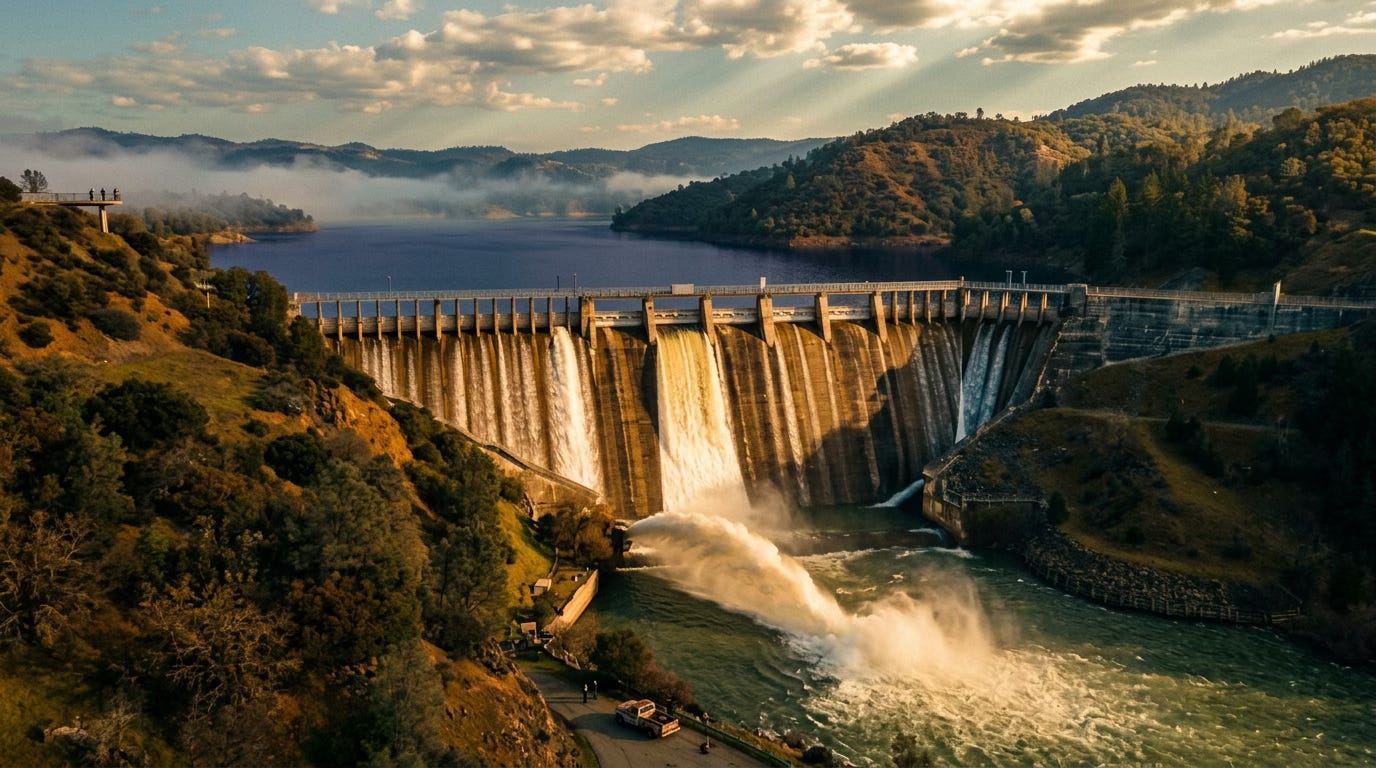
For more than a century, two modest dams on the Eel River — Scott Dam, which created Lake Pillsbury, and the smaller Cape Horn Dam — have quietly powered homes and farms across Northern California. Through the Potter Valley Project, they divert water from the Eel River watershed into the Russian River system, supplying drinking water and irrigation for roughly 750,000 people while generating clean hydroelectric power.
Pacific Gas & Electric (PG&E) now wants the dams gone. The utility filed to surrender its Federal Energy Regulatory Commission (FERC) license years ago, citing economics and aging infrastructure. Environmental groups, tribes, and Governor Gavin Newsom have long championed removal as a way to restore salmon runs.
But a new development has upended the narrative.
In a recent in-depth interview with Yanasa TV, Dr. Rich Brazil — a longtime Potter Valley veterinarian, rancher advocate, and chairman of the Save Potter Valley Project — revealed that a legitimate buyer has been quietly pursuing the entire project since at least January 2026. The buyer: the Elsinore Valley Municipal Water District, a Southern California agency based hundreds of miles south in Riverside County.
According to Brazil, representatives from Elsinore met with PG&E shortly after meeting U.S. Agriculture Secretary Brooke Rollins. They arrived prepared to sign nondisclosure agreements and make a formal offer. PG&E, Brazil said, discouraged them — warning of crumbling infrastructure, potential lawsuits from environmental groups like Friends of the Eel River, and massive liability. The district representative reportedly responded that they understood the risks and were still interested. PG&E, Brazil claimed, continued to stall.
Only after the Trump administration and USDA went public did PG&E begin showing “a little more flexibility,” Brazil said.
The Alleged Quid Pro Quo
Brazil’s most explosive claim goes far beyond the buyer.
He alleges that in the aftermath of the 2018 Camp Fire — which killed 85 people and led to PG&E’s conviction on 84 counts of involuntary manslaughter — the utility and Governor Newsom struck a private understanding. Out of that meeting, Brazil said, came two things: PG&E reversed its earlier resistance and agreed to pursue dam removal; in exchange, Newsom’s administration fast-tracked legislation (AB 1054) that shielded PG&E from massive wildfire liability.
The bill, signed by Newsom in July 2019, created the California Wildfire Fund. It allowed utilities to limit their exposure to catastrophic fire claims in exchange for safety certifications and contributions to a ratepayer-backed pool. Investigative reporting by ABC10 later revealed that Newsom’s office hired the New York law firm O’Melveny & Myers — which had previously represented PG&E — to help draft the language.
Newsom has publicly tied the dams to his environmental agenda. In his January 2024 salmon recovery strategy, he specifically named Scott Dam and Cape Horn Dam, pledging to complete agreements for their removal (or modification) within 18 months — a move he framed as restoring the longest free-flowing river in California and bolstering his national profile.
Brazil argues the timing is no coincidence: PG&E had previously explored selling the project and found no takers. Now, with a serious buyer on the table, the utility is still dragging its feet — even though the project reportedly loses $5–7 million annually, decommissioning could cost ratepayers more than $532 million, and the utility faces ongoing litigation from environmental NGOs.
“Why wouldn’t a rational company jump at the chance to offload a money-losing, lawsuit-plagued asset?” Brazil asked in the interview.
PG&E’s Position and the Public Record
PG&E has confirmed it met with Elsinore Valley officials earlier this year but states it has not received a formal purchase proposal. A spokesperson told multiple outlets the company remains “open to reviewing and considering any proposal from an entity… that have the technical and financial capability to own and operate the dams.”
The utility maintains that decommissioning is the responsible path forward, consistent with its long-standing plan and stakeholder agreements that include local water agencies, tribes, and environmental groups.
Environmental organizations and some local tribes have expressed alarm at the sudden Southern California interest, fearing it could lead to water exports out of the basin or complicate restoration efforts.
Federal Intervention Changes the Game
The buyer revelation did not emerge in a vacuum. Since late 2025, the Trump administration has aggressively intervened. Secretary Rollins filed formal comments with FERC opposing license surrender and highlighting impacts on agriculture, rural communities, and National Forest lands. In April 2026, she publicly touted Elsinore Valley as “a legitimate buyer” on X, stating the administration was exploring ways to keep the dams operating for both water supply and expanded hydroelectric generation — potentially including new capacity at Lake Pillsbury.
USDA has emphasized working in coordination with the Department of the Interior, framing the effort as protecting food security, power reliability (especially amid growing AI energy demands), and rural economies.
Local stakeholders like Brazil credit Rollins and NRCS Chief Aubrey Betancourt with giving rural voices a seat at the table for the first time.
Why This Matters
At stake is far more than two aging dams. The Potter Valley Project represents a century-old water compact that supports farms, ranches, towns, and firefighting reservoirs across multiple counties. Removal would drain Lake Pillsbury, eliminate the diversion, and — critics argue — provide uncertain benefits to fish while delivering a severe blow to agriculture and reliable summer water supplies.
The story also crystallizes deeper tensions in California: urban environmental priorities versus rural economic survival, one-party state politics versus federal oversight, and the question of whether major infrastructure decisions are being driven by science, economics, or political ambition.
Brazil does not mince words. He sees manufactured narratives around “fish” and “tribes” (selectively applied, he says) as cover for a larger agenda. Whether one fully accepts that framing or not, the optics are striking: a willing buyer surfaces, the numbers appear to favor a sale, yet progress toward removal continues — until federal sunlight forces the issue into the open.
PG&E, the governor’s office, and FERC have not yet responded directly to the specific allegations raised in the Yanasa TV interview. The public deserves full transparency: any communications surrounding the alleged post-fire meeting, the full details of Elsinore Valley’s interest and proposals, and a clear explanation of why a money-losing asset with a ready buyer remains on the chopping block.
As FERC weighs the license surrender and the Trump administration pushes alternatives, one question lingers over the Eel River:
If a credible buyer wants to keep the dams, the water, and the power — why is that still so difficult to make happen?