



Iranian state media has confirmed the death of Supreme Leader Ali Khamenei, and announced a 40‑day mourning period. That single confirmation didn’t just change politics—it hardened what markets were already beginning to price: heightened disruption risk around the Strait of Hormuz.
This is not a “Will America run out of food?” story.
The United States remains a major exporter of grains and meats. We’re not running out of calories.
This is a cost‑structure story.
And cost structures move before most headlines do.
If you want to understand what this war means for your grocery bill and the rural economy, skip the cable shouting and follow three things:
Insurance
Freight
Fertilizer
That’s where the squeeze begins—and why it hits rural America first.
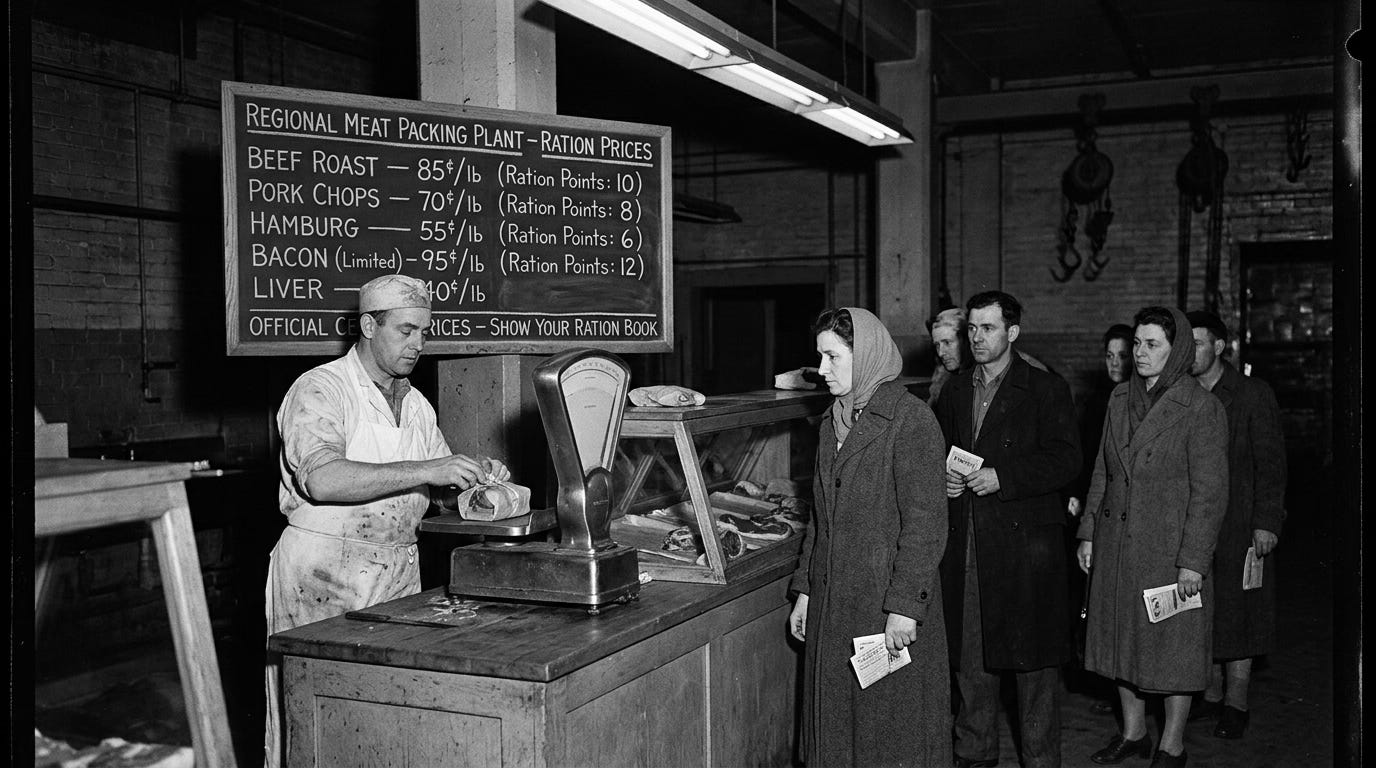
Where we’re starting from: not 2019
Before this war shock, USDA’s 2026 outlook already projected:
All food: +3.1%
Food at home (grocery): +2.5%
Food away from home (restaurants): +3.7%
And certain categories were already expected to run hot:
Sugar and sweets: +6.7%
Nonalcoholic beverages: +5.2%
Translation: we were already in an era of elevated food prices. This war is less “starting a new fire” and more “throwing another log on the one that’s already burning.”
The Hidden Blockade
Here’s the part that will decide whether this becomes a short, sharp price jolt—or a longer, stickier squeeze:
Insurance is the legal and financial backbone of shipping.
Reports indicate multiple marine insurers and P&I clubs are cancelling war‑risk coverage for vessels operating in Iranian and surrounding Gulf waters, effective March 5, 2026.
That matters more than missiles.
When war‑risk cover is withdrawn, ships don’t need to be physically blocked to stop moving. Operators and charterers can’t assume liability that insurers refuse to cover. Even without a formal “closure decree,” the world can still get a de facto choke point.
It has also been reported that the conflict has already disrupted maritime traffic, with at least four tankers damaged and roughly 150 vessels stranded or anchored in the region as risk spikes.
This is not yet a fleet collapse. The global tanker fleet is vast.
But you don’t need to sink the fleet to raise prices.
You just need to make the route uninsurable, unpredictable, or both.
Freight: The Immediate Tax
If you want to see war show up as a price tag, this is where it hits first.
The Middle East–Asia VLCC benchmark route (TD3C) has been nearing 12 million dollars per voyage, with rates nearly tripling since early 2026.
That is the invisible tax on energy and bulk commodities. And once energy and shipping costs rise, food costs follow—because modern food is “built” out of movement:
Inputs moved to farms
Crops moved to elevators
Livestock moved to processors
Packaged food moved to distribution centers
Refrigerated loads moved to stores
And on the consumer side, the U.S. fresh produce aisle is more import‑exposed than many realize: the import share of U.S. availability has grown to about 59% for fresh fruit and 35% for fresh vegetables (excluding potatoes, sweet potatoes, and mushrooms).
So what do Americans see first when freight gets weird?
Not “empty shelves.”
You see:
price spikes
thinner selection
vanishing promotions
substitution (your usual brand disappears; a more expensive alternative remains)
And you see it quickly.
Diesel: The fastest transmission mechanism
Diesel is the bloodstream of the food system—tractors, irrigation, grain hauling, refrigeration, rural distribution routes.
Recent reporting has diesel up roughly 17% amid the escalation narrative and Hormuz disruption fears.
A rural‑specific reality check: if a rural grocery is 50–100 miles from its distribution point, a diesel spike shows up in inbound freight fast—and that store spreads the increase over a smaller customer base than a metro big‑box. That’s how rural areas can feel inflation first and harder, even when “average CPI” takes time to catch up.
Fertilizer: The delayed fuse
If freight and diesel are the first wave, fertilizer is the fuse for the second wave.
Egyptian granular urea cargoes have recently sold at:
505 dollars per ton FOB (6,000t by Mopco)
495 dollars per ton FOB (6,000t by Alexfert)
for March loading—after prior assessments around 480–485 dollars per ton FOB in late February.
That’s a clean “war premium” repricing in real trade.
And the U.S. was already under pressure before the strikes, with urea back above the 600‑dollar level and averaging around 601 dollars per ton in mid‑February—before this escalation.
The underrated truth: the “we make it here” trap
Yes, the U.S. has significant domestic nitrogen production. But fertilizer is globally priced, and U.S. farmers pay into global benchmarks.
Analyses of USGS data show that net imports have accounted for roughly 6–13% of total U.S. nitrogen consumption since 2020, with import reliance projected at around 5.5% for 2024.
That’s real resilience compared to some other inputs.
But resilience is not insulation.
When global supply risk spikes, domestic product can chase global premiums, and domestic pricing follows. That’s why you can have “enough” fertilizer in aggregate and still see farmers paying far more—or facing delivery timing risk—right when timing matters most.
Market commentary has also highlighted how New Orleans (NOLA) urea values jumped from about 350 dollars to around 430 dollars per ton in less than six weeks heading into 2026, even as global supply conditions appeared to improve—because geopolitics kept the risk premium alive.
The hidden “credit limit” crisis
This is the rural choke point that almost never makes national coverage.
Farmers finance spring planting with operating lines established months earlier based on projected input costs. If diesel and fertilizer spike mid‑stream, the question becomes:
Do you still have enough approved credit to plant the crop you planned to plant?
If not, you’re forced into:
emergency conversations with community banks
higher interest costs
reduced input purchases
fewer acres, fewer passes, fewer upgrades
That’s how a war becomes consolidation pressure. Not in one dramatic collapse—but in quiet attrition.
The Corn vs. Soy pivot
Corn is nitrogen‑hungry. Soybeans fix nitrogen.
If nitrogen stays expensive or volatile into planting decisions, it becomes rational to shift acreage away from corn toward soybeans. That matters because corn is foundational to the U.S. livestock complex—feed for poultry, hogs, dairy, and beef finishing.
This is how fertilizer turns into meat inflation: not overnight, but with a lag.
Who gets squeezed in rural America
Not everyone equally. That’s the point—and it’s why the “average consumer” narrative misses the real damage.
Independent livestock and mixed operations
Feed and freight move faster than the price they receive for finished animals. Margin compression hits first here.Custom haulers and small trucking outfits
Diesel spikes hit immediately; many contracts lag. They eat the volatility first.Rural groceries and dollar‑style stores
Lower volume, thinner margins, less ability to smooth wholesale jumps. Rural consumers feel the shelf price change sooner.
The nuance critics will raise—and we’ll answer in advance:
Some row‑crop producers may see partial revenue offsets if grain markets strengthen. But whether that helps depends on basis, hedges, and whether inputs were locked in pre‑spike. Many don’t get to “win”—they get to “lose less.”
Realistic scenarios
Here’s the most honest way to frame it: the war can “end” and the invoice can continue.
You can break it out like this:
Short disruption (weeks)
What changes: War‑risk premiums spike then partially ease.
Farm‑side stress: Diesel and fertilizer volatility; credit stress for some.
What consumers notice most: Produce, dairy, and restaurants jump first.
Prolonged disruption (2–6 months)
What changes: Insurance and freight stay elevated; backlogs build.
Farm‑side stress: Input costs stay high into decisions; more margin compression.
What consumers notice most: Imports and ingredients, menu repricing, fewer promos.
Chronic chokepoint risk (6–12+ months)
What changes: Risk premium becomes structural.
Farm‑side stress: Acreage or yield pressure possible; feed costs lift.
What consumers notice most: A “second wave” in meat, eggs, and processed foods.
The hinge isn’t the day the last bomb falls. The hinge is when shipping becomes reliably insurable and predictable again. The early‑March war‑risk cancellation date is exactly the kind of marker that tells you the risk premium is getting institutionalized.
Policy accountability
If Washington wants to claim it’s “protecting the American consumer,” here are the questions that matter:
Are insurers and diplomats actively negotiating war‑risk “buy‑back” structures to keep shipping legal and moving?
Are U.S. fertilizer plants running flat‑out, and are logistical bottlenecks (river, rail, terminal) being addressed?
If input costs surge mid‑season, will federal agencies pursue temporary relief measures for producers (diesel, credit, transport) rather than lectures about “efficiency”?
Will USDA revise guidance if this shock persists beyond a few weeks?
Are major meatpackers passing volatility downstream to contract growers, and who is absorbing risk in the supply chain?
Rural America deserves clarity—not slogans, not scapegoats, not another round of “you should have planned better” after the system reprices overnight.
Planning: A victory garden is a hedge, not a fantasy
A garden won’t fix diesel. It won’t fix fertilizer markets.
But it can carve out a corner of your budget that is less hostage to weekly trucking surcharges, especially for the categories that turn over fastest: produce and herbs.
High‑ROI crops (most regions):
greens (repeat harvest)
tomatoes/peppers (high value, preserve‑friendly)
beans (fresh or storage types)
squash (stores well)
onions/garlic (high utility)
potatoes/sweet potatoes (calorie‑dense, storage)
If gardening isn’t realistic, the same logic applies to:
CSAs
farmers‑market buying clubs
bulk staple purchases of what you already eat (not panic buying)
This isn’t panic. It’s household risk management.
Signals to watch in the next 30–90 days
If you want to know whether this becomes a Scenario 1 bump or a Scenario 3 grind, watch:
Do war‑risk insurance cancellations narrow or expand after early March?
Do fertilizer benchmarks continue to climb after March, or flatten? (Watch NOLA urea and downstream retail quotes.)
Does diesel stay elevated or normalize quickly?
Do planting intentions show meaningful corn acreage erosion?
Does USDA revise its food inflation path above the current baseline?
Final word
America will not starve.
But rural America can be squeezed first—through diesel, through fertilizer, through credit lines—long before urban consumers understand why their grocery bill jumped.
The war does not need to “close Hormuz forever.”
It only needs to keep risk elevated long enough for the food system’s cost structure to reset.
And once cost structures reset, they rarely reset back quietly.
The Second Wave: Modeling How the Iran War Could Reshape Food Prices Into 2027
Subscriber Deep Dive: In this extended analysis, we move beyond headlines and model what the second and third wavesof this conflict could look like for food prices, farm margins, and rural communities into 2027. We break down fertilizer stress scenarios, corn-versus-soy acreage pivots, protein price transmission timelines, rural credit pressure, and the consolidation risk most media outlets won’t touch. This isn’t speculation — it’s a forward-looking framework to help producers, investors, and households understand how diesel, freight, and nitrogen volatility translate into real-world decisions at the farm gate and real prices at the checkout line.
The public conversation is stuck on tankers and oil prices.
But for subscribers, we need to think one level deeper.
The first wave is diesel and freight.
The second wave is fertilizer and planting decisions.
The third wave — if it materializes — is protein inflation and structural margin compression.
Let’s model this step by step.
The Timeline Nobody Explains
Most people assume shocks hit immediately.
In agriculture, they move in stages.
Stage 1 (Weeks 0–8):
Freight volatility
Diesel spikes
Insurance uncertainty
Retail produce and restaurant pricing reacts
Stage 2 (Months 2–6):
Fertilizer pricing locked into planting decisions
Credit line adjustments
Acreage shifts
Feed contracts reset
Stage 3 (Months 6–18):
Harvest outcomes
Feed cost transmission
Livestock margin compression
Retail meat/dairy inflation
The second wave is the one policymakers underestimate.
Fertilizer Stress Modeling
Let’s run realistic scenarios.
Baseline:
U.S. nitrogen largely domestically produced.
Net import reliance ~5–6%.
Urea already elevated before escalation (~$600/ton mid-February).
Scenario A: Fertilizer +15% Sustained for 3–4 Months
Farm impact:
Most farmers absorb it.
Operating lines stretched but workable.
Slight reduction in nitrogen application on marginal acres.
Yield impact:
Minimal nationally.
Slight pressure on high-cost acres.
Consumer impact:
Modest second-wave feed pressure.
Meat inflation +1–2% above baseline later in 2026.
Scenario B: Fertilizer +25–40% Sustained Into Planting
Farm impact:
Acreage shifts away from nitrogen-heavy crops.
Reduced application rates.
Smaller operators cut back first.
Yield impact:
Corn yields soften.
Basis tightens regionally.
Feed costs rise materially.
Consumer impact:
Poultry and pork first.
Dairy next.
Beef last (lagged).
Meat inflation +3–5% above baseline into early 2027.
Scenario C: Chronic Disruption + Credit Stress
If freight + fertilizer + diesel all stay elevated simultaneously:
Smaller operations liquidate first.
Consolidation accelerates.
Contract growers absorb volatility.
This becomes less about CPI and more about structural rural reshaping.
Corn vs Soy — The Acreage Math
Corn:
High nitrogen requirement.
High input exposure.
Backbone of feed complex.
Soybeans:
Lower nitrogen dependence.
More resilient to fertilizer volatility.
If nitrogen volatility persists, rational behavior shifts acreage toward soybeans.
Let’s examine the implications:
Less corn acreage →
Tighter corn supply →
Higher feed costs →
Higher poultry and pork prices →
Higher grocery protein pricing.
Corn is the quiet hinge in this system.
The Protein Transmission Map
Here’s how it moves:
Fertilizer → Corn cost → Feed rations → Integrator pricing → Processor margins → Retail meat.
The lag:
Poultry: 2–4 months
Pork: 4–6 months
Dairy: 6–9 months
Beef: 9–18 months
That’s why meat inflation often shows up when the public thinks the “event” is over.
Rural Credit Stress — The Silent Accelerator
This is the risk that doesn’t show up in commodity charts.
If operating lines need to expand:
Banks reassess risk.
Interest rates matter.
Collateral matters.
Past performance matters.
Operators with strong balance sheets survive.
Operators already thin? They become price-takers under stress.
This is where consolidation accelerates.
And consolidation changes rural communities permanently.
The Export Feedback Loop
If global supply tightens:
U.S. grain exports increase.
Domestic prices firm.
Producers with surplus benefit.
But that also means:
Domestic livestock producers pay global feed pricing.
Rural protein-heavy regions feel more stress.
The system is interconnected. Protectionist reflexes (like export restrictions) could destabilize it further.
What Would De-Escalation Actually Fix?
Even if combat stops in 4 weeks:
Insurance premiums may linger.
Freight contracts reset quarterly.
Fertilizer purchased at high cost stays high.
Operating loans don’t rewind.
So the relevant question is not:
“When does the war end?”
It is:
“When does volatility disappear from pricing models?”
Those are different timelines.
Household Planning Matrix (6–12 Months)
Here’s the practical layer.
If Scenario A (Short Shock):
Watch produce pricing.
Moderate pantry buffer.
Garden is useful but not critical.
If Scenario B (Sustained Input Shock):
Expect meat volatility later this year.
Lock in freezer capacity early.
Watch feed-heavy protein pricing.
If Scenario C (Chronic Risk):
Expect multi-year price floor shift.
Protein inflation persistent.
Rural consolidation accelerates.
What Would Calm This?
Three things would materially de-risk the second wave:
Insurance frameworks restored with predictable premiums.
Fertilizer benchmarks stabilize for 60+ days.
Diesel returns to pre-escalation range.
Absent those, volatility remains embedded.
Final Assessment
Probability-weighted outlook:
Most likely: Scenario A or mild Scenario B.
Worst case: Scenario C if Hormuz risk becomes chronic.
The U.S. will not run out of food.
But food inflation could reaccelerate in late 2026, and rural margin compression is likely before that.
The first wave hits consumers.
The second wave hits producers.
The third wave reshapes communities.