



You ever notice how every time somebody in a suit says they’ve found a “climate solution,” it somehow ends up putting more money in the pockets of the same handful of corporations… and more pressure on the same struggling farmers?
Well pull on your boots, because today we’re stepping straight into the world of manure digesters—a place where cow poop becomes a multi-billion-dollar revenue stream, Wall Street calls it “clean energy,” and rural communities are left wondering why their skies smell like a propane tank married a hog lagoon.
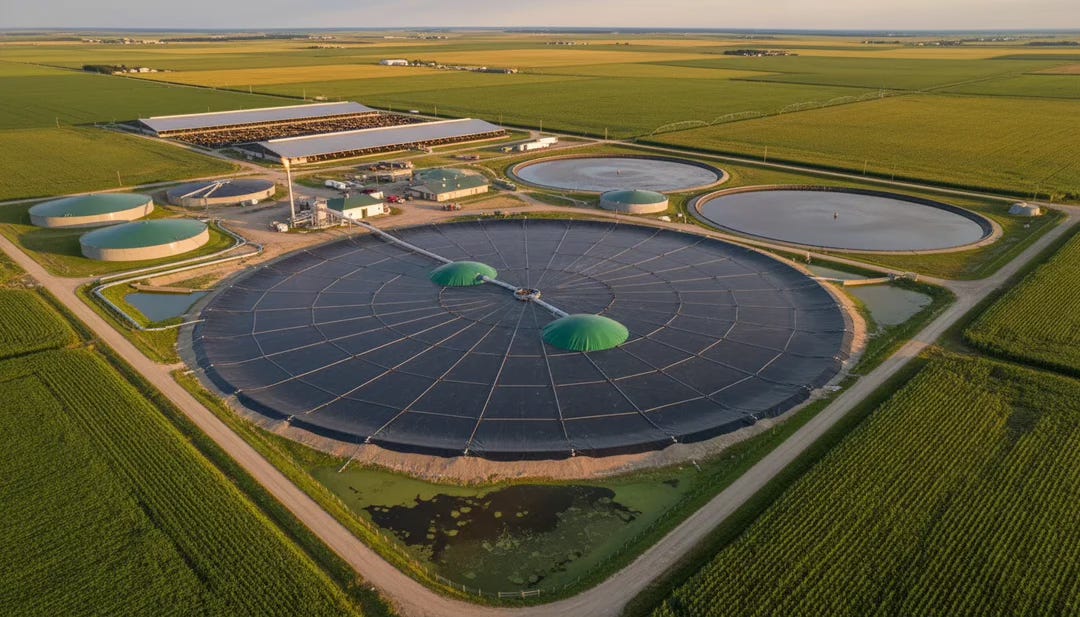
This, my friends, is the story of the Methane Machine, and why some of the nation’s top researchers are calling the whole thing a greenwash wrapped in subsidies, wrapped in gas pipelines.
Let’s break it down in plain English, Yanasa-style.
What the Heck Is a Manure Digester?
Imagine a giant metal stomach. Now imagine it’s sitting on a farm, and instead of eating grass, it’s eating… everything the cows already ate.
A manure digester is a sealed tank or covered lagoon where microbes break down manure without oxygen, producing:
Biogas (mostly methane)
Digestate (a leftover soup of nitrogen, phosphorous, and whatever else survived the ride through the cow… twice)
That biogas is sold or burned as “renewable natural gas.” The digestate gets sprayed on fields.
This technology isn’t new—what’s new is the massive push from governments and corporations calling it a climate miracle.
The Pitch: “We’re Saving the Planet—One Poop Bubble at a Time!”
The sales job is slick:
“Manure lagoons release methane. Methane is bad. If we catch that methane and burn it, we stop climate change.”
Sounds simple, right?
Except here’s the fine print they don’t want you to read:
They only reduce a piece of the methane from manure.
They don’t touch the MUCH larger methane source—cow burps.
They don’t reduce herd size.
And the second the system leaks?
Poof. The climate benefit disappears.
But regulators love this stuff because they can punch big numbers into their emissions spreadsheets.
Corporations love it because each methane molecule they “capture” turns into:
Tax credits
Carbon credits
Renewable fuel credits
Guaranteed revenue streams
We’re not just dealing with manure. We’re dealing with a subsidy gold mine.
So What Did Johns Hopkins Just Blow the Whistle On?
The Johns Hopkins Center for a Livable Future recently dropped one of the most comprehensive analyses ever done on manure digesters.
And it wasn’t pretty.
Here’s what they found—translated from academic to ranch-country English:
1. The climate benefit is tiny.
Manure methane is about 11% of agricultural emissions. Even if digesters worked perfectly (they don’t), they’d only shave off a slice of that slice.
2. Leaks are common.
Think of it like a balloon full of methane. Now poke 20 tiny holes in it. You don’t get credit for the air that didn’t escape.
Digesters leak at every stage: pipes, compressors, valves, tanks, covers.
3. Some pollution risks actually increase.
Hopkins flagged:
Ammonia spikes
Nutrient runoff from digestate
Explosion and fire hazards
Air quality issues
And the risk of locking communities into permanent CAFO expansion
4. The whole system only works if taxpayers fund it.
Digesters are often:
Built with public grants
Financed with government-backed loans
Profitable only because carbon credits tilt the math
When you remove subsidies?
Most digesters are financial sinkholes.
So Who Really Wins Here?
Let’s follow the money. Because it’s sure not flowing to small family farms.
Big CAFOs (Industrial Dairies & Hog Factories)
The bigger the herd, the more manure.
The more manure, the more methane.
The more methane, the more credits.
Suddenly pollution becomes a commodity.
Oil & Gas Companies
Many digesters pipe their “renewable natural gas” straight into existing gas infrastructure. Major pipeline companies are buying into these projects like they’re lottery tickets.
Carbon Traders & Corporate ESG Funds
They get to slap “climate positive” on their portfolio and keep the money flowing.
Meat & Dairy Multinationals
Digesters make their supply chains look greener on paper… without changing the underlying industrial model.
And Who Loses?
Easy.
Small and Mid-Size Farms
They can’t afford digesters.
They don’t produce enough manure flow.
They don’t get the credits.
They just get the regulations.
Rural Communities
Digesters often mean:
Larger herds
More liquid manure
More tanker traffic
Stronger odors
Increased ammonia
Higher water contamination risk
But hey, at least Wall Street is happy.
The Climate
If the goal is lowering emissions, there are dozens of solutions that beat digesters:
Pasture-based grazing
Smaller distributed herds
Composting instead of lagoons
Manure solids separation
Regenerative crop rotations
But those solutions don’t generate tradable credits—or huge corporate partnerships. So they get ignored.
The Real Story: Digesters Don’t Solve the Problem—They Fund It
Here’s the uncomfortable truth:
Manure digesters work best when manure is concentrated, wet, and abundant.
In other words:
More cows per acre
More confinement
More lagoons
More liquid waste
More industrialization
Digesters reward the worst manure systems with the biggest checks.
They don’t fix the CAFO model—
they financially solidify it.
And that’s why small farmers are furious.
How This Ties Into Everything Else We’ve Been Covering on Yanasa TV
Bovaer® and methane-reducing feed additives?
Same logic: patch a symptom of industrial production without changing the system that caused it.
JBS climate pledges and lawsuits?
Same pattern: big corporations push flashy “climate solutions” that burden farmers while keeping profits flowing upward.
COP30 methane targets?
Politicians love digesters because they can point to “methane reductions” without touching deeper systemic issues in meat and dairy.
Digesters are the perfect climate policy tool because:
They look good on a press release
They produce measurable numbers
They keep corporate partners happy
And the people who pay the price are politically weak rural communities
Final Word: Are Manure Digesters a Climate Solution or a Diversion?
If you ask the people making money off them:
They’re a miracle.
If you ask researchers:
They’re a very narrow fix with serious risks.
If you ask small farmers:
They’re a corporate subsidy scheme that leaves the little guy behind.
If you ask someone living downwind of one:
They’re a public health and environmental justice nightmare.
But if you ask the climate math?
They’re a rounding error being sold as salvation.
This is the real question America needs to ask:
Are we actually trying to fix methane emissions…
or are we trying to create new markets out of manure?
Because right now, the Methane Machine isn’t solving agriculture’s problems—
it’s just monetizing them.