



In the center of the Village of Orleans, Vermont, stands a barn built in 1905. Behind it once stood an older dairy structure from the 1850s with a milking parlor and silos. For generations, this location served as a gathering point where farmers from the Northeast Kingdom brought cattle, sheep, goats, and produce for auctions, trading, feeding, and dispersal.
Wood says the site has served agriculture for more than 175 years — long before the town grew up around it. Rail cars once unloaded livestock nearby. Animals were walked up the road. Parents conducted business while kids played in the loft.
This wasn’t an edge-of-town hobby farm.
It was where farming happened.
And today, according to the Town of Barton and Village of Orleans, it never was one.
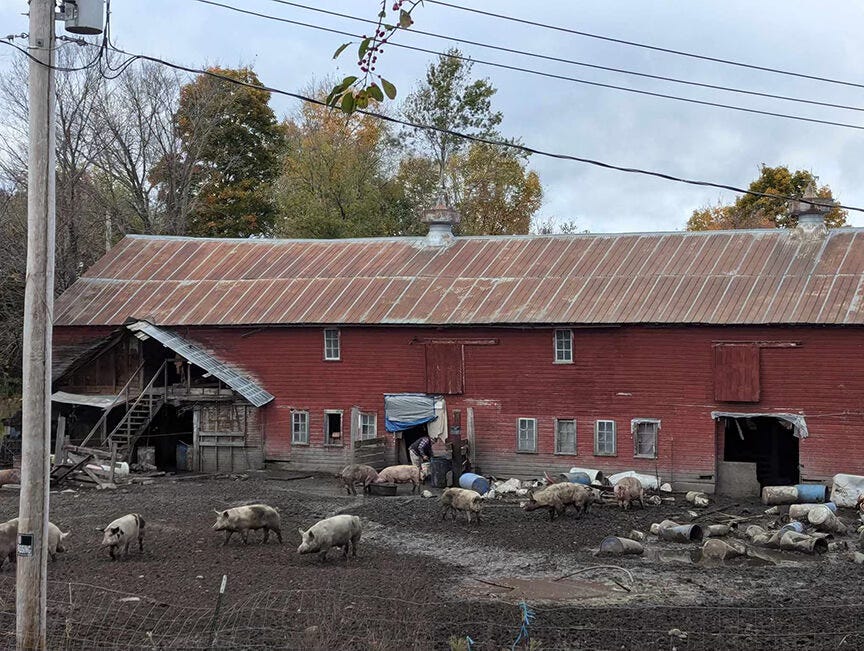
“I Was Here Before Zoning Even Existed”
The man at the center is Thomas “Tom” Wood, a 74-year-old farmer who has worked in agriculture since 1966. He attended Essex Agricultural Technical Institute, worked historic farms, held livestock dealer licenses across multiple states, and was federally registered with the Packers and Stockyards. In 2020, during a state inventory, veterinarians counted nearly 500 head of livestock on the property.
Wood first leased the site around 2000. Zoning regulations for the area did not take effect until 2006.
“I was here six years before there was ever any zoning,” he says.
For more than two decades the property operated as a working agricultural hub — livestock moving through, farmers meeting and doing business. No formal zoning violations. No daily fines. No declarations that it “wasn’t a farm.”
Until the interpretation changed.
Nothing About the Land Changed. Only the Interpretation Did.
The barn didn’t move. The animals didn’t change. The history didn’t disappear.
Only the way the rules are being applied did.
Complaints about odor began around 2019. Pressure built gradually. Then, following the Vermont Supreme Court’s May 30, 2025 ruling in the Essex Junction “Weed & Ducks” case — which clarified that towns can regulate many aspects of farming beyond specific water-quality rules — enforcement against Wood escalated.
In July 2025, the Barton Development Review Board upheld zoning violations, ruling that the operation constituted an impermissible agricultural use in a high-density Village Residential / mixed-use zone. The board viewed the historic sales barn primarily as a commercial auction facility rather than a protected ongoing farm operation.
Wood argues the long agricultural history, continuous use since he leased the property, and his own documented farming activities should qualify it as a legal non-conforming use. He maintains he operated openly for years without prior formal notice.
The Human Cost
At 74, with no children to carry on his legacy, Wood is fighting while his health and finances deteriorate.
He has spent more than $25,000 on legal fees in the past two years, with another $10,000 bill arriving recently. He now buys expensive grain after the supply of Cabot Creamery byproduct feed ended. Wood says the town pressured Cabot to stop providing it.
The stress has compounded existing hardships: a severe bull injury that destroyed his knee (surgery delayed by COVID), the loss of roughly 150 head of livestock in the 2023 floods when 3.5 feet of water filled the barn, and another flood in 2024. Doctors have attributed his congestive heart failure and other health issues largely to the ongoing battle.
Wood alleges repeated harassment, including physical attacks on the property and fences being cut while he was away at medical appointments. He obtained a court order of protection against one neighbor following alleged threats. A 2024 stalking charge filed by the zoning administrator was dismissed.
Still, he refuses to walk away.
“It’s killing me… I’m going broke fighting them,” Wood says. “But I won’t stop. I don’t want them to think they win.”
The Offer That Says Everything
Wood has tried to end the conflict. He offered to sell the 5-acre property to the town or village for $400,000 — a figure he notes is modest given new housing density allowances under Act 181. The offer was declined.
He also proposed donating the historic barn to the Historical Society and Department of Agriculture to create an agricultural research and education site while reopening auctions. That suggestion was rejected as well.
The pattern raises a pointed question: Is the objection truly about nuisance or zoning compatibility — or about the farming activity itself?
A Contradiction That Reaches Far Beyond Vermont
At the federal level, Wood’s operation fits squarely within the livestock economy — licensed, inspected, and recognized as agricultural commerce.
At the local level, the same operation is being redefined as something else entirely.
So which definition wins?
This case highlights a growing tension in rural America. And it’s not isolated. People move to places like Vermont seeking open land, quiet roads, and pastoral beauty — the very landscape shaped by generations of farming. Yet many resist the smells, noise, and realities of actual working agriculture next door. Slowly, the farms disappear while the “rural charm” remains in name only.
Federal policy talks about supporting small and mid-size producers and building resilient local food systems. Yet local zoning decisions can remove livestock hubs and aggregation points — the infrastructure those systems depend on.
What Counts as a Farm?
Tom Wood is 74. He has farmed his entire adult life. The site he operates on has served agriculture, by his account, for more than 175 years. Deeds retained pasture, water, and fencing rights when much of the original land was sold to Vermont Fish & Game.
And yet he is being told it was never really a farm.
If a place like this can be erased — a site with generations of agricultural use, operated by a lifelong farmer, and previously recognized as part of the agricultural system — then the question isn’t just what counts as a farm.
It’s who gets to decide… and how quickly that answer can change.
The Environmental Court case remains ongoing. Vermont’s strengthened Right-to-Farm law (Act 61, passed in 2025) includes provisions that could require the town to cover Wood’s legal expenses if he ultimately prevails.
Tom Wood continues reduced operations on the historic site, still feeding animals and still fighting.
If this story hits you — if you believe history, hard work, and real agriculture still matter — share it widely.
Because once they can erase a farm that has stood for generations with a simple change in how the rules are read, no farm is truly safe.