



A cyberattack doesn’t need to blow up a grain silo to cripple it.
It only needs to lock the gate to its digital controls.
For most Americans, wartime retaliation still conjures images of missiles, bombers, and naval fleets. But as geopolitical tensions escalate and cyberwarfare becomes an increasingly common tool of state conflict, security planners in Washington are paying closer attention to a quieter battlefield.
The next attack may not target a military base.
It may target a farm.
Over the past decade, federal agencies, cybersecurity experts, and agricultural organizations have warned that America’s food system—one of the country’s most essential industries—has become an emerging cyber vulnerability. What once required physical sabotage can now be attempted through a keyboard, potentially disrupting food production, processing, and distribution across the country.
And the federal government has already been running exercises to prepare for exactly that scenario.
The Food System Is Critical Infrastructure
Food and agriculture are officially designated as one of the 16 critical infrastructure sectors in the United States, alongside energy, water, finance, and transportation.
That classification means federal authorities consider the sector essential to national stability. A major disruption could ripple through the economy, public health systems, and national security.
The modern food system stretches far beyond farms themselves. It includes an interconnected chain of operations:
crop production and livestock operations
fertilizer and chemical supply chains
grain elevators and storage facilities
food processing plants
transportation networks
grocery distribution systems
Disrupting any one of these links can cascade across the entire system.
And cybercriminals have already shown they understand where the weak points are.
The Attack That Shut Down America’s Meat Plants
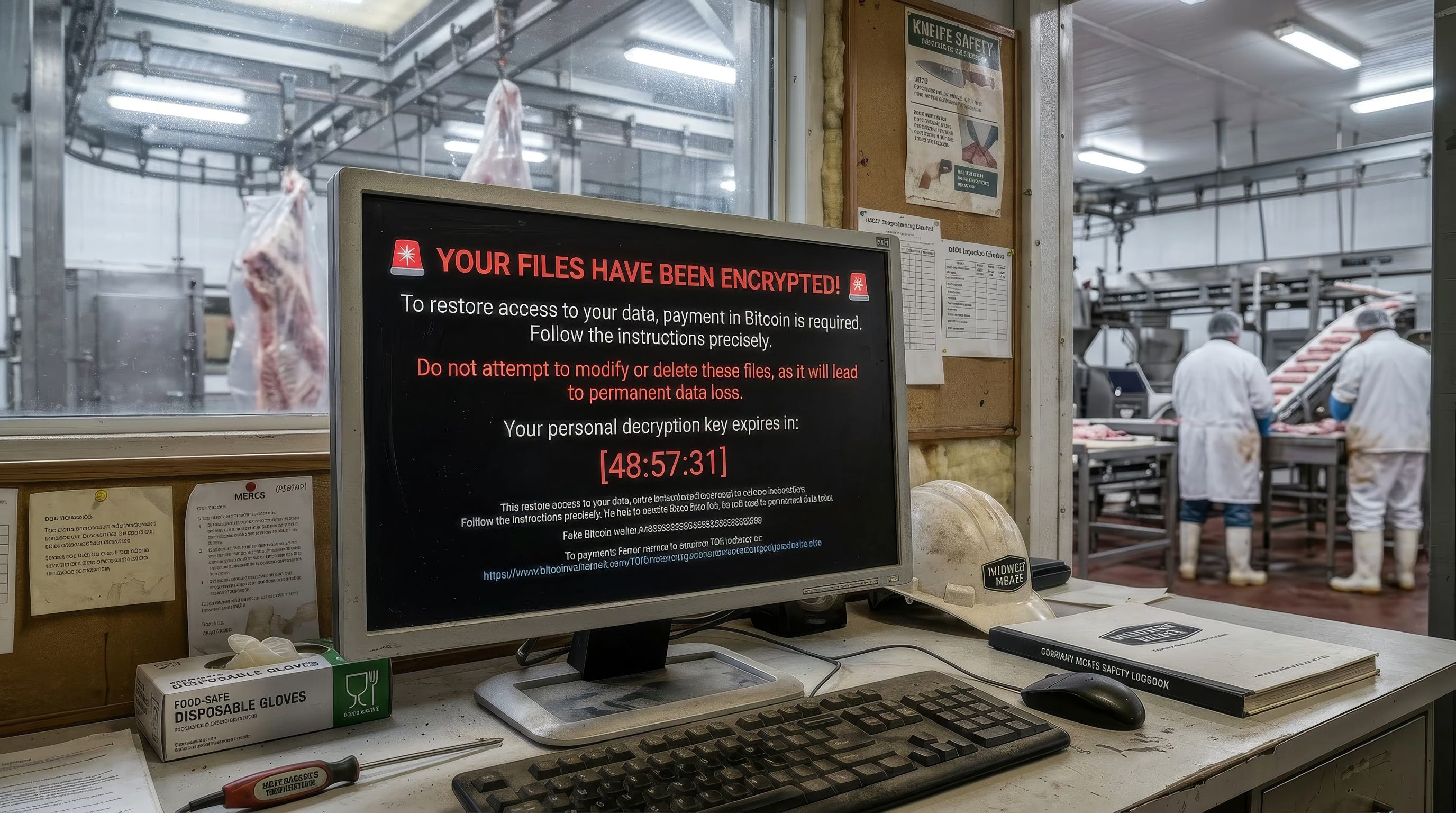
In May 2021, the world’s largest meat processor, JBS, suffered a ransomware attack that forced the company to shut down slaughter operations at multiple facilities across the United States, Canada, and Australia.
For several days, slaughter lines stopped. Livestock deliveries backed up. Meat prices jumped across wholesale markets.
The company ultimately paid approximately $11 million in ransom to regain control of its systems.
The attack was widely compared to the Colonial Pipeline cyber incident earlier that same month because it demonstrated how cyberattacks can disrupt essential infrastructure.
That same year, hackers targeted NEW Cooperative, an Iowa-based agricultural services company that manages grain storage, feed logistics, and farm management software. Attackers demanded nearly $6 million in ransom, warning that disruptions could affect the supply chains for pork, poultry, and grain if the cooperative’s systems remained offline.
These incidents demonstrated something the agricultural sector had rarely confronted before:
A cyberattack lasting only a few days can ripple across the entire food economy.
Federal Warnings: Hackers Are Targeting Agriculture
U.S. law enforcement agencies have been warning the agricultural sector that these attacks are not random.
In a cybersecurity advisory to the food and agriculture sector, the Federal Bureau of Investigation warned that ransomware groups may deliberately time attacks to coincide with critical planting and harvest seasons, when farmers and cooperatives are under the greatest operational pressure.
According to the advisory, six agricultural cooperatives were hit by ransomware during the fall harvest season of 2021, and additional attacks occurred in early 2022 that could have disrupted planting operations.
Investigators noted that agricultural cooperatives can be attractive targets because they sit at critical points in the supply chain. When their systems go offline, farmers may suddenly be unable to deliver grain, receive inputs, schedule trucking, or process payments.
In a time-sensitive industry where crops and livestock cannot simply wait, attackers understand that pressure.
The Quiet War Games
Behind the scenes, federal agencies have begun preparing for the possibility of a large-scale cyber disruption of the food system.
The U.S. Department of Agriculture, the Department of Homeland Security, and other federal agencies now collaborate on cybersecurity planning for agriculture, including risk assessments and simulation exercises designed to model supply-chain disruptions.
These exercises explore scenarios such as:
ransomware shutting down grain logistics networks
cyberattacks disabling meat processing plants
intrusions targeting fertilizer or seed distribution systems
digital disruptions affecting precision farming equipment
The goal is to understand how quickly such attacks could ripple through the farm-to-table system—and how governments and industry might respond.
The conclusions are sobering.
Three Choke Points That Could Disrupt Farming in Days
Security analysts increasingly point to several critical choke points where cyber disruptions could cascade through the agricultural economy in less than a week.
Grain Cooperative Shutdowns
Agricultural cooperatives serve as the logistical backbone of many rural communities.
They coordinate:
grain delivery and storage
seed and fertilizer supply
livestock feed distribution
trucking logistics
farmer payments and accounting systems
If ransomware locks those systems during planting or harvest season, farmers may suddenly be unable to deliver grain, receive fertilizer, or schedule transportation.
Even a short shutdown during peak season could create immediate bottlenecks across regional food supply chains.
Meat Processing Disruption
America’s meat industry is highly centralized. A relatively small number of companies process the majority of the nation’s beef, pork, and poultry.
The 2021 JBS attack demonstrated how quickly a cyber incident can cascade through that system.
When slaughter plants shut down, livestock remain on farms longer than expected. Feed costs increase. Processing schedules collapse.
Within days, shortages can begin appearing in grocery stores.
Federal cybersecurity experts warn that disruptions to protein processing facilities can also lead to product spoilage, supply chain backlogs, and price volatility.
The Hidden Vulnerability: Digital Farming Systems
The least discussed risk may lie in the technologies increasingly used in modern farming.
Precision agriculture systems now rely on:
GPS-guided tractors
automated planting equipment
connected irrigation systems
cloud-based farm management platforms
These technologies allow farmers to plant straighter rows, apply fertilizer more precisely, and monitor crops in real time.
But they also expand the sector’s digital attack surface.
Researchers studying cybersecurity risks in agriculture warn that the rapid digitization of farming has introduced new vulnerabilities into production systems that historically relied on mechanical processes rather than digital networks.
In tightly timed planting or spraying windows, even a short disruption to these systems could interfere with field operations and affect yields.
A Sector That Was Never Built for Cyber Warfare
One of the biggest challenges facing the food system is simple: agriculture was never designed with cybersecurity in mind.
Unlike banks or defense contractors, most farms and food processors do not maintain dedicated cybersecurity teams.
Yet the industry increasingly depends on interconnected digital systems—from cloud-based logistics software to automated farm machinery.
That combination creates a growing attack surface across one of the most essential industries in the country.
When War Comes Home
The United States has not yet experienced a large-scale cyberattack targeting its food system during an international conflict.
But intelligence officials increasingly warn that modern warfare is no longer confined to battlefields.
Economic disruption, infrastructure sabotage, and cyber operations have become standard tools in geopolitical competition.
And in a nation where grocery shelves are expected to remain full, few disruptions would be more visible—or more unsettling—than a sudden shock to the food supply.
As the line between digital and physical warfare continues to blur, America’s farms may become some of the quietest battlefields in the next global conflict.
And the most personal.
References
Federal Bureau of Investigation. “Ransomware Attacks on Agricultural Cooperatives.” Cybersecurity Advisory, 2022.
U.S. Department of Homeland Security. Critical Infrastructure Sectors Overview.
U.S. Department of Agriculture. Food and Agriculture Sector Cybersecurity Planning.
JBS S.A. Ransomware Incident, May 2021.
Cybersecurity research on food and agriculture sector vulnerabilities, 2023–2024.