



There are infrastructure projects.
And then there are infrastructure projects proposed in one of the most geologically sensitive landscapes in North America.
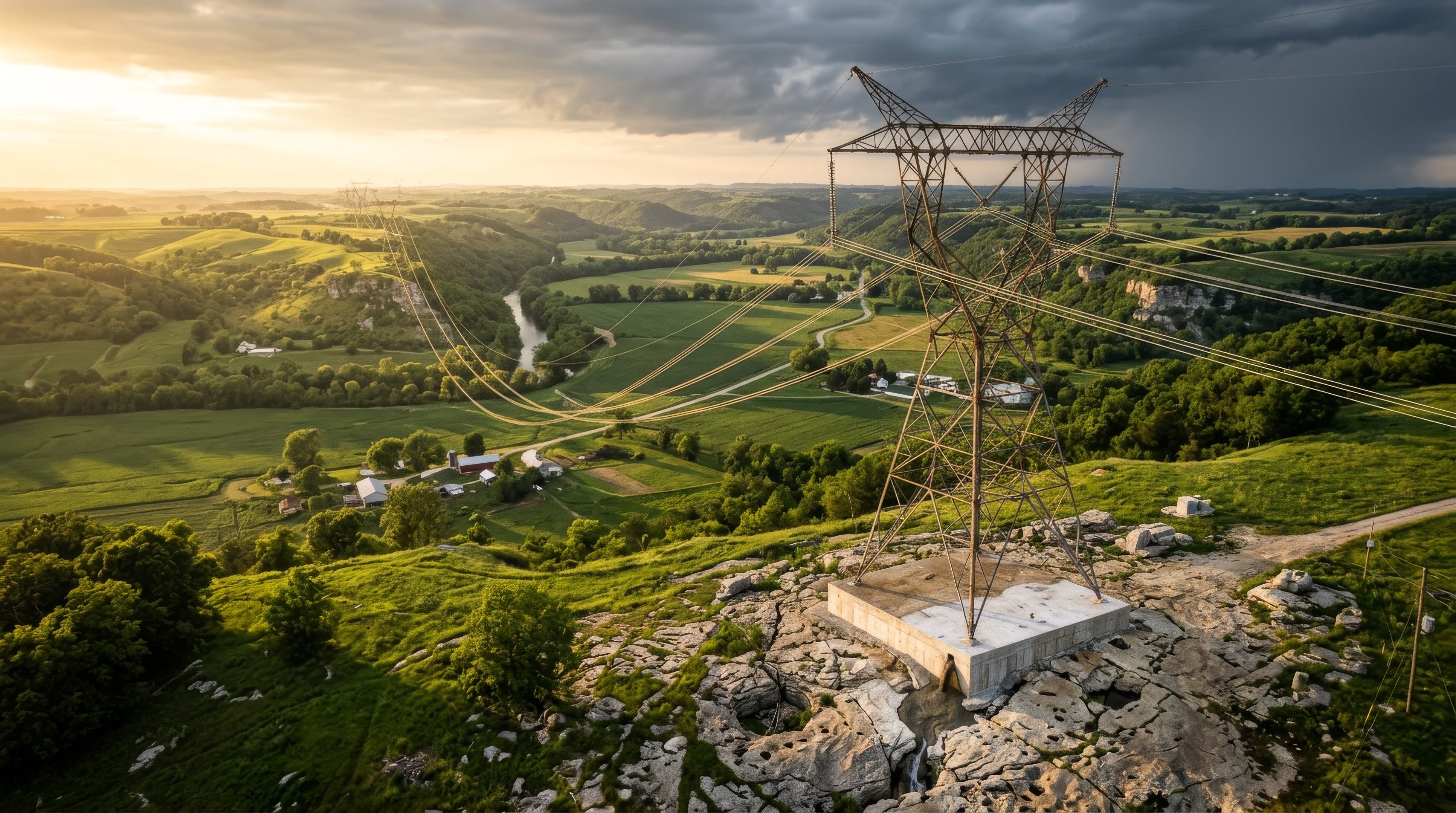
A 765-kilovolt transmission line — among the largest high-voltage systems ever advanced in the Midwest — is now moving forward through southwestern Wisconsin as part of MISO’s Long Range Transmission Planning (LRTP) Tranche 2.1 portfolio, approved in late 2024.
Portions of it are expected to cross the Driftless Area.
This is not a small upgrade.
This is a generational build.
What Is Being Proposed?
The project most directly affecting southwestern Wisconsin is the MariBell Transmission Project — a proposed 139–140 mile, 765/161 kV double-circuit line stretching from Marion, Minnesota, to Bell Center, Wisconsin.
It is being developed by Dairyland Power Cooperative and GridLiance Heartland (a NextEra Energy Transmission subsidiary) as part of a broader regional transmission expansion under MISO’s Tranche 2.1 framework.
Developers are currently holding public open houses (as of March 2026) and anticipate filing a Certificate of Public Convenience and Necessity (CPCN) with the Wisconsin Public Service Commission (PSC) in fall 2026. If approved, construction could begin around 2031, with an in-service date targeted for 2034.
According to publicly available materials and local reporting:
Towers may reach 150 to 200 feet in height
Corridor (right-of-way) width may expand up to 250 feet
Structures would replace or parallel existing 161 kV wooden H-frame lines (approximately 70 feet high, 100-foot corridor)
Local landowner materials illustrate this scale shift through before-and-after comparisons .
This would be the first 765 kV transmission line constructed in Wisconsin.
Why the Driftless Area Is Different
The Driftless Area — spanning parts of Wisconsin, Minnesota, Iowa, and Illinois — escaped the last glacial period.
Instead of deep, stable glacial soils, it features:
Thin soils over fractured limestone and dolomite
Sinkholes, caves, and underground drainage systems
Rapid groundwater transport with minimal natural filtration
This is classic karst terrain.
In karst systems, surface water can move quickly through fractures and voids into aquifers. That makes subsurface conditions more complex — and more sensitive to disturbance — than in glaciated regions.
Karst Engineering Questions That Must Be Answered
Transmission structures of this scale require substantial foundations.
For large 765 kV lattice towers, typical engineering ranges (which vary by site conditions) may include:
Depths of 50–65 feet or more
Pier diameters up to 8 feet
Total concrete volumes of 120–200+ cubic yards per structure
These figures are representative of comparable high-voltage installations; final designs depend on detailed geotechnical findings.
In karst terrain, this raises a set of technical questions that should be addressed through site-specific study:
What detailed karst mapping has been conducted along proposed corridors?
Will geotechnical borings be required at each tower location?
How will subsurface void detection and mitigation be handled?
What groundwater protection standards will apply to drilling fluids, runoff, and grouting?
Will foundation designs be adapted for known sinkhole-prone areas?
In karst environments, construction practices such as drilling and grouting require careful management because subsurface materials can move through fractures.
These are not abstract concerns.
They are standard engineering and environmental questions for infrastructure built in karst landscapes that support drinking water and agriculture.
The Regulatory Process
In Wisconsin, major transmission projects require approval from the Public Service Commission (PSC).
The PSC evaluates:
Project “need”
Route alternatives
Environmental impacts
Public interest considerations
The project is currently in a public information phase, during which developers gather input prior to formal application .
Formal CPCN filings are expected in 2026. Once filed, the process becomes more structured, with defined opportunities for public comment and evidentiary review.
At this stage, route development is still in progress.
The “Need” Question
Supporters of the 765 kV backbone argue it is necessary to:
Improve grid reliability
Enable long-distance energy transfer
Support evolving generation sources
However, critiques referenced in public materials question whether:
Previously planned 345 kV upgrades should be completed first
Load-growth assumptions fully justify 765 kV expansion
Lower-cost alternatives — including grid-enhancing technologies — were sufficiently evaluated
MISO has publicly supported the Tranche 2.1 portfolio as a long-term reliability and economic investment.
The debate is not whether the grid should evolve.
It is how.
Ratepayer Impact
Large transmission infrastructure is typically funded through regional cost allocation.
Local materials referencing MISO documentation estimate that individual Wisconsin segments may approach $1 billion, while the broader Tranche 2.1 portfolio exceeds $20 billion regionally .
Under MISO’s structure, costs are shared across participating states.
That means ratepayers — including those far from the physical corridor — may contribute to project funding.
Final cost impacts depend on PSC approval, allocation formulas, and construction outcomes.
Property, Farmland, and Corridor Expansion
A 765 kV line typically requires:
Expanded right-of-way
Additional easements
Access road construction
Vegetation clearing
These changes can affect working agricultural land by:
Altering land use patterns
Introducing long-term structural presence
Limiting future development flexibility
Project materials acknowledge that corridor expansion and easement acquisition will be necessary .
The PSC process includes consideration of these impacts, but documentation and participation from landowners remain critical.
A Note on Rural Infrastructure and Transparency
This is not an anti-energy story.
The electrical grid must evolve to meet changing demands.
But when a project of this scale intersects:
Sensitive karst geology
Prime agricultural land
Private property rights
Billion-dollar ratepayer investment
Transparency and site-specific analysis are essential.
Recent federal initiatives, including USDA efforts to provide reporting channels for agricultural concerns, may offer additional avenues for landowners to document infrastructure-related impacts.
What Comes Next
Developers are expected to file formal applications with the Wisconsin PSC in fall 2026.
Before that process advances:
Public input remains open
Route alternatives are still being evaluated
Technical questions can still be raised and documented
Yanasa TV will continue to review:
PSC docket filings
Route and corridor maps
Environmental review documents
Geotechnical and karst assessments
MISO planning and cost allocation materials
Final Thought
The Driftless Area has endured for thousands of years.
The infrastructure decisions made in the next 12 to 18 months will shape it for the next 50.
The question is not whether the grid should evolve.
It is whether that evolution is being carried out with full transparency, sound engineering, and a complete understanding of the land it crosses.
If you are a landowner, engineer, or public official with documentation related to the MariBell 765 kV project or related transmission segments in southwestern Wisconsin, Yanasa TV would like to hear from you.
We are building the public record.