



For years, policymakers have searched for a climate solution that wouldn’t require politically painful tradeoffs. Cutting herd sizes was unpopular. Regulating manure more tightly was expensive. Changing global feed supply chains was complicated.
Then came 3-NOP.
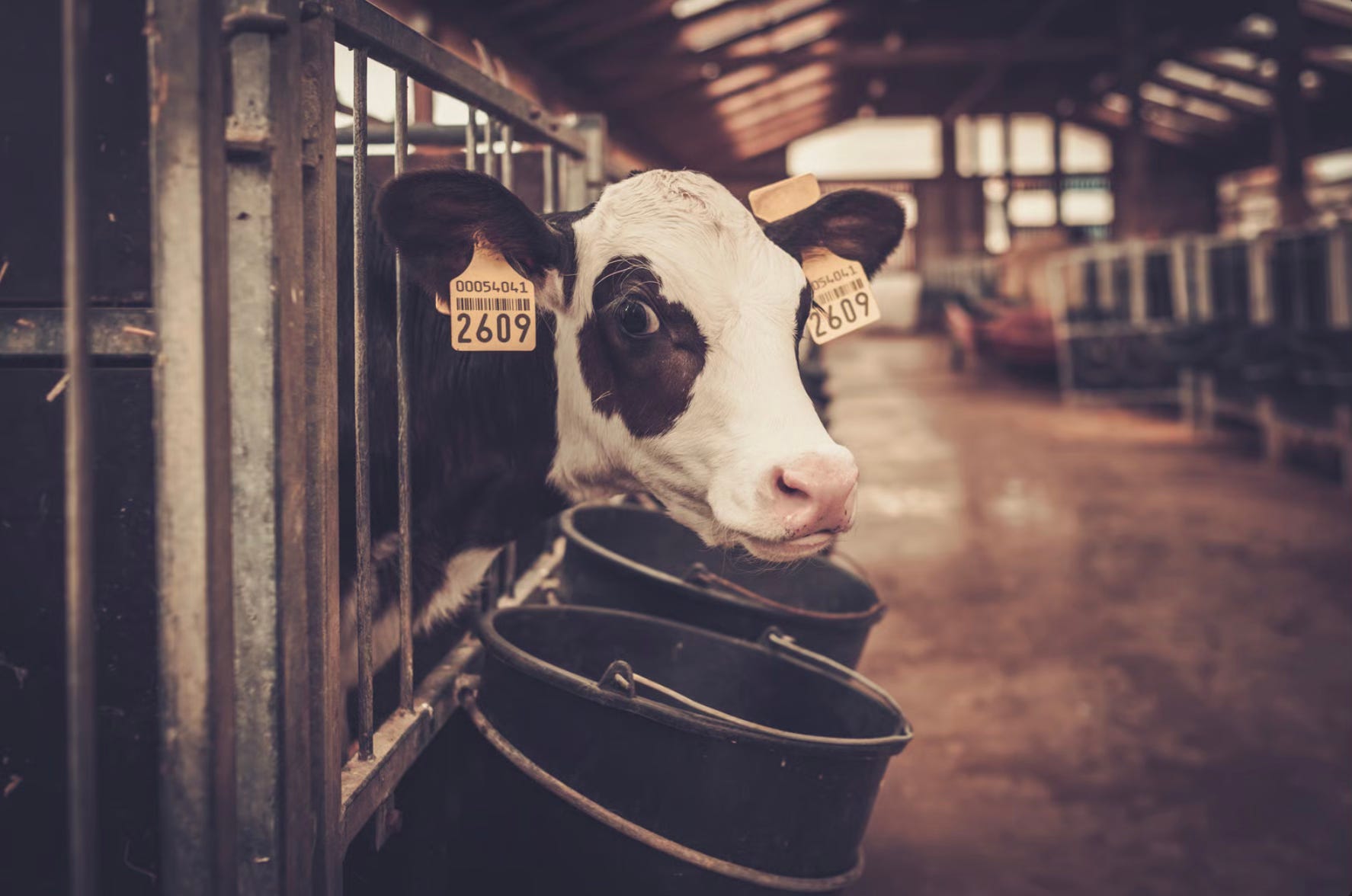
Marketed under the brand name Bovaer, the feed additive promised to reduce methane emissions from dairy cattle by as much as 30 percent—without affecting milk production, animal health, or food safety. Regulators across Europe approved it. Governments praised it. Climate targets leaned on it.
Denmark went further than anyone else.
Rather than encouraging voluntary adoption, the Danish government embedded Bovaer into national climate law. Dairy farms with more than 50 cows would be required to feed the additive for a minimum number of days per year. Non-compliance would carry penalties.
In effect, Denmark transformed its national dairy herd into a real-world climate experiment.
Within months, that experiment began to unravel.
A Policy Built on Controlled Conditions
The regulatory case for Bovaer rested on controlled trials. Studies showed that inhibiting methane production in the rumen did not measurably harm cows under test conditions. Residue analyses indicated that 3-NOP broke down rapidly and did not appear in milk or meat.
On that basis, the additive was approved by bodies including the European Food Safety Authority and subsequently authorized in multiple countries.
What those approvals did not test—at least not at scale—was how the additive would perform across diverse herds, diets, production intensities, and metabolic stresses.
Denmark’s mandate removed that distinction overnight.
Once use became compulsory, farmers could no longer simply discontinue the product at the first sign of trouble. The policy assumed safety first and allowed adjustment later.
That sequencing would prove critical.
The First Reports from the Barn
By late autumn, Danish farmers began reporting problems.
Cows were eating less. Milk production declined—sometimes sharply. Fertility performance deteriorated. Some animals developed digestive issues, lameness, or unexplained fevers. In a small number of cases, cows collapsed and were euthanized.
At first, these accounts were dismissed as anecdotal. Seasonal variation, feed changes, weather stress, and unrelated herd health issues were all offered as possible explanations.
Then the reports multiplied.
Farmers described a consistent pattern: when Bovaer was removed, animal performance improved. When it was reintroduced—often to remain compliant with the law—problems returned.
This pattern did not prove causation. But it raised a question regulators had not anticipated having to answer so quickly: What happens when a “safe” intervention produces widespread distress in the field?
Data That Couldn’t Be Ignored
The debate shifted when SEGES Innovation surveyed more than 550 dairy farms using Bovaer.
The results were difficult to dismiss:
Approximately two-thirds of respondents reported reduced feed intake
Nearly 70 percent reported lower milk yields
A majority reported experiencing both
These were not isolated complaints from fringe operators. They represented a substantial share of Denmark’s commercial dairy sector.
At that point, the issue moved beyond farmer skepticism. It became a national policy problem.
The Nordic Pause
Other countries were watching closely.
Norwegian dairy cooperatives announced a pause in Bovaer use, even though Norway had not yet recorded comparable welfare incidents. Swedish dairy organizations halted trials entirely. Elsewhere in Northern Europe, rollout plans slowed quietly.
This was not a coordinated regulatory reversal. It was a precautionary retreat—driven by producer concern rather than government instruction.
The contrast was stark. Farmers were adjusting behavior faster than policy.
The Investigation—and Its Limits
Under growing pressure, Denmark’s Veterinary and Food Administration acknowledged an official investigation into farmer reports.
Its language was careful.
Officials emphasized that no causal relationship had been established between Bovaer and the reported health effects. Complaints were framed as observations, not confirmed adverse reactions. Regulators stressed that existing approvals remained valid.
What did not happen was equally important.
There was no suspension of the mandate.
No recall of the product.
No independent, multinational field audit announced.
The investigation focused on whether individual cases met a threshold sufficient to justify exemptions—not on whether the mandate itself had been premature.
This distinction matters because causation is a legal standard, not a welfare standard. Animal health decisions in agriculture are typically made on risk signals, not courtroom proof.
Farmers do not require molecular certainty to recognize harm in their herds.
A Partial Retreat That Changed Little
In late November, Danish authorities issued a clarification: farmers could discontinue Bovaer if cows showed signs of illness or compromised welfare.
It was presented as flexibility.
In practice, the mandate remained intact. Penalties still applied. Farmers were still required to document and justify their decisions.
The policy had not been reversed. It had been softened—just enough to reduce public pressure without addressing the underlying conflict between climate compliance and animal welfare judgment.
Quiet Non-Compliance
As formal policy remained unchanged, behavior shifted.
Agricultural media in Denmark reported that many farmers intended to stop using Bovaer once compliance requirements were clarified. Others began documenting welfare concerns preemptively. Some reduced usage to the minimum necessary to avoid penalties.
This form of quiet non-compliance is not unusual in agriculture. It emerges when rules are technically enforceable but practically unsustainable.
When compliance becomes performative rather than genuine, policy credibility erodes.
The Consumer Question
Regulators continue to assert that consumers face no risk.
They argue that 3-NOP does not persist in animal products and that human exposure remains far below any level of concern. Those claims may ultimately prove accurate.
But public confidence depends on more than toxicology.
If regulatory modeling failed to anticipate widespread animal distress—distress significant enough to disrupt production and force national reconsideration—then trust in the system weakens.
Food safety, in the end, is as much about governance as it is about chemistry.
A Mandate-First Mistake
The core failure in Denmark’s Bovaer rollout was not scientific misconduct or malicious intent. It was policy design.
A voluntary program would have allowed learning without coercion. Long-term, large-scale field studies could have preceded enforcement. Early farmer warnings might have triggered adjustments rather than resistance.
Instead, Denmark treated its dairy sector as a finished proof of concept.
The result was predictable. Risk flowed downward—to farmers, animals, and production systems—while decision-remaking authority remained centralized.
This Matters Beyond Denmark
Bovaer has already been approved in multiple countries, including the United States and Canada. Discussions about methane-reduction mandates are ongoing worldwide.
Denmark’s experience is no longer a success story. It is a stress test.
The lesson is not that methane reduction is impossible. It is that climate interventions applied through force rather than partnership transfer uncertainty to those least able to absorb it.
Agriculture is biological, not mechanical. It does not respond well to shortcuts.
Science Needs Time—and Consent
The Bovaer crisis does not prove that 3-NOP is unsafe. It proves that regulatory confidence can outrun real-world complexity.
Climate policy that bypasses farmer judgment undermines its own goals. Trust breaks first in the barn. Then it breaks everywhere else.
If governments want lasting methane reductions, they will need something more durable than mandates.
They will need transparency.
They will need humility.
And they will need to remember that food systems cannot be fixed by decree.
Because you cannot save the planet by sacrificing the people who feed it.