



When the Bison Became the Headline
The recent headline — “BLM kicks bison off the land” — is powerful, emotional, and incomplete.
It suggests a familiar story: bureaucracy versus nature, regulation versus restoration, capitalism versus conservation. But once the facts are laid out, that framing begins to unravel. The Bureau of Land Management’s proposed decision affecting American Prairie’s grazing leases in northeastern Montana is not, by the agency’s own explanation, a rejection of bison as a species. Nor is it a blanket shift away from conservation on public lands.
Instead, it centers on a narrower — and more uncomfortable — question about use, scale, and purpose.
That question exposes a gap between how American Prairie is often described, how it describes itself, and how its land and animals are actually being used after more than two decades in operation.
This article is not an attack on American Prairie, nor an argument against bison restoration. It is an attempt to understand what happened, why it happened, and why the story sounds so different when translated from advocacy language into statutes, acreage, and herd numbers.
American Prairie: The Structure Behind the Story
American Prairie was founded in 2001 and began acquiring land around 2004. Its stated mission is ambitious: to assemble a vast prairie landscape in northeastern Montana that supports wildlife, ecological processes, and public access.
Today, the organization describes its footprint as a “habitat base” of approximately 603,657 acres, consisting of:
approximately 167,070 acres of deeded private land, and
roughly 436,587 acres of public land managed under federal and state grazing leases.
The long-term vision often cited — a connected prairie approaching 3.2 million acres — is aspirational, not owned.
This distinction matters. “Habitat base,” “managed land,” “owned land,” and “authorized grazing land” are not interchangeable terms, even though they are often blended together in public messaging.
The Bison Numbers, Plainly Stated
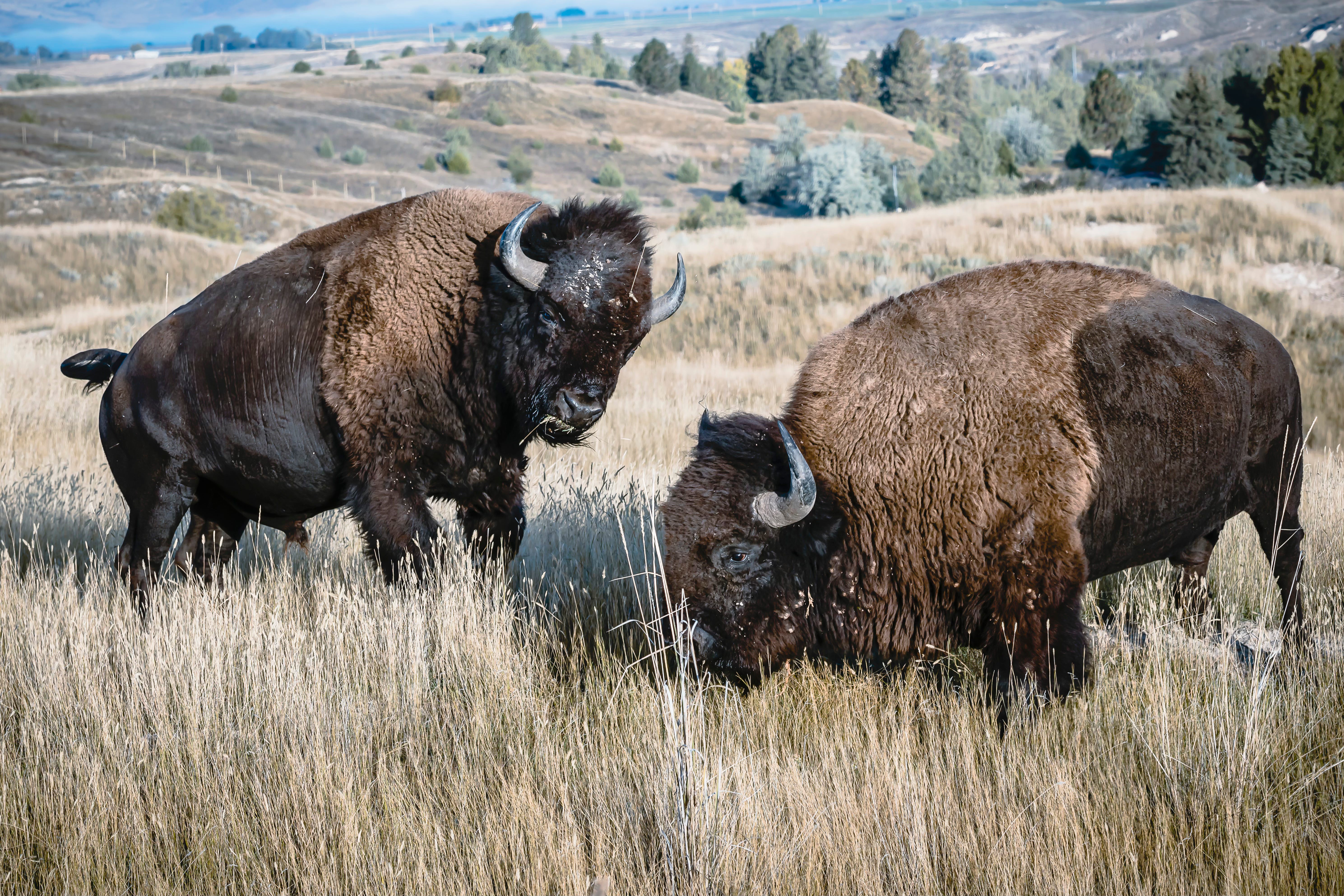
After roughly twenty years of operation, American Prairie reports a bison herd of approximately 900 animals.
Those bison are primarily confined to about 50,000 acres, largely within the White Rock and Sun Prairie units.
That means:
less than one-third of the land American Prairie owns supports bison,
less than ten percent of the land it claims to manage is occupied by bison, and
bison density averages roughly one animal per 56 acres.
That density can produce meaningful local ecological effects — grazing heterogeneity, wallows, nutrient redistribution — but it does not approach the scale implied by phrases such as “restoring prairie processes across a vast landscape.”
This does not make the effort meaningless. But it does narrow the claim.
Cattle, Not Bison, Dominate the Landscape
American Prairie openly acknowledges that most of its land is used for cattle grazing, not bison.
According to the organization’s own statements:
approximately 80% of its management units
are leased to around 25 local livestock producers,
supporting roughly 7,000 head of cattle.
American Prairie describes this leasing as transitional management, community engagement, and grass or fuel management. Those explanations are plausible and consistent with standard range management practices.
Still, the optics are difficult to ignore: bison-centered messaging paired with cattle-centered land use.
For critics, this raises a fair and reasonable question — not an accusation, but an inquiry:
Is bison restoration the core operation, or is it the narrative frame placed over a much larger land-and-leasing enterprise?
The Financial Picture and the Capital Question
American Prairie’s 2024 audited financial statements report:
$47.7 million in total revenue and support,
approximately 93% derived from philanthropic contributions, and
about $590,000 from grazing rentals.
Leasing cattle is not the organization’s primary revenue source. Philanthropy is.
That leads to a question donors and observers are increasingly justified in asking:
If American Prairie has access to substantial capital, why has bison stocking expanded relatively slowly — and only across a fraction of owned land — over a twenty-year period?
There may be legitimate explanations: fencing costs, water infrastructure, staffing capacity, regulatory constraints, or phased development. Those factors are common in large-scale land projects. But they are not consistently presented alongside fundraising narratives that emphasize landscape-scale restoration.
Who Funds the Vision — and What That Signals About Public Support
One aspect of American Prairie that receives comparatively little public scrutiny is who funds the project — and in what proportion.
According to audited financial statements and IRS filings, the organization’s operations are financed largely by a small number of major donors, rather than broad-based public contributions. In 2024, approximately 93% of revenue came from philanthropic support, with seven donors accounting for roughly 77% of total contributions, including multi-year pledges.
This funding structure is neither illegal nor unusual in conservation work. Many large environmental projects rely on major benefactors. But it does raise reasonable questions about representation, accountability, and public mandate, particularly for a project that presents itself as a public-facing conservation effort with significant land-use implications.
A concentrated donor base can shape priorities indirectly — not through overt control, but through which outcomes are rewarded, which narratives are emphasized, and which metrics are deferred. It may also help explain how land acquisition can proceed rapidly while core operational indicators — such as bison stocking density or food-production output — remain modest.
Public Concern, Local Backlash, and the State Steps In
The dispute between American Prairie and the Bureau of Land Management did not arise in isolation.
Long before the January 2026 proposed decision, American Prairie had become one of the most debated landholders in northeastern Montana — not because of bison alone, but because of the pace, scale, and cumulative effect of its land acquisitions.
Public comments, county debates, and years of reporting reflect recurring concerns:
land consolidation outpacing local economic integration,
displacement through market pressure rather than force, and
land shifting from production and community networks toward conservation objectives shaped outside the region.
These tensions surfaced repeatedly in Phillips County, where American Prairie’s presence led to years of disputes over fencing, bison management, disease protocols, and local ordinances before eventual resolution through negotiated agreements.
The questions sharpened when American Prairie sought to expand bison grazing onto adjacent public lands. Critics did not argue that bison could not graze public allotments — many producers already do — but questioned whether American Prairie’s use model aligned with the statutory purpose of public grazing leases.
Those concerns ultimately reached the state level.
The State of Montana filed suit against the Bureau of Land Management, arguing that the agency had misapplied the Taylor Grazing Act by authorizing grazing changes that emphasized conservation demonstration over productive domestic livestock use. The lawsuit was framed not as opposition to bison, but as a challenge to precedent.
BLM’s January 2026 proposed decision appears to respond directly to that challenge. The agency emphasized that it was not rejecting bison as a species, noting that dozens of other bison producers hold BLM grazing permits without issue. Instead, it concluded that American Prairie’s conservation-forward framing did not clearly fit the statutory purpose of the permits in question.
Lease Income, Land Power, and Why the Optics Get Radioactive
Following the cash flow reveals another layer of the controversy.
American Prairie’s $589,897 in rental income — derived primarily from grazing contracts on deeded land — is often misinterpreted as profit from public lands. It is not. It reflects private-side grazing agreements and receivables, consistent with the organization’s acknowledgment that cattle grazing remains a dominant operational use across much of its footprint.
Even so, lease income becomes symbolically potent because it reflects how land is actually used day-to-day, regardless of how it is framed publicly.
Large landowners do possess influence — but it is specific and limited:
They can set lease terms on private land, shape grazing patterns through who they lease to, and control access across deeded parcels. They cannot own or commercialize public land, nor can they sublease BLM grazing permits, which remain revocable authorizations rather than property rights.
The controversy is fueled by two competing perceptions:
First, de facto control over public land. In checkerboard landscapes, control over access corridors can feel like control over land use, even when legal authority remains unchanged. American Prairie’s acquisitions at places like Anchor Ranch and the 73 Ranch have been cited both as examples of reopening access to landlocked public acres and, by critics, as evidence of growing gatekeeper influence.
Second, a real-estate operation framed through bison imagery. American Prairie openly describes how acquiring relatively small amounts of deeded land can yield access to a much larger “habitat base.” That is a structural reality of the West, not a scandal. But it creates a communications challenge when bison remain concentrated on a comparatively small portion of the landscape.
The result is a gap between public impression and operational math — and that gap is where distrust grows.
Public Lands, Grazing Law, and What the BLM Actually Said
BLM grazing permits do not mandate minimum stocking levels. They establish maximum authorized use, measured in Animal Unit Months (AUMs), define seasons of use, and allow for approved nonuse.
In this case, American Prairie’s BLM allotments total approximately:
63,500 acres, and
7,969 authorized AUMs.
What remains unavailable publicly is how many of those AUMs were actually used by bison versus cattle. That information exists in Actual Use Reports and billing records, but it has not yet been released. A FOIA request has been submitted.
According to BLM, the issue is use model, not conservation intent. That distinction may be debated, but it is statutory rather than ideological.
Bison Meat, Markets, and Production
American Prairie does participate in bison meat production.
The organization offers public bison harvest opportunities, awarding approximately 24 permits in a recent season, with animals legally harvested and processed for human consumption. It also transfers live animals to tribal and conservation herds — 107 bison in 2023, and more than 550 since 2005.
These outputs demonstrate that the herd is not purely symbolic. But the scale is limited.
A herd of roughly 900 bison producing around 24 harvests per year represents an annual removal rate of 2–3%. By comparison, the U.S. bison industry harvests approximately 75,000 animals annually.
Measured against that backdrop, American Prairie’s contribution is culturally and symbolically significant, but modest in terms of protein production or landscape-scale ecological pressure.
That does not invalidate the project. But it does constrain the claims that can reasonably be made about scale and impact.
What We Still Don’t Know — and Why It Matters
Several key datasets remain unavailable:
actual AUMs used by bison versus cattle,
deeded acres currently fenced and stocked for bison,
contiguous deeded acreage available for expansion,
annual herd accounting (births, deaths, harvests, transfers), and
public-land acreage with active bison authorization.
Transparency on these points could strengthen American Prairie’s case — or complicate it. Either way, it would clarify the debate.
So What Is This Really About?
Strip away the slogans, and the dispute looks less like “BLM versus bison” and more like a question of alignment:
a powerful conservation narrative,
a relatively small bison program,
a landscape largely managed through cattle leasing, and
public grazing frameworks built for production.
The decision was not against our national mammal.
It was a reminder that numbers matter, definitions matter, and public-land programs exist for specific purposes.
If bison are going to be invoked as the moral center of a land-use debate, it is fair — and necessary — to ask whether they are truly at the center of the operation itself.